
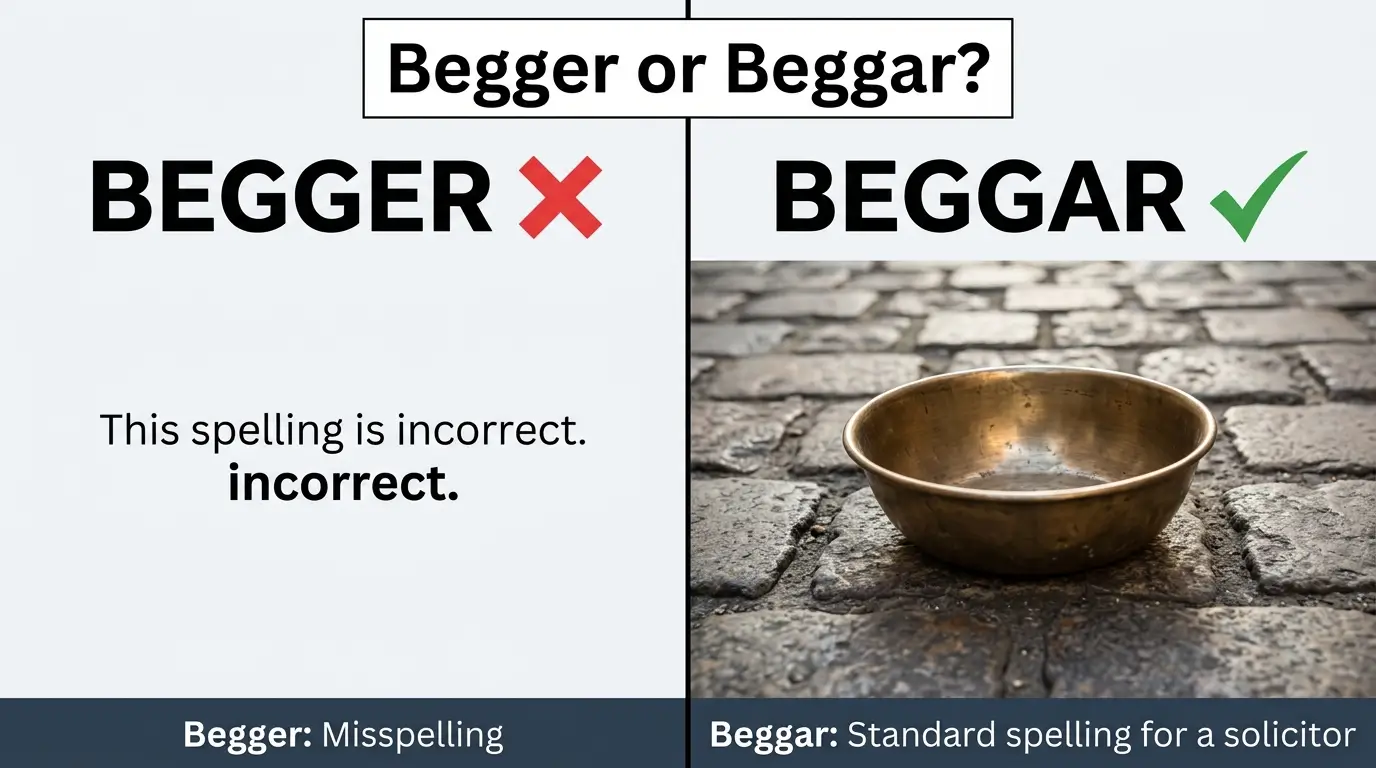
Begger or Beggar: Which Spelling Is Correct?
Begger or beggar? Beggar is the correct modern spelling; begger is an obsolete form.
Have you ever typed “begger” and wondered if it should be “beggar”? You are not alone.
These two spellings look almost identical, and their pronunciation can make the wrong version seem reasonable. But when you need correct English, there is a clear answer.
Beggar is the correct modern English spelling. Begger is an obsolete historical form and is not the standard spelling used today.
The word beggar can mean a person who asks for money or food. It can also be used as a verb meaning to make someone poor or to exceed the limits of something, as in “beggar belief.”
People often search for “begger or beggar” because many English words use the -er ending, such as teacher, runner, and writer.
This makes begger look logical. However, beggar has a long history that explains its unusual spelling.
In this guide, you will learn which spelling is correct, where the word came from, whether British and American English differ, and how to use it correctly.
Begger or Beggar Quick Answer
Beggar is the correct spelling in modern English.
Begger is not the standard modern spelling. It is recorded as an obsolete form.
Examples
- ✅ The beggar asked for food.
- ❌ The begger asked for food.
- ✅ The charity helps people who are living in poverty.
- ❌ The charity helps people who are living as beggers.
Easy rule: Spell it beggar, with -ar at the end.
The Origin of Begger or Beggar
The history of beggar is one reason the spelling can seem unusual.
The word appeared in English in the Middle Ages. Merriam-Webster traces it to Middle English forms such as beggere and beggare, connected with beggen, meaning “to beg.” Its first known use as a noun dates to the 13th century.
Another widely discussed explanation connects the word with Old French begart and Middle Dutch beggaert, referring to a mendicant. The exact history is not completely certain.
Interestingly, begger was not simply a modern spelling mistake throughout history. It was used widely in earlier English.
The Oxford English Dictionary records the -ar spelling from the 14th century, while the -er form was common during the 15th–17th centuries. Over time, beggar became the standard form.
So, the spelling beggar survived because of historical usage, even though begger may seem more logical today.
British English vs American English Spelling
There is no spelling difference between British and American English for this word.
Both use beggar.
| English Variety | Correct Spelling | Example |
| British English | beggar | The beggar stood outside the shop. |
| American English | beggar | The beggar asked for help. |
| Canadian English | beggar | The charity helped the beggar. |
| Australian English | beggar | The beggar received food. |
| Global English | beggar | He wrote about the life of a beggar. |
| Incorrect modern form | begger | ❌ Avoid this spelling |
The pronunciation can differ slightly. Collins gives British pronunciation as /ˈbɛɡə/ and American pronunciation as /ˈbɛɡər/. The spelling, however, remains beggar in both varieties.
Which Spelling Should You Use?
The answer is simple: use beggar.
For a US audience
Use beggar in emails, schoolwork, articles, reports, and everyday writing.
For a UK or Commonwealth audience
Use beggar as well. British English does not change the spelling to begger.
For a global audience
Use beggar. It is the recognized standard spelling across English varieties.
For formal writing
Always choose beggar.
If you are writing about poverty or homelessness, also consider your wording carefully. Terms such as person experiencing homelessness may be more appropriate in some formal or social contexts.
Common Mistakes with Begger or Beggar
1. Writing “begger”
❌ The begger asked for money.
✅ The beggar asked for money.
2. Assuming every agent noun ends in “-er”
Words such as runner and teacher can make begger look correct. But English spelling is full of historical exceptions.
3. Confusing “beggar” with “bigger”
The words look and sound different:
- beggar = a person who begs
- bigger = comparative form of big
Example:
The box is bigger than the bag.
4. Using “begger” in formal writing
❌ The report described the needs of street beggers.
✅ The report described the needs of street beggars.
5. Misspelling the plural
The plural is beggars, not beggers.
Begger or Beggar in Everyday Examples
In Emails
The charity provides meals to people in need, including street beggars.
For sensitive topics, use respectful and accurate language.
In News Writing
The city introduced a program to provide shelter and food to people living on the streets.
If the word is needed:
The article examined the lives of street beggars.
On Social Media
Kindness can make a difference in someone’s life.
If discussing the spelling itself:
Beggar is correct; begger is an obsolete form, not the standard modern spelling.
In Formal Writing
Beggar can also be a verb.
The situation beggars belief.
This means the situation is so surprising that it is difficult to believe. Dictionaries also record the verb beggar with meanings related to impoverishing someone or making something seem inadequate.
Common Expression
Beggars can’t be choosers.
This saying means that people without options may need to accept what is available. Oxford lists it as a standard idiom.
Begger or Beggar – Google Trends & Usage Data
Search interest in begger or beggar is mainly driven by spelling questions. People usually want to know which form is correct rather than choose between two accepted modern spellings.
Available search-focused sources consistently identify beggar as the standard spelling and begger as an obsolete or incorrect modern form.
Search behavior can also vary by context:
- Beggar appears in dictionaries, books, news, education, and everyday writing.
- Begger commonly appears when people are checking or questioning the spelling.
- Searches such as “begger or beggar” show strong spelling-learning intent.
- English-speaking and English-learning audiences may search the phrase when writing schoolwork, emails, articles, or social posts.
Google Trends uses relative interest rather than showing an absolute number of searches. Therefore, a Trends graph should be treated as a comparison of search interest, not as a direct count of how many people use each spelling.
For SEO and normal writing, the practical takeaway is clear: target “beggar” for correct usage, while “begger or beggar” can be addressed as a spelling-question keyword.
Begger vs Beggar Comparison Table
| Variation | Correct? | Meaning | Recommended Use |
| beggar | ✅ Yes | Person who begs; also a verb | Use it |
| beggers | ❌ No | Incorrect plural spelling | Avoid |
| beggars | ✅ Yes | More than one beggar | Use it |
| begger | ❌ Modern standard | Obsolete historical form | Avoid |
| begar | ❌ No | Not the standard spelling of beggar | Avoid |
| begging | ✅ Yes | Present participle of beg | Use it |
FAQs About Begger or Beggar
Is begger or beggar correct?
Beggar is the correct modern English spelling. Begger is an obsolete historical form.
Why is beggar spelled with “ar”?
The spelling comes from historical English usage and developed through Middle English forms such as beggare and beggere.
Is begger a real word?
It is a historical or obsolete English form, but it is not the standard spelling used in modern English.
Is beggar British or American English?
Beggar is correct in both British and American English.
What is the plural of beggar?
The plural is beggars.
What does beggar mean?
As a noun, a beggar is a person who asks others for money or food. It can also mean a very poor person.
Can beggar be a verb?
Yes. As a verb, beggar can mean to impoverish someone or make something seem beyond adequate description or comparison.
Conclusion
The answer to begger or beggar is simple: beggar is the correct spelling in modern English. It is used in British English, American English, and other major varieties of English.
Begger may look natural because many English words use the -er ending, but it is not the standard modern form.
The history of the word explains some of this confusion. Earlier forms included beggere and begger, and the -er spelling was used for centuries. Over time, however, beggar became the established spelling.
When writing an email, essay, article, report, or social media post, choose beggar. For the plural, use beggars.
You can also use beggar as a verb in expressions such as “beggar belief” and “beggar description.”
The easiest memory trick is this: beg + ar = beggar. Once you remember that pattern, you will not need to wonder about begger or beggar again.
Related Post: Usable or Useable: Which Spelling Is Correct?