
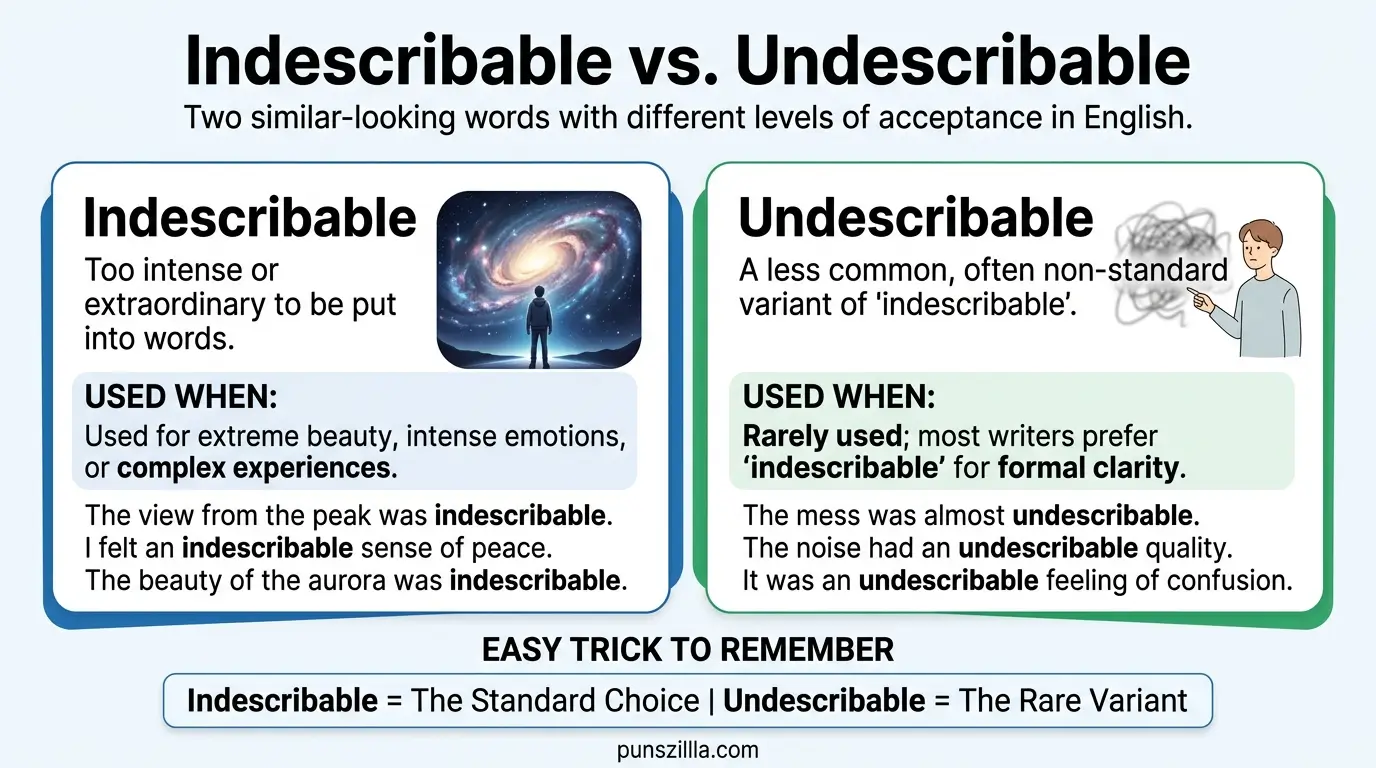
Indescribable or Undescribable: Which Spelling Is Correct?
Indescribable or Undescribable: Indescribable is the correct and standard spelling, meaning impossible or extremely difficult to describe.
Have you ever typed “undescribable” and wondered if it should be “indescribable” instead? You are not alone.
This spelling question is common because both forms look natural, and both have appeared in English. Yet one is far more common and is the best choice for most modern writing.
The correct standard choice is indescribable. It means something is so unusual, powerful, beautiful, painful, or extreme that it is almost impossible to describe in words.
For example: “The view from the mountain was indescribable.”
People search for “undescribable or indescribable” because English uses both in- and un- to create negative meanings.
This can make spelling hard to predict. The confusion is even greater because some dictionaries record undescribable as a rare alternative form.
This guide gives you the quick answer first, then explains the history, spelling, regional usage, common mistakes, examples, and search trends.
By the end, you will know which form to use in professional, academic, and everyday writing.
Indescribable or Undescribable Quick Answer
Indescribable is the standard and strongly preferred spelling.
It means impossible or very difficult to describe, especially because something is extremely intense, unusual, beautiful, or unpleasant.
Oxford defines it as something so extreme or unusual that it is almost impossible to describe.
Correct
- The view was indescribable.
- She felt indescribable joy.
- The pain was indescribable.
- His reaction was indescribable.
Rare alternative
Undescribable is not simply meaningless or impossible English. Cambridge lists it as a word meaning “impossible to describe” and gives indescribable as its synonym.
Collins also calls it a variant of indescribable.
However, indescribable is the safer choice for modern English.
| Variation | Status | Meaning | Best choice? |
| indescribable | Standard/common | Impossible or very difficult to describe | ✅ Yes |
| undescribable | Rare/variant | Impossible to describe | ⚠️ Usually avoid |
| indescribably | Standard adverb | In a way that cannot be described | ✅ Yes |
| indescribability | Standard noun | The quality of being indescribable | ✅ Yes |
Merriam-Webster defines indescribable as “that cannot be described” or something that surpasses description.
The Origin of Indescribable or Undescribable
The word indescribable is formed from:
in- + describe + -able
The prefix in- can mean “not,” while -able means “capable of being.” So indescribable literally means something that is not capable of being described.
The word describe comes from Latin roots connected with writing or marking out something clearly. English later formed describable, meaning something that can be described.
Historical sources place indescribable in English in the 18th century.
Merriam-Webster gives 1751 as its first known use, while other historical sources record the word earlier in the 1700s.
Why, then, does undescribable exist?
English has several negative prefixes. Writers may use un-, in-, im-, il-, or ir-, depending on the word. But these prefixes cannot always be chosen freely.
For example:
- unhappy — not happy
- unable — not able
- invisible — not visible
- impossible — not possible
- irregular — not regular
- indescribable — not describable
Historically, undescribable also appeared in English. Wiktionary records it as an alternative form of indescribable, including a 19th-century example.
So the spelling difference is mainly a matter of English word formation and historical usage—not a British-versus-American spelling rule.
British English vs American English Spelling
There is no major British-versus-American spelling difference between indescribable and undescribable.
Both British and American English use indescribable as the normal form.
| Feature | British English | American English |
| Standard spelling | indescribable | indescribable |
| Rare alternative | undescribable | undescribable |
| Meaning | Impossible to describe | Impossible to describe |
| Recommended form | indescribable | indescribable |
| Common adverb | indescribably | indescribably |
Oxford lists indescribable in both its general and American English dictionaries.
This means you should not think of indescribable as British English and undescribable as American English. That would be incorrect.
The same spelling works well in:
- the United States
- the United Kingdom
- Canada
- Australia
- New Zealand
- international English
Which Spelling Should You Use?
For almost every situation, use indescribable.
For a US audience
Use indescribable in:
- business emails
- school assignments
- websites
- news writing
- marketing
- social media
- academic work
For UK and Commonwealth audiences
Use indescribable as well. It is the familiar and professional choice.
For global English
Indescribable is the safest option. It is easy to recognize and widely accepted.
What about undescribable?
You may see undescribable in older texts or rare modern usage. Dictionaries such as Cambridge and Collins recognize it, but it is much less common than indescribable.
If you are writing for a general audience, there is little reason to choose it.
Professional advice: Choose “indescribable.”
Common Mistakes with Indescribable or Undescribable
Mistake 1: Using “undescribable” in formal writing
❌ The experience was undescribable.
✅ The experience was indescribable.
Mistake 2: Assuming “un-” must mean “not”
English prefixes do not always work in a simple, logical way.
For example:
- unhappy
- uncertain
- unable
But:
- invisible
- inaccurate
- indescribable
The correct form depends on established English usage.
Mistake 3: Writing “indescribeable”
❌ indescribeable
✅ indescribable
Do not add an extra e before -able.
Mistake 4: Confusing the adjective and adverb
Indescribable is an adjective:
The beauty was indescribable.
Indescribably is an adverb:
The view was indescribably beautiful.
Mistake 5: Using “indescribable” when a precise word is better
“Indescribable” is useful, but it can be vague.
Instead of:
The problem was indescribable.
You might write:
The problem was extremely complex and difficult to explain.
Precise writing is often stronger than general emotional language.
Indescribable or Undescribable in Everyday Examples
In emails
Thank you for your kindness. Your support has been indescribable.
A more professional option may be:
Thank you for your support. It has meant more to me than I can express.
In news writing
Witnesses described the scene as indescribable.
News writers may use the word when an event is especially shocking, emotional, or difficult to put into words.
On social media
This sunset is indescribable. 🌅
This is a natural casual use.
In formal writing
The study produced an indescribable sense of uncertainty among participants.
However, formal writing often benefits from more exact wording.
In creative writing
For a moment, she felt an indescribable mixture of joy and fear.
This is one of the word’s strongest uses because emotions can be difficult to express precisely.
In everyday conversation
The food was indescribable.
Depending on context, this could mean the food was wonderful—or so bad that words cannot explain it.
Indescribable or Undescribable Google Trends & Usage Data
Google Trends measures relative search interest, not the exact number of searches. A Trends comparison can also change depending on the country, date range, language, and search type.
For this spelling question, the important pattern is clear: indescribable is the established mainstream form, while undescribable is a rare alternative.
Dictionary evidence supports this distinction. Cambridge lists undescribable as a synonym-level alternative, while Collins explicitly describes it as a variant of indescribable.
Search interest is also likely to appear in different contexts:
| Region/context | Likely preference | Why |
| United States | indescribable | Standard American usage |
| United Kingdom | indescribable | Standard British usage |
| Canada | indescribable | Follows mainstream English usage |
| Australia/New Zealand | indescribable | Standard Commonwealth usage |
| International English | indescribable | Most recognizable form |
| Spelling searches | Both | Users search because they are unsure |
The word itself remains common in modern writing.
Merriam-Webster continues to give current examples from newspapers and magazines, showing that indescribable remains an active English word.
A useful SEO point is that people may search the wrong spelling when they are unsure. That does not make the wrong spelling the best form to use in your content.
Indescribable vs Undescribable: Comparison Table
| Word | Correct? | Frequency | Meaning | Recommended use |
| indescribable | ✅ Yes | Common | Impossible or very difficult to describe | Use normally |
| undescribable | ⚠️ Yes, as a rare variant | Rare | Impossible to describe | Usually avoid |
| indescribably | ✅ Yes | Common | In an indescribable way | Use when modifying an adjective/adverb |
| indescribability | ✅ Yes | Less common | Quality of being indescribable | Formal/specialized use |
| describable | ✅ Yes | Common | Able to be described | Opposite idea |
FAQs About Indescribable or Undescribable
Is it “indescribable” or “undescribable”?
Indescribable is the standard and preferred spelling. Undescribable exists as a rare alternative form, but it is much less common.
Is “undescribable” a real word?
Yes. Some dictionaries recognize undescribable as an alternative or variant of indescribable. It is not the usual choice in modern professional writing.
What does indescribable mean?
It means impossible or very difficult to describe, often because something is extremely intense, unusual, beautiful, painful, or emotional.
Is indescribable British or American?
It is used in both British and American English. There is no special regional spelling for the word.
What is the opposite of indescribable?
The closest opposite is describable, meaning something that can be described.
What is another word for indescribable?
Depending on context, you can use inexpressible, ineffable, unspeakable, undefinable, or inexplicable.
How do you use indescribable in a sentence?
For example:
The feeling of seeing my child graduate was indescribable.
Another example:
The beauty of the mountains was indescribable.
Conclusion
If you are wondering whether to write “indescribable or undescribable,” the simple answer is indescribable.
Indescribable is the standard, familiar, and professional form in modern English. It means that something is so intense, unusual, beautiful, painful, or extreme that it is difficult or impossible to describe with words.
Major dictionaries such as Merriam Webster and Oxford recognize it as the normal form.
Undescribable is not completely unknown. Cambridge lists it, and Collins describes it as a variant of indescribable. However, it is much less common.
There is also no meaningful British-versus-American spelling difference here. Writers in both varieties normally use indescribable.
So, whether you are writing an email, blog post, school essay, news article, social media caption, or business document, choose indescribable.
It is the clearest and safest choice for modern readers.