
Protester or Protestor: Which Is Correct?
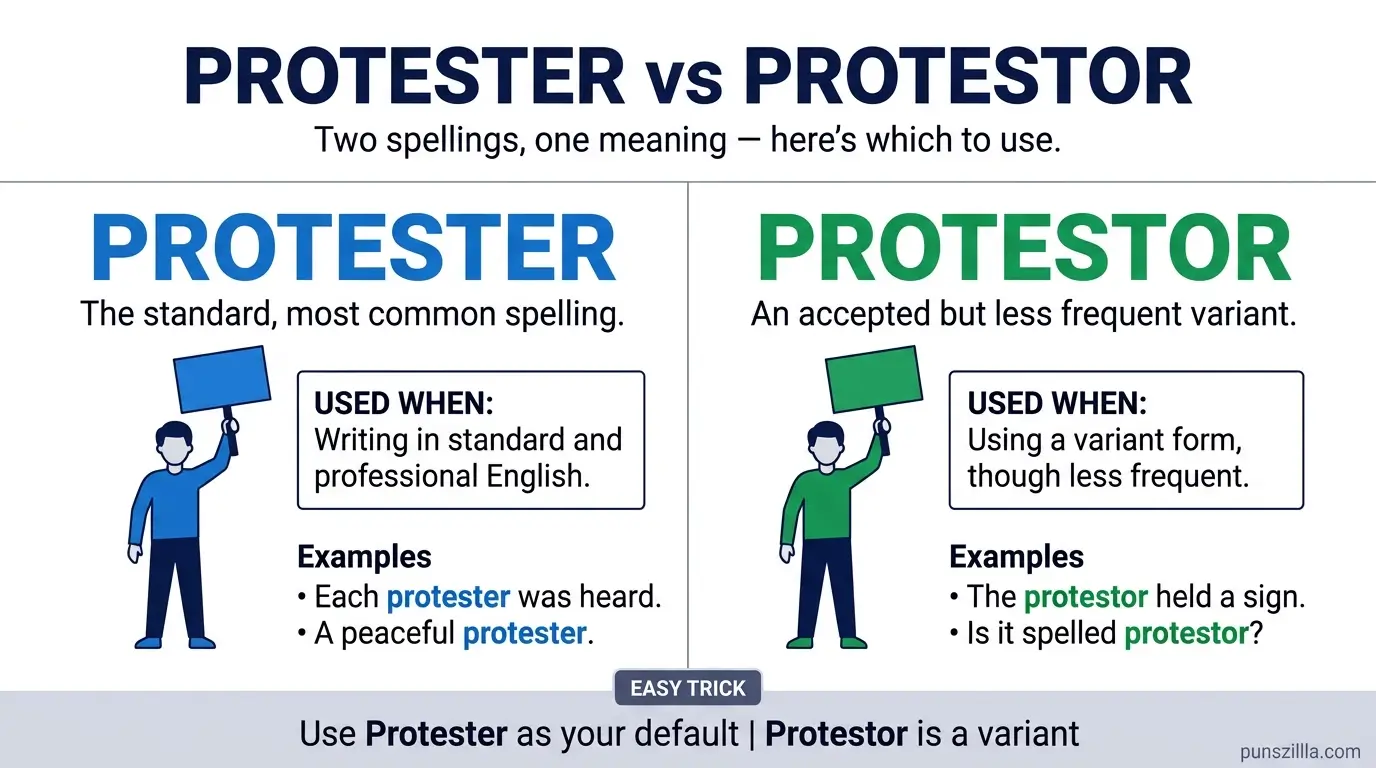
Protester or protestor? Both spellings are correct, but protester is more common in American and British English. Use protester for clear, consistent writing unless your style guide prefers protestor.
Both protester and protestor are correct spellings. However, protester is the more common choice, especially in American English.
British English also uses both forms, but protester is generally preferred. Both words describe someone who publicly expresses disagreement with an issue, decision, or policy.
If you are writing a school assignment, news report, business email, or English exam, choose protester. It is widely recognized and easy for readers to understand. You can use protestor when following a style guide that prefers it.
The confusion comes from the endings -er and -or. English uses both endings to describe people who perform an action. For example, we write teacher but actor. There is no single rule that works for every word.
The good news is that you do not need to memorize a complicated spelling rule here. Just remember that protester is the safer default in most situations.
This guide explains the difference between protester and protestor, their origins, regional usage, and the best spelling for everyday and formal writing.
Protester or Protestor Quick Answer
Quick Answer: Both protester and protestor are accepted English spellings for someone who publicly expresses disagreement.
However, protester is more common and is the preferred choice for most American, British, and international writing. Use protester unless your organization follows a specific spelling preference.
Examples of Protester
- The protesters gathered outside the government building.
- A peaceful protester held a sign calling for change.
- Every protester had the right to express an opinion peacefully.
Examples of Protestor
- The protestor spoke against the proposed law.
- Police asked each protestor to leave the restricted area.
- The newspaper interviewed a protestor after the demonstration.
Both spellings communicate the same meaning. The main difference is their frequency and spelling preference, not their definition.
The Origin of Protester or Protestor
The word protester comes from the verb protest. To protest means to express disagreement, objection, or disapproval. A protester is someone who performs that action.
The verb protest entered English through French and ultimately comes from the Latin protestari, meaning to declare or affirm publicly. Its history explains the word’s connection to public statements and objections.
English often adds -er or -or to words to describe people who perform an action. The ending depends on the word and its history.
For example:
- Teach becomes teacher.
- Act becomes actor.
- Direct becomes director.
- Protest becomes protester or protestor.
The two spellings developed as alternative forms. Neither ending changes the basic meaning of the word.
Modern dictionaries recognize both protester and protestor. Cambridge lists protestor as an alternative spelling under protester. Collins also recognizes both forms.
You can check their definitions in the Cambridge Dictionary and the Collins English Dictionary.
British English vs American English Spelling
Unlike some spelling differences between American and British English, this pair does not have a strict regional divide.
American writers generally favor protester. British writers use both forms, but protester is also common in British English.
The important point is that protestor is not exclusively British English. You should not assume that the spelling changes automatically when writing for a British audience.
Comparison Table
| Word | Use when | Example sentence |
|---|---|---|
| Protester | You want the widely preferred spelling | The protester addressed the crowd. |
| Protestor | You follow a preference for this alternative | The protestor opposed the new policy. |
Which Form Is More Common?
Protester is the better default for most readers.
American English strongly favors this form. British English also uses it frequently, although protestor remains an accepted alternative.
In international news, academic writing, and everyday communication, protester is a practical choice. It is widely understood and avoids unnecessary questions about spelling.
If your employer, newspaper, school, or publisher has a house style, follow that guidance. Consistency matters more than switching between the two forms.
Which Spelling Should You Use?
The right choice depends on your audience and the rules you need to follow. In most cases, choosing protester will keep your writing clear and consistent.
For American English
Use protester as your standard spelling.
It is the familiar form in American English dictionaries and general writing. It works well in news stories, school essays, reports, and online content.
Example: The protesters gathered to demand safer roads.
For British English and Commonwealth Readers
Use protester unless your preferred dictionary or style guide recommends otherwise.
British English accepts protestor, too. However, you do not need to use the alternative to make your writing sound British.
Example: The protesters marched through the city centre.
For International Readers
Choose protester for broad readability.
People learning English may find it easier to remember one standard form. Using the more common spelling also helps keep articles and documents consistent.
Example: Each protester carried a sign with a clear message.
For IELTS and TOEFL
Use protester in essays and other formal answers.
These exams assess your ability to communicate clearly. Since both forms are accepted, the spelling choice itself is not the main issue. Correct usage, grammar, and consistency matter more.
For exam preparation, learn protester as your default spelling.
For Business Emails and Professional Writing
Use protester unless your organization’s style guide specifies protestor.
This applies to reports, press releases, research papers, and other professional documents. Avoid changing spellings without a clear reason.
Simple rule to remember: When in doubt, write protester. It is the more widely preferred spelling.
Common Mistakes with Protester or Protestor
Although both spellings are accepted, writers sometimes make mistakes when choosing or using them. These are the most common problems to avoid.
| Wrong | Right | Why |
|---|---|---|
| The protester and protestor means different things. | Protester and protestor mean the same thing. | Both spellings have the same meaning. |
| Protestor is always incorrect. | Protestor is an accepted alternative. | Dictionaries recognize both forms. |
| Protestor is only used in British English. | Both forms appear in English varieties. | The difference is not strictly regional. |
| The protester protested peaceful. | The protester protested peacefully. | The verb needs an adverb here. |
| The protesters was outside. | The protesters were outside. | The plural subject takes were. |
| She is a protestor’s. | She is a protester. | The apostrophe is unnecessary for a singular noun. |
Mistake 1: Treating Protestor as a Misspelling
Some writers assume that protestor is always wrong. This is not accurate. Major dictionaries recognize it as an alternative spelling.
However, protester remains the safer choice for general writing. Use the alternative only when you have a reason to prefer it.
Mistake 2: Assuming the Words Have Different Meanings
The spelling difference does not create a difference in meaning. Both words describe someone who expresses disagreement or objection.
For example, a person protesting a new law can be called either a protester or a protestor.
Mistake 3: Switching Between Spellings
Avoid using both forms randomly in the same article. Readers may assume that the words have different meanings.
Choose one spelling and use it consistently. For most writing, protester is the easiest option.
Mistake 4: Confusing Protester with Protest
These words are related, but they serve different purposes.
A protest is an act or expression of disagreement. A protester is the person who takes part in it.
For example: The protest attracted hundreds of protesters.
Mistake 5: Using the Wrong Plural
The usual plural of protester is protesters. The usual plural of protestor is protestors.
Do not combine the two forms without a reason. Keep the singular and plural spellings consistent throughout your writing.
Protester or Protestor in Everyday Examples
Seeing both spellings in context makes the choice easier. The following examples show how to use these words in common situations.
| Context | Example |
|---|---|
| The report includes statements from several protesters. | |
| Please confirm whether the protesters can enter the designated area. | |
| News headline | Protesters Gather Outside City Hall |
| News headline | Protesters Call for Changes to Local Policy |
| Social media | The protesters shared their message peacefully. |
| Social media | Every protester deserves to be heard respectfully. |
| Formal writing | The study examined the experiences of protesters during public demonstrations. |
| Formal writing | Researchers interviewed each protester about the event. |
Using Protester in Emails
In professional emails, use protester when discussing demonstrations, public events, or related reports.
Example: “The security team prepared a plan for managing the crowd of protesters.”
This sentence is clear and suitable for workplace communication.
Another example: “Please include the protesters’ statements in the final report.”
The apostrophe after protesters shows possession because the statements belong to multiple protesters.
Using Protester in News Headlines
News writing often uses short, direct language. Protester fits naturally into headlines and news reports.
Example: “Protesters March Against Proposed Changes.”
The headline identifies the people involved and the action they took.
Another example: “Local Protesters Call for Better Public Transport.”
This headline uses protesters to identify the people expressing their concerns.
Using Protester on Social Media
On social media, the word can describe people participating in a demonstration or expressing public opposition.
Example: “The protesters gathered peacefully to support their cause.”
Another example: “A protester explained why the issue mattered to the community.”
Both sentences use the preferred spelling without changing the meaning.
Using Protester in Formal Writing
In essays, reports, and research papers, choose one spelling and maintain it throughout the document.
Example: “The researchers interviewed protesters to understand their views on public policy.”
Another example: “The report examined how protesters communicated their concerns.”
These examples work in academic and professional settings.
Protester or Protestor – Google Trends and Usage Data
There is no live Google Trends dataset supplied for this article. Therefore, exact search volumes, percentages, rankings, and peak dates should not be assumed.
Dictionary usage supports a general preference for protester. Both spellings are recognized, but protester is the more widely preferred form. American English strongly favors it, while British English uses both.
The words may appear in news reports, academic studies, public statements, websites, and social media posts. Their use often depends on the writer’s preferred spelling and the publication’s style guide.
Search interest can differ from actual word usage. Someone searching for protestor may simply be checking whether it is correct. Search results alone cannot establish which spelling appears most often in published writing.
Regional and Contextual Usage
| Word | More common in | Where you see it |
|---|---|---|
| Protester | American English and widely across English varieties | News, essays, reports, and social media |
| Protestor | Accepted alternative; also used in British English | News articles, general writing, and online searches |
These descriptions reflect general usage patterns, not measured search statistics. Exact regional comparisons should be verified before publication.
Check It Yourself:
Follow these steps to compare both spellings:
- Open Google Trends. Enter protester and protestor as separate search terms. Compare the United States, United Kingdom, and other regions.
- Select the same time range and search category for both terms. Remember that Trends shows relative search interest, not exact search volume.
- Open Google Books Ngram Viewer. Compare both words to explore their frequency in the books covered by its database.
These tools measure different things. Google Trends tracks search interest, while Ngram Viewer examines word usage in its book collection.
Comparison Table: Protester vs Protestor
Use this table for a quick review of the spelling, meaning, and regional preferences.
| Word | Type/Meaning | Region or Status | Example | Formality | Memory Trick |
|---|---|---|---|---|---|
| Protester | A person who protests | Preferred in American English; widely used internationally | The protester held a sign. | Formal and informal | Remember the common -er ending. |
| Protestor | A person who protests | Accepted alternative in American and British English | The protestor joined the march. | Formal and informal | Remember it as the alternative form. |
Both words have the same meaning and can appear in formal or casual writing. The main difference is spelling preference.
For a consistent style, choose protester unless your publication or organization requires protestor.
FAQs About Protester or Protestor
Is Protester or Protestor Correct?
Both spellings are correct. Protester is the more widely preferred form, particularly in American English. Protestor is an accepted alternative. For schoolwork, professional writing, and general communication, protester is usually the safest choice.
Is Protestor a Real Word?
Yes, protestor is a real English word. Major dictionaries recognize it as an alternative to protester. Both describe someone who publicly expresses disagreement or objection. However, protester is more common and is generally the better default.
Which Spelling Is More Common in American English?
Protester is more common in American English. It is widely used in news reports, essays, and everyday writing. Although protestor is understood and accepted, most writers should choose protester unless a style guide recommends otherwise.
Do British People Write Protester or Protestor?
British writers use both spellings, but protester is also widely preferred in British English. The spelling protestor is not limited to Britain. If you are writing for a British audience, protester remains a safe and natural choice.
Do Protester and Protestor Mean the Same Thing?
Yes, both words mean a person who protests. Neither spelling indicates a different political position, type of demonstration, or level of disagreement. The choice concerns spelling preference rather than meaning.
What Is the Plural of Protester?
The plural of protester is protesters. For example, “The protesters gathered outside the courthouse.” The plural of protestor is protestors. Keep each form consistent within your writing.
Should I Use Protester in IELTS, TOEFL, and Business Emails?
Yes, protester is a practical choice for IELTS, TOEFL, business emails, and academic assignments.
Both spellings are accepted, but protester is more widely preferred. Focus on correct grammar, clear meaning, and consistent spelling throughout your work.
Conclusion: Protester or Protestor?
Key Takeaways:
- Protester is the preferred spelling for most writing.
- Protestor is also correct and has the same meaning.
- American English strongly favors protester, while British English accepts both.
- Use one spelling consistently in essays, emails, reports, and articles.
Choosing between protester and protestor can seem confusing because English uses both -er and -or endings. However, this particular choice is simple once you know the difference.
Both forms describe someone who publicly expresses disagreement with an issue, decision, or policy. You do not need to learn separate meanings or use one spelling for a particular political cause.
For most readers, protester is the best option. It is widely recognized in American and British English and works well in international communication. It is also a sensible choice for school assignments, English exams, news articles, and professional documents.
If your publisher or employer prefers protestor, you can follow that preference. Otherwise, stick with protester.
The easiest rule to remember is this: Both spellings are correct, but protester is the safer everyday choice. When you are unsure, use the more widely preferred form and keep your writing consistent.