
Honey or Hunny: Which Is Correct?
Have you ever wondered whether to write “honey” or “hunny”? Both spellings appear in messages, social media posts, and popular culture. However, they do not have the same status in standard English.
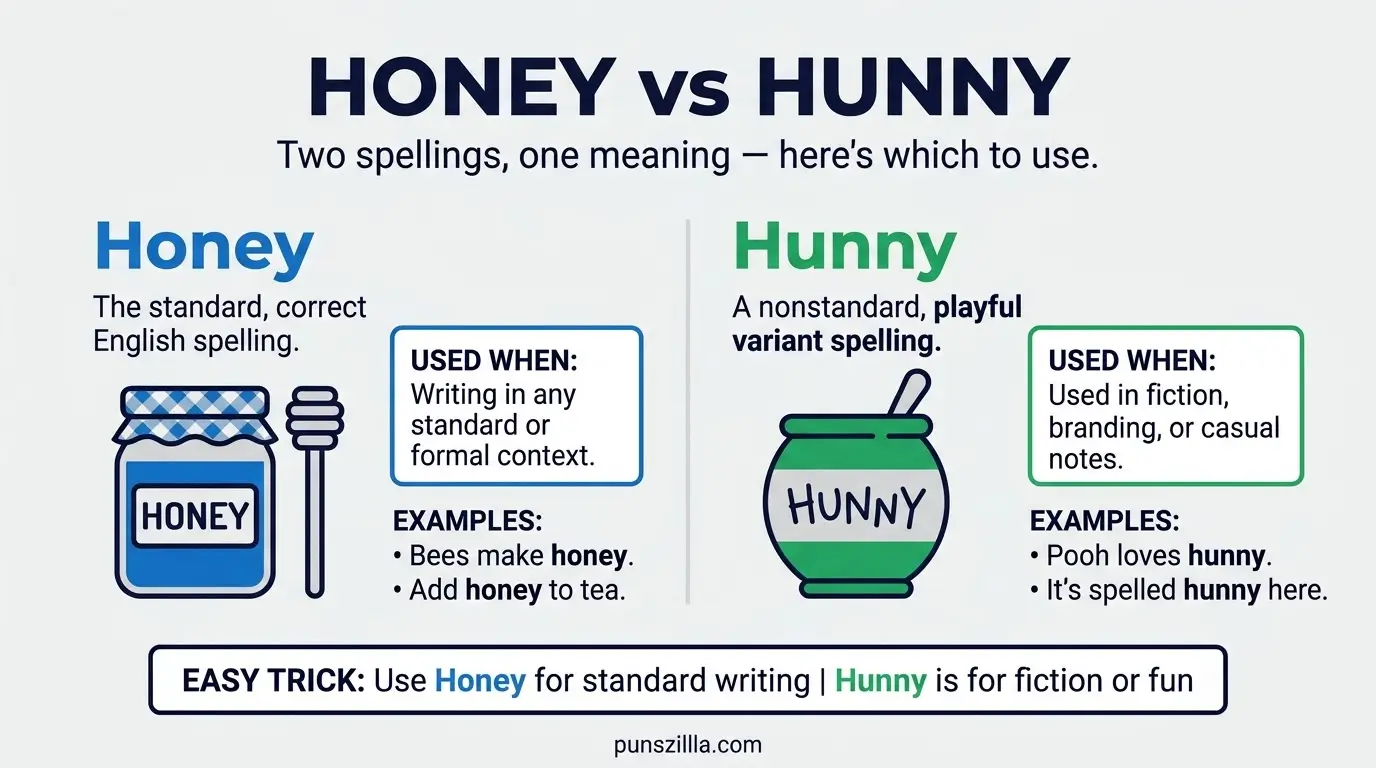
Honey is the correct standard spelling. It refers to the sweet food made by bees. It can also be an affectionate name for someone you love.
Hunny is an informal, playful spelling sometimes used in nicknames, personal messages, and creative writing.
People often search for “honey or hunny” because both words sound alike. They may also see “hunny” in online conversations or in Winnie-the-Pooh stories. This can make it difficult to know which spelling belongs in everyday writing.
The good news is that the choice is simple. Use honey for normal writing, schoolwork, professional communication, and descriptions of food. Choose hunny only when you want a playful or personal style.
This guide explains the difference, gives clear examples, and shares an easy rule to remember. You will also learn how to choose the right spelling for different situations.
Honey or Hunny Quick Answer
Quick Answer: Honey is the standard English spelling. It describes the sweet substance made by bees or serves as an affectionate term for someone.
Hunny is an informal alternative used in some nicknames, messages, and fictional contexts. For schoolwork, business emails, and formal writing, choose honey.
Examples of Honey
- The bees produced fresh honey for the market.
- Honey, could you please help me with this bag?
- She added a spoonful of honey to her tea.
Examples of Hunny
- Good morning, hunny! I hope you have a lovely day.
- The character called his teddy bear “Hunny.”
- “Love you, hunny!” she wrote in her private message.
These examples show how context affects your choice. Honey works in standard English. Hunny can express a playful or personal tone.
The Origin of Honey or Hunny
The word honey has a long history in English. It comes from the Old English word hunig. It is also related to words for honey in other Germanic languages.
The word passed through earlier forms of English before reaching its modern spelling. Today, dictionaries recognize honey as the standard form.
Honey has two common uses. First, it names the sweet substance made by bees from flower nectar. Second, it can be a term of affection for someone you love or care about.
For example, someone might say, “Honey, dinner is ready.” In this sentence, honey is not food. It is a friendly or loving way to address another person.
Hunny is a nonstandard spelling that reflects the same pronunciation. Writers may use it to make a message feel cute, casual, or personal. It also appears in popular culture, including the familiar spelling associated with Winnie-the-Pooh.
The spelling difference does not usually indicate a different meaning. Instead, it signals a difference in style and context.
For more information, consult the Oxford Learner’s Dictionary entry for honey.
Correct Spelling vs Common Misspelling
Honey is the spelling you should use in standard English. Hunny is best treated as an informal or creative alternative, not a standard replacement.
When Should You Use Honey?
Use honey when writing about food, addressing someone affectionately, or describing something sweet.
Examples:
- The recipe calls for two tablespoons of honey.
- Honey, I will call you after work.
- The honey tasted sweet and fresh.
This spelling is suitable for formal and informal writing. It is also the safest choice when you are unsure.
When Can You Use Hunny?
Use hunny when you deliberately want a cute or playful tone. It may appear in a nickname, a private message, a fictional character’s speech, or a social media caption.
Examples:
- Thanks for everything, hunny!
- Sleep well, hunny. See you tomorrow.
- Her nickname for her partner was Hunny.
Remember that readers may see hunny as a spelling mistake outside these informal settings. Avoid it in school assignments, professional documents, and formal correspondence.
Honey vs Hunny Comparison Table
| Word | Use when | Example sentence |
|---|---|---|
| Honey | Writing standard English | I bought a jar of honey. |
| Honey | Addressing someone affectionately | Honey, your phone is ringing. |
| Hunny | Creating a playful nickname | Good night, hunny! |
| Hunny | Writing informal character dialogue | “Come here, hunny,” she said. |
The main rule is simple: honey is the standard choice, while hunny is a deliberate stylistic choice.
Which Spelling Is Correct?
Choose honey whenever you need standard English. It works in nearly every situation, whether you are describing food or addressing someone you love.
For American English
American writers use honey in everyday speech and writing. You can use it in school assignments, work emails, recipes, and personal messages.
Hunny may appear in casual online conversations. However, it is not the usual spelling in standard American English.
For British English and Commonwealth Countries
British English also uses honey. The spelling does not change between American and British English.
Writers in countries such as Australia, Canada, and New Zealand can also use honey. There is no regional spelling rule that makes hunny the standard form.
For Global English Learners
If English is not your first language, remember honey as the correct spelling. It is widely understood and appropriate for most situations.
In exams such as IELTS and TOEFL, use honey when the word is needed. Avoid hunny unless you are discussing a specific nickname or quoting informal text.
For Business Emails
Professional communication usually requires standard spelling. Use honey only when an affectionate greeting is appropriate for your relationship with the reader.
For example:
- Professional: “Thank you for sending the report.”
- Personal: “Hi, honey! I will be home soon.”
In most workplace emails, a greeting such as “Hello” or “Dear” is more suitable than either affectionate term.
Common Mistakes with Honey or Hunny
Writers often confuse these spellings because they sound alike. The following table explains how to avoid common errors.
| Wrong | Right | Why |
|---|---|---|
| I added hunny to my tea. | I added honey to my tea. | Honey is the standard food spelling. |
| The recipe needs hunny. | The recipe needs honey. | Recipes use the standard spelling. |
| Dear Hunny, please see the attached report. | Dear [Name], please see the attached report. | Professional letters usually use a person’s name. |
| Honey is only a nickname. | Honey can mean food or an affectionate name. | The word has more than one common meaning. |
| Hunny is always the standard spelling. | Honey is the standard spelling. | Hunny is an informal variant. |
| Every use of hunny is a typo. | Hunny can be a deliberate stylistic choice. | Informal writing sometimes uses playful spellings. |
A useful way to avoid these mistakes is to consider your audience. If you are writing for a teacher, employer, or general audience, choose honey.
If you are writing a personal message, you can use hunny when it matches your intended tone. Make sure the reader understands that the spelling is deliberate.
Honey or Hunny in Everyday Examples
The right choice depends on the situation. Honey is suitable for standard writing, while hunny may fit casual and affectionate messages.
| Context | Example |
|---|---|
| Please add honey to the shopping list. | |
| Hi, honey. I will be late today. | |
| News headline | Local Beekeepers Produce Fresh Honey |
| News headline | Why Honey Remains a Popular Natural Sweetener |
| Social media | Homemade bread with honey for breakfast! |
| Social media | Missing you, hunny! See you soon. |
| Formal writing | Honey is commonly used as a sweetener in food. |
| Formal writing | The character addresses her partner as “honey.” |
Notice that the formal examples use honey, even when the word expresses affection. Hunny is more suitable when a writer wants to show an informal voice.
Is Hunny Ever Acceptable?
Yes, hunny can be acceptable in creative or personal writing. A writer might choose it for a nickname, a playful caption, or dialogue that reflects a character’s personality.
However, acceptable informal usage does not make it the standard spelling. If you want your writing to follow conventional English spelling, choose honey.
Honey or Hunny Google Trends and Usage Data
Honey is the standard spelling and the safer choice for general English writing. Hunny appears in informal contexts, including affectionate messages, nicknames, and references to fictional characters.
Search interest can vary by country and context. Someone searching for honey may want information about food, recipes, or the meaning of an affectionate expression.
Someone searching for hunny may be looking for a nickname, a character reference, or help checking the spelling.
Without a verified comparison of live search data, it would be misleading to give exact popularity figures or claim a specific country has the highest interest.
Honey vs Hunny: General Usage
| Word | More common in | Where you see it |
|---|---|---|
| Honey | Standard English worldwide | Recipes, dictionaries, books, everyday writing |
| Hunny | Informal and playful contexts | Nicknames, personal messages, social media, fictional references |
These descriptions reflect the words’ standard and informal uses, not measured search rankings.
Check It Yourself:
- Open Google Trends and compare “honey” with “hunny.” Select your country and a suitable time range.
- Check the search-interest graph and regional results. Remember that Trends shows relative search interest, not the total number of searches.
- Open Google Books Ngram Viewer to compare the terms in its indexed books. Check the selected dates and corpus before drawing conclusions.
Search results may include unrelated meanings and fictional references. Consider these differences before deciding what the data means.
Comparison Table: Honey vs Hunny
| Word | Type/Meaning | Region or Status | Example | Formality | Memory trick |
|---|---|---|---|---|---|
| Honey | Sweet food made by bees | Standard worldwide | Bees make honey. | Formal or informal | Honey is the usual spelling. |
| Honey | Affectionate name | Standard English | Hello, honey! | Informal and affectionate | Use honey for a loved one. |
| Hunny | Playful spelling of honey | Nonstandard, informal | Love you, hunny! | Very casual | Hunny is for a playful tone. |
| Hunny | Creative name or character reference | Context-dependent | The character wrote “Hunny.” | Creative or informal | Keep it when the style matters. |
This table highlights the key difference. Honey is the standard spelling, while hunny is a stylistic alternative.
FAQs About Honey or Hunny
Is honey or hunny correct?
Honey is the correct standard spelling. It refers to the sweet food made by bees and can also be an affectionate name. Hunny is an informal spelling sometimes used for playful effect. Choose honey in schoolwork, professional writing, and everyday standard English.
Is hunny a real word?
Hunny appears in informal English, nicknames, and creative writing. However, it is not the standard spelling of honey.
People may use it intentionally to sound cute or playful. In formal writing, use honey unless you are quoting a name or preserving a specific style.
Does honey mean the same as hunny?
Usually, yes, when hunny is used as a playful spelling of honey. Both may express affection in personal messages. Honey also refers to food made by bees. The main difference is spelling and tone, rather than a separate standard meaning.
Can I call my boyfriend or girlfriend hunny?
Yes, you can use hunny as a personal nickname if your partner likes it. It gives a message a playful tone. Honey is the more conventional spelling. Either can work in private messages, but honey is safer when you want standard spelling.
Is hunny a spelling mistake?
Hunny is generally nonstandard, but it is not always an accidental mistake. Writers sometimes choose it deliberately for a nickname, fictional dialogue, or playful message. In formal documents and standard English writing, use honey instead.
Is honey the same in American and British English?
Yes. Honey is the standard spelling in both American and British English. There is no US-versus-UK spelling difference here.
Writers in other English-speaking countries can also use honey. Hunny remains an informal alternative rather than a regional standard.
Why is Winnie-the-Pooh associated with hunny?
Winnie-the-Pooh is famously associated with the spelling “hunny” on his honey pots.
The playful spelling is part of the character’s familiar fictional world. It does not change the standard spelling used in recipes, schoolwork, or ordinary English writing.
Conclusion: Honey or Hunny?
Key Takeaways:
- Honey is the standard English spelling.
- Hunny is an informal, playful alternative.
- Use honey in schoolwork, professional emails, recipes, and formal writing.
- Choose hunny only when you want a cute or personal style.
The choice between honey and hunny becomes easy when you think about your purpose. If you are writing about food, honey is always the usual spelling. If you are addressing someone you love, honey is also the conventional choice.
Hunny can work in a private message, nickname, or creative piece. It may make your words feel more playful or personal. However, readers may consider it a mistake when they expect standard English.
The same rule applies across American, British, and other varieties of English. Honey remains the standard spelling, so you do not need to change it for a different country.
When in doubt, choose honey. It is widely understood, accepted in standard writing, and suitable for almost every context. Save hunny for situations where the playful spelling is intentional.
Remember: Honey is standard; hunny is playful.