
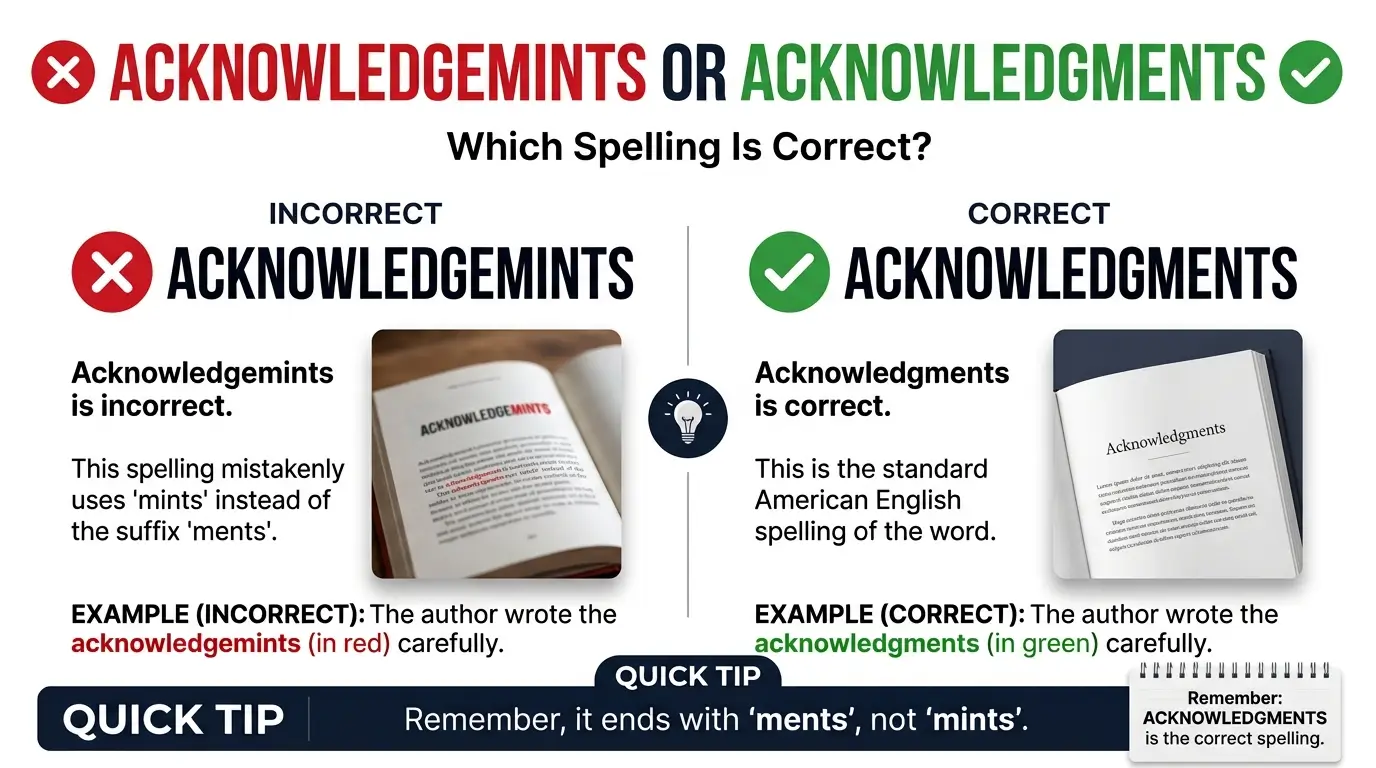
Acknowledgements or Acknowledgments: Which Spelling Is Correct?
Acknowledgements or acknowledgments? Both are correct. Use “acknowledgments” in American English and “acknowledgements” in British English.
Have you ever finished a paper, book, report, or project and stopped at the last section? You may wonder: Should I write “acknowledgements” or “acknowledgments”?
The short answer is simple: both spellings are correct. The difference depends mainly on the type of English you use.
“Acknowledgments” is more common in American English, while “acknowledgements” is widely used in British English and many other English-speaking countries.
This small spelling difference can cause confusion, especially when writing academic papers, books, business reports, websites, or formal documents. You may also see both forms online, which makes the choice seem even less clear.
The good news is that you do not need to memorize a difficult rule. Once you know your audience and follow one spelling style consistently, the choice becomes easy.
In this guide, you will learn the difference between acknowledgements or acknowledgments, where the spellings come from, which one to use, common mistakes to avoid, and how to use each form with confidence.
Acknowledgements or Acknowledgments Quick Answer
Both “acknowledgements” and “acknowledgments” are correct.
The main difference is spelling preference:
- Acknowledgments → Usually preferred in American English.
- Acknowledgements → Usually preferred in British English and often in Commonwealth English.
Examples
American English:
The book includes a section for acknowledgments.
British English:
The book includes a section for acknowledgements.
Both sentences have the same meaning. The only difference is the spelling.
The Origin of Acknowledgements or Acknowledgments
The words acknowledgement and acknowledgment come from the verb acknowledge.
To acknowledge something means to:
- Recognize it.
- Accept it.
- Confirm it.
- Show appreciation for it.
For example:
She acknowledged her team’s hard work.
Over time, the noun forms acknowledgment and acknowledgement developed. Both forms refer to the act of recognizing, confirming, or thanking someone.
The spelling difference comes from a wider pattern in English. Some words can end in either -gment or -gement.
American English often prefers shorter spellings. British English sometimes keeps an extra e before -ment.
That is why both forms are accepted.
British English vs American English Spelling
The easiest way to choose between the two spellings is to think about your audience.
| English Style | Preferred Spelling | Example |
|---|---|---|
| American English | Acknowledgments | Please read the acknowledgments section. |
| British English | Acknowledgements | Please read the acknowledgements section. |
| Canadian English | Often Acknowledgements | The report includes acknowledgements. |
| Australian English | Usually Acknowledgements | The author added acknowledgements. |
| Global audience | Either, but stay consistent | Choose one style and use it throughout. |
The meaning does not change.
Acknowledgements vs Acknowledgments
| Variation | Main Usage | Correct? |
|---|---|---|
| Acknowledgements | British and Commonwealth English | Yes |
| Acknowledgments | American English | Yes |
| Acknowledgment | Singular form, mainly US spelling | Yes |
| Acknowledgement | Singular form, mainly UK spelling | Yes |
The key rule is simple: match the spelling to your chosen English style.
Which Spelling Should You Use?
If You Write for a US Audience
Use acknowledgments.
This is usually the better choice for:
- American websites
- US universities
- US businesses
- American publishers
- US-based readers
Example:
See the acknowledgments page for more information.
If You Write for a UK or Commonwealth Audience
Use acknowledgements.
This is common in:
- The United Kingdom
- Australia
- New Zealand
- Many Commonwealth countries
- British-style academic writing
Example:
The acknowledgements section thanks everyone involved.
If You Write for a Global Audience
Either spelling can work.
However, choose one style and use it consistently.
For example, do not write:
See the acknowledgments section. The acknowledgements page also lists our sponsors.
Instead, pick one spelling:
See the acknowledgments section. The acknowledgments page also lists our sponsors.
Consistency makes your writing look more professional.
Common Mistakes with Acknowledgements or Acknowledgments
Here are some common errors and how to fix them.
1. Mixing Both Spellings
Incorrect:
The acknowledgments section includes acknowledgements for the research team.
Better:
The acknowledgments section includes thanks for the research team.
Or use one spelling throughout.
2. Thinking One Spelling Is Always Wrong
Both spellings are correct.
The best choice depends on your English style and audience.
3. Using the Wrong Form for Your Style Guide
A university, publisher, or company may follow a specific style guide.
Always check the required style before submitting formal work.
4. Misspelling the Word
Common incorrect spellings include:
- Acknowledgements with missing letters
- Acknowledgments with incorrect letter order
- Acknowlegments
- Acknowledgemants
The correct forms are:
- Acknowledgement
- Acknowledgment
- Acknowledgements
- Acknowledgments
5. Using the Plural Form When You Need the Singular
Use the singular form when talking about one act or statement.
She received an acknowledgment.
Use the plural form when referring to a section or several statements of thanks.
The book includes acknowledgments.
Acknowledgements or Acknowledgments in Everyday Examples
You may see these words in many types of writing.
In Emails
American English:
Thank you for your acknowledgment of my request.
British English:
Thank you for your acknowledgement of my request.
In News and Media
The company issued an acknowledgment of the problem.
Or:
The company issued an acknowledgement of the problem.
Both can be correct depending on the publication’s style.
On Social Media
A quick acknowledgment can make your followers feel valued.
Or:
A quick acknowledgement can make your followers feel valued.
Short posts often follow the spelling style used by the writer or brand.
In Formal Writing
Academic papers and books often include an Acknowledgments or Acknowledgements section.
Example:
The acknowledgments section thanks the researchers, editors, and supporters who helped complete the project.
Acknowledgements or Acknowledgments – Google Trends & Usage Data
Search interest and usage can differ by country because spelling habits often follow local English standards.
In general:
- Acknowledgments is more strongly linked with American English.
- Acknowledgements is more common in countries that follow British English conventions.
- Both forms appear in books, academic papers, news articles, websites, and formal documents.
Google Trends can help show how search interest changes by country and over time. However, search data should not be treated as a grammar rule.
A spelling can be popular in one country and less common in another while still being completely correct.
The best choice depends on:
- Your target audience.
- Your location or market.
- Your school’s style guide.
- Your publisher’s rules.
- Your existing spelling style.
For professional writing, consistency matters more than choosing one form as universally “better.”
Acknowledgements vs Acknowledgments: Side-by-Side Comparison
| Feature | Acknowledgements | Acknowledgments |
|---|---|---|
| Correct spelling | Yes | Yes |
| Main English style | British English | American English |
| Common in the UK | Yes | Less common |
| Common in the US | Less common | Yes |
| Meaning | Recognition or thanks | Recognition or thanks |
| Best for global writing | Yes, if using British style | Yes, if using American style |
FAQs About Acknowledgements or Acknowledgments
Is it acknowledgements or acknowledgments?
Both are correct. Acknowledgments is usually preferred in American English, while acknowledgements is more common in British English.
Which spelling is correct in academic writing?
Both can be correct. Follow your university, journal, or publisher’s style guide.
Does acknowledgment have an “e”?
It depends on the English style. Acknowledgment is common in American English. Acknowledgement is common in British English.
Is acknowledgements British English?
Yes. Acknowledgements is widely used in British English and other English varieties that follow similar spelling patterns.
Is acknowledgments American English?
Yes. Acknowledgments is the usual spelling in American English.
Can I use acknowledgements in the United States?
Yes. People will understand it, and it is not generally considered incorrect. However, acknowledgments is more consistent with standard American spelling.
Which spelling should I use for my website?
Use acknowledgments if your main audience is American. Use acknowledgements if you follow British English. For a global website, choose one style and stay consistent.
Conclusion
The choice between acknowledgements or acknowledgments is easier than it first appears. Both words are correct, and both have the same meaning. The main difference is the spelling style you follow.
If you write for an American audience, acknowledgments is usually the best choice. If you write for a British, Australian, or other Commonwealth audience, acknowledgements is often more suitable. For international writing, either spelling can work.
The most important rule is consistency. Choose the spelling that matches your audience, style guide, or existing content. Then use that same spelling throughout your document.
This is especially important in academic papers, books, business reports, and professional websites. A consistent spelling style makes your writing look clear and polished.
So, when asking “acknowledgements or acknowledgments?”, remember the simple answer: both are correct choose the one that matches your English style and audience.