Analyses or Analysis: Which Spelling Is Correct?
If you have ever wondered whether to write “analyses” or “analysis,” the answer depends on whether you mean one study or more than one.
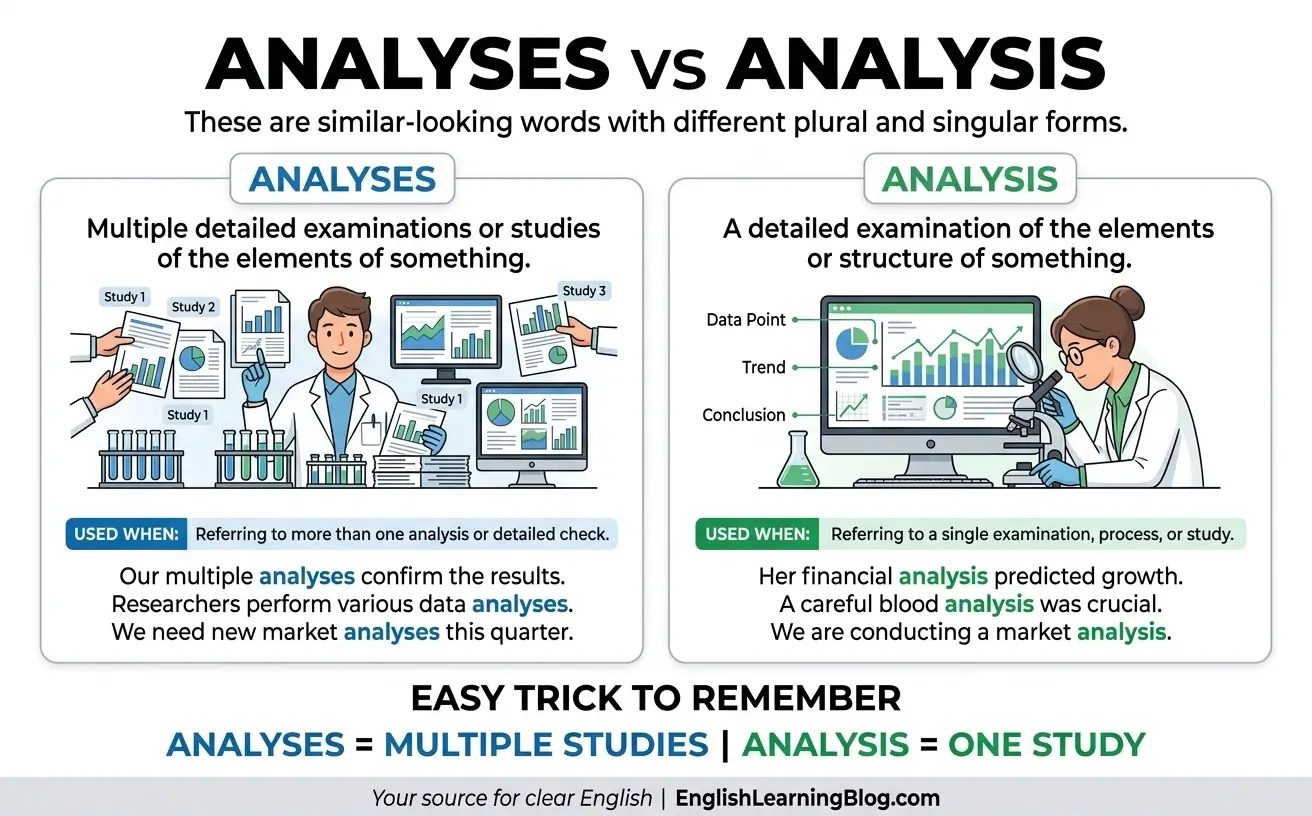
Analysis is the singular noun, while analyses is its plural form. For example, you can write, “The analysis is detailed,” when talking about one examination of information. If you mean several examinations, write, “The analyses are detailed.”
This spelling pair often causes confusion because analyses looks and sounds very different from the singular word analysis.
The change from -is to -es is common in some Greek-derived English words, but it does not follow the usual English plural rule of simply adding -s. People may also confuse the words because their pronunciations differ.
Understanding the difference is important in school, business, research, journalism, and professional writing. Using the correct form makes your writing clearer and more polished.
This guide explains analyses or analysis, their origins, spelling rules, common mistakes, examples, and when to use each word.
Analyses or Analysis Quick Answer
Analysis is singular. Analyses is plural.
- Analysis = one detailed examination or study.
- Analyses = two or more detailed examinations or studies.
Examples
- Correct: The analysis shows a clear trend.
- Correct: The analyses show several different trends.
- Incorrect: The analyses shows a clear trend.
- Incorrect: The analysis show several trends.
| Word | Meaning | Example |
|---|---|---|
| Analysis | One examination | The analysis was useful. |
| Analyses | More than one examination | The analyses were useful. |
A simple way to remember it is:
One = analysis
More than one = analyses
The Origin of Analyses or Analysis
The word analysis comes from Ancient Greek analysis, meaning “a breaking up” or “loosening.” It entered English through Latin and French and became associated with examining something by separating it into parts.
The plural form analyses also comes from Greek. This explains why its plural form does not follow the usual English pattern of adding -s.
Many English words borrowed from Greek retain older plural patterns. For example:
- analysis → analyses
- basis → bases
- crisis → crises
- thesis → theses
- diagnosis → diagnoses
The spelling changes because -is becomes -es in the plural.
This is why analyses is not simply analysis + s. The spelling reflects the word’s Greek origin and historical development in English.
British English vs American English Spelling
There is no major British-American spelling difference between analysis and analyses. Both forms are standard in British English and American English.
The main difference is not the country but the number being discussed.
| Meaning | British English | American English |
|---|---|---|
| One examination | analysis | analysis |
| More than one examination | analyses | analyses |
| One report | analysis | analysis |
| Several reports | analyses | analyses |
Examples in Both Varieties
British English:
The analysis of the results was completed.
American English:
The analysis of the results was completed.
British English:
Several analyses were included in the report.
American English:
Several analyses were included in the report.
The spelling remains the same.
Which Spelling Should You Use?
Choose the word based on whether you are discussing one or several examinations.
Use “analysis” for one
Use analysis when the noun is singular.
The analysis is accurate.
Our analysis found three main problems.
This analysis explains the results.
Use “analyses” for more than one
Use analyses when discussing multiple examinations.
The analyses were completed by different teams.
Several analyses support the conclusion.
The report contains three separate analyses.
For US, UK, and Commonwealth English
You can use analysis and analyses in all major forms of standard English. There is no need to change the spelling based on your audience’s location.
Common Mistakes with Analyses or Analysis
1. Using “analyses” for one thing
Incorrect:
The analyses is complete.
Correct:
The analysis is complete.
2. Using “analysis” for multiple things
Incorrect:
The analysis were published.
Correct:
The analyses were published.
3. Writing “analysises”
Incorrect:
The analysises were reviewed.
Correct:
The analyses were reviewed.
Analysises is not the standard plural form.
4. Confusing “analysis” with the verb “analyze”
Analysis is a noun.
The analysis was helpful.
Analyze is a verb in American English.
We will analyze the results.
In British English, the verb is usually spelled analyse.
We will analyse the results.
5. Using the wrong verb
Because analysis is singular, it normally takes a singular verb.
The analysis shows a problem.
Because analyses is plural, it takes a plural verb.
The analyses show several problems.
Analyses or Analysis in Everyday Examples
Knowing how these words work in real writing makes the difference easier to remember.
In an Email
Our analysis of the customer feedback is now complete.
For multiple studies:
The analyses of the customer data are attached.
In News Writing
A new analysis of the economy suggests slower growth.
For multiple reports:
Several analyses of the election results reached similar conclusions.
In Social Media
This analysis explains why the campaign worked.
For multiple examples:
I compared several analyses before forming an opinion.
In Academic Writing
The analysis examines the relationship between the two variables.
For multiple methods:
The researchers conducted three analyses of the data.
In Business Writing
Our analysis shows that sales increased in the second quarter.
The analyses from different departments produced similar results.
Analyses or Analysis Google Trends & Usage Data
Search interest for “analysis” is generally much higher than for “analyses.” This is expected because analysis is the singular form and is used frequently in everyday, academic, business, scientific, and news writing.
The plural analyses is more common in specialist contexts where writers discuss several studies, reports, datasets, or methods.
Searches for phrases such as “analysis meaning,” “analysis definition,” and “analysis vs analyses” are often driven by people learning English or checking grammar.
Usage can also vary by context:
- Academic writing: Both forms are common.
- Business: Analysis is especially common.
- News: Analysis is frequently used.
- Scientific research: Analyses becomes more common when multiple tests or datasets are discussed.
- Education: Both forms appear regularly.
Google Trends data can change over time, so exact popularity levels should be treated as current search-interest measurements rather than permanent language rules.
Analyses vs Analysis: Comparison Table
| Feature | Analysis | Analyses |
|---|---|---|
| Number | Singular | Plural |
| Meaning | One examination | More than one examination |
| Correct plural | No | Yes |
| Example | The analysis is complete. | The analyses are complete. |
| Verb used with it | is, shows | are, show |
| British English | Correct | Correct |
| American English | Correct | Correct |
| Common mistake | Using it for multiple studies | Using it for one study |
| Pronunciation | uh-NAL-uh-sis | uh-NAL-uh-seez |
FAQs About Analyses or Analysis
Is “analyses” the plural of “analysis”?
Yes. Analyses is the standard plural form of analysis.
Is “analysis” singular or plural?
Analysis is singular. It refers to one examination or study.
Is “analyses” singular?
No. Analyses is plural. It refers to two or more analyses.
Is “analysises” correct?
No. The standard plural is analyses, not analysises.
Which is correct: “the analysis is” or “the analysis are”?
Use “the analysis is.” Analysis is singular.
The analysis is complete.
Which is correct: “the analyses is” or “the analyses are”?
Use “the analyses are.” Analyses is plural.
The analyses are complete.
Is “analyses” British or American spelling?
It is correct in both British and American English. The difference is grammatical number, not regional spelling.
Conclusion
The difference between analyses or analysis is simple once you focus on number. Analysis is the singular form and refers to one detailed examination, study, or interpretation. Analyses is the plural form and refers to two or more examinations.
For example, write “The analysis is complete” when discussing one study. Write “The analyses are complete” when discussing several studies. Remember that analyses is not spelled analysises. Its unusual plural form comes from the Greek origin of the word.
There is also no British-versus-American spelling issue here. Both varieties of English use analysis for singular and analyses for plural. The most important thing is to match the noun with the correct verb: analysis is/shows, but analyses are/show.