
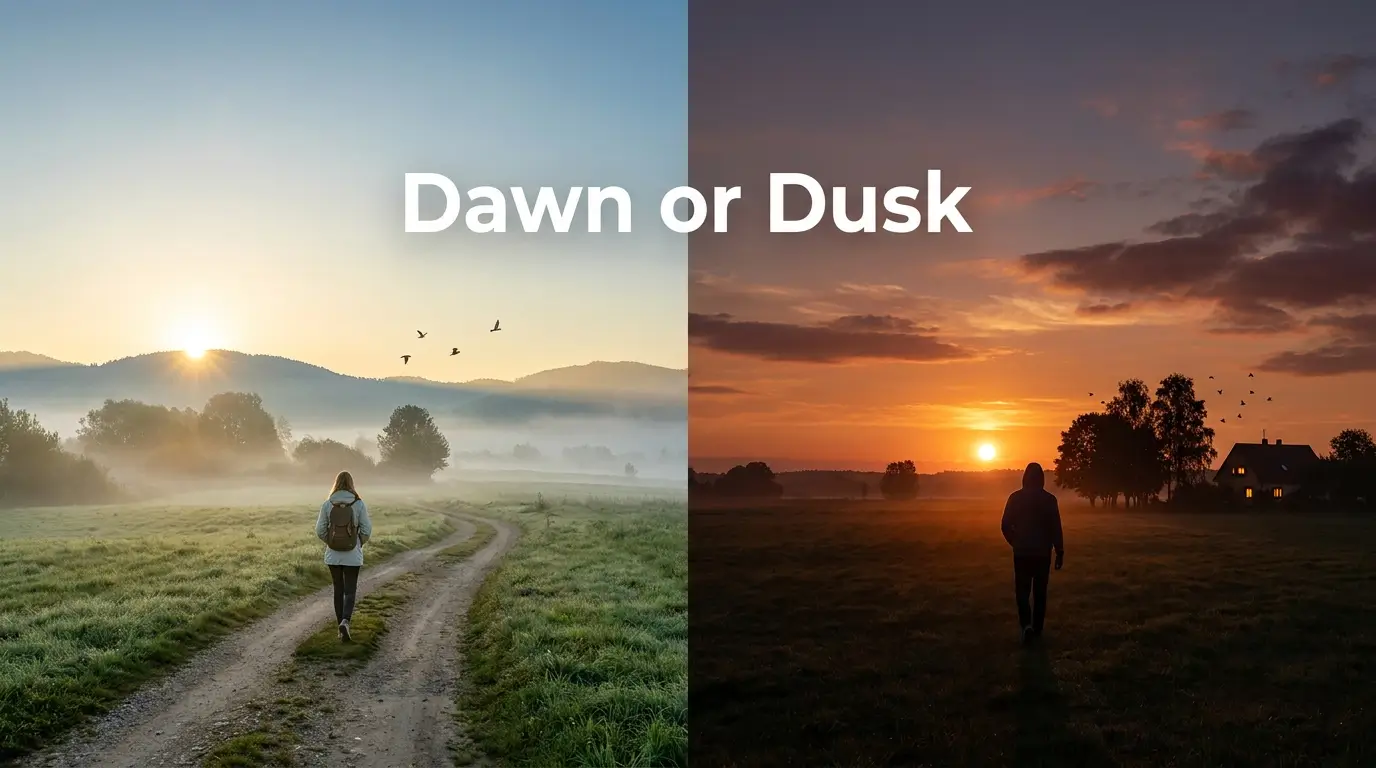
Dawn or Dusk: What’s the Real Difference and Which One Do You Mean?
Dawn or Dusk? Dawn is the early morning light before or around sunrise, while dusk is the fading light after sunset. So, sunrise = dawn; sunset = dusk.
You’re writing an email. You want to say “reach out any time, dawn or dusk.” Then you stop. Wait, does dawn mean morning or evening? And is dusk the same thing, just backward?
You’re not alone. Thousands of people search “dawn or dusk” every month because these two words get mixed up all the time.
They sound like they could mean the same thing. They don’t. One happens when the sun comes up.
The other happens when it goes down. Simple, right? Except most people can’t remember which is which under pressure, especially in writing where getting it wrong looks sloppy.
This mix-up shows up everywhere. Poems. Photography captions. Weather reports. Text messages. Even news headlines get it wrong sometimes.
This article gives you the fast answer first. Then it breaks down where these words came from, how spelling and usage shift between British and American English, and the mistakes people make most often. By the end, you’ll never second-guess yourself again.
Dawn or Dusk Quick Answer
Here’s the short version.
Dawn means the first light of day. It’s when the sky starts to brighten before the sun actually rises.
Dusk means the last light of day. It’s the dim period right after the sun sets, before full darkness.
Think of it this way: dawn opens the day, dusk closes it.
Example sentences:
- “We left for the hike at dawn, right as the sky turned pink.”
- “The fireflies came out at dusk, just as the light faded.”
Both words describe twilight, but they sit on opposite ends of the day. Dawn is morning twilight. Dusk is evening twilight.
The Origin of Dawn or Dusk
Both words have deep roots in Old English, and that history explains why they still feel a bit poetic today.
Dawn comes from the Old English word dagian, which meant “to become day.” Over centuries, it shifted through Middle English forms like dawen before settling into the word we use now. It’s tied to the idea of light breaking through darkness, which is why writers love using it as a symbol for new beginnings.
Dusk traces back to the Old English dox, meaning dark-colored or dim. It’s related to words describing shadowy, faded light rather than a sudden event. That’s part of why dusk feels softer and quieter in tone compared to dawn.
Neither word has major spelling variants the way some words do (like “colour” vs “color”). The spelling is the same in both British and American English. What differs is how each culture uses and interprets the words in daily speech, which we’ll cover next.
British English vs American English Spelling
Good news here: dawn and dusk are spelled the same in both British and American English. No extra letters, no swapped endings, nothing like “grey” versus “gray.”
But usage differs slightly. British English tends to use “dawn” and “dusk” more often in everyday casual speech, including weather reports and travel notices. American English leans more toward “sunrise” and “sunset” in casual talk, saving “dawn” and “dusk” for more literary or formal writing.
| Feature | British English | American English |
|---|---|---|
| Spelling of “dawn” | dawn | dawn |
| Spelling of “dusk” | dusk | dusk |
| Common casual term for morning light | dawn | sunrise |
| Common casual term for evening light | dusk | sunset |
| Typical use in weather reports | Frequent | Less frequent |
| Typical use in literature/poetry | Frequent | Frequent |
So if you’re writing for a British audience, dawn and dusk will sound natural in everyday content. For an American audience, you might get more clicks and feel more natural using “sunrise” and “sunset” in casual pieces, while saving dawn and dusk for more descriptive or emotional writing.
Which Spelling Should You Use?
Since spelling isn’t the issue here, this section is really about which word fits your audience and your tone.
If you’re writing for a US audience: Use “sunrise” and “sunset” for casual, everyday content like blog posts, product descriptions, or social captions. Save “dawn” and “dusk” for travel writing, poetry, or anything that needs a more reflective tone.
If you’re writing for a UK or Commonwealth audience: Dawn and dusk work fine in regular writing, including news articles and everyday descriptions. They don’t feel overly formal the way they sometimes do in American English.
If you’re writing for a global audience: Stick with dawn and dusk. They’re understood everywhere, they don’t carry regional baggage, and they sound professional without being stiff.
If you’re writing something emotional or descriptive (a memoir, a photography caption, a travel blog): Dawn and dusk almost always beat sunrise and sunset. They carry more weight and a bit more mood.
Common Mistakes with Dawn or Dusk
Here are the errors people make most often, and how to fix them.
Mistake 1: Using them interchangeably. Wrong: “I love dawn walks in the evening.” Right: “I love dusk walks in the evening.” Dawn is morning only.
Mistake 2: Confusing dusk with midnight or “late at night.” Dusk is the period right after sunset, not several hours later. If it’s pitch dark and stars are fully out, that’s night, not dusk.
Mistake 3: Assuming “twilight” only means evening. Twilight actually applies to both dawn and dusk. It’s the general term for that soft, in-between light. Many people wrongly think twilight only means evening because of pop culture.
Mistake 4: Writing “at the crack of dusk.” This is a common phrase mix-up. The correct expression is “at the crack of dawn,” meaning very early morning. There’s no equivalent “crack of dusk” phrase.
Mistake 5: Overusing dawn/dusk in casual writing where sunrise/sunset would read more naturally, especially for American readers.
Dawn or Dusk in Everyday Examples
In emails: “Let’s catch up before dawn, I have an early flight.” “I’ll send the report by dusk today.”
In news headlines: “Storms Expected at Dawn, Clearing by Noon” “Curfew Begins at Dusk in Downtown Area”
In social media captions: “Golden hour hits different at dusk 🌅” “5am dawn run, worth it for this view”
In formal writing: “The ceremony will commence at dawn, weather permitting.” “Visitors must vacate the park grounds by dusk.”
Notice how dawn and dusk show up more in writing meant to sound intentional or scenic, while casual daily language often reaches for sunrise and sunset instead.
Also Read: Dual or Duel: Which One Do You Actually Mean?
Dawn or Dusk Google Trends & Usage Data
Search interest in “dawn or dusk” tends to spike around specific moments: photography discussions, travel planning, poetry assignments, and questions about wildlife behavior (since many animals are described as “dawn” or “dusk” active).
By country, search behavior varies. UK, Australian, and Indian English speakers search these terms more casually, often just to confirm meaning in daily contexts. US search traffic for “dawn or dusk” leans more toward writing help, homework questions, and vocabulary clarification, which lines up with the more literary use of these words in American English.
Context also matters. In wildlife and nature content, “dawn” and “dusk” show up constantly to describe animal activity patterns (crepuscular animals are active at both). In business or scheduling content, people usually default to “morning” and “evening” instead, since those terms are clearer for logistics.
Comparison Table: Keyword Variations Side by Side
| Term | Meaning | Common Region | Typical Use |
|---|---|---|---|
| Dawn | First light of morning | Global, more common in UK | Literary, descriptive, formal |
| Dusk | Last light of evening | Global, more common in UK | Literary, descriptive, formal |
| Sunrise | Sun appears above horizon | More common in US | Casual, everyday |
| Sunset | Sun disappears below horizon | More common in US | Casual, everyday |
| Twilight | General term for dawn or dusk light | Global | Descriptive, scientific |
| Daybreak | Synonym for dawn | Global | Literary |
| Nightfall | Synonym for dusk | Global | Literary |
FAQs
Is dawn morning or night?
Dawn is morning. It’s the very first light in the sky before sunrise, marking the start of the day.
Is dusk before or after sunset?
Dusk comes right after sunset. It’s the dim light that lingers once the sun has dropped below the horizon, before full darkness sets in.
What is the difference between dawn and daybreak?
They mean almost the same thing. Daybreak is often used as a direct synonym for dawn, both describing the first light of morning.
Can dusk mean nighttime?
Not exactly. Dusk is a transition period, not full night. Once it’s completely dark, that’s night, not dusk.
Why do British and American English use these words differently?
It comes down to style, not grammar rules. British English keeps dawn and dusk in everyday use, while American English often swaps them for sunrise and sunset in casual writing.
What animals are active at dawn or dusk?
Animals active during these times are called crepuscular. Deer, rabbits, and many cat species are common examples, since low light gives them an advantage for hunting or grazing.
Is it correct to say “dawn or dusk” together in one sentence?
Yes. It’s a common phrase used to describe either end of the day, often in contexts like lighting conditions, animal activity, or travel timing.
Conclusion
Dawn and dusk aren’t interchangeable, even though they sound like they could be. Dawn opens the day with the first light of morning. Dusk closes it with the last light of evening.
The spelling never changes between British and American English, but how often people use these words does.
British writing keeps them in casual use, while American writing tends to save them for more descriptive or formal moments, leaning on sunrise and sunset for everyday talk.
If you’re writing for a global audience, dawn and dusk are safe, clear, and universally understood.
If you’re writing for American readers in a casual tone, sunrise and sunset might land better. And if you want your writing to feel more vivid or emotional, dawn and dusk almost always win.
Next time you catch yourself pausing over which word to use, remember the simple rule: dawn is the start, dusk is the end. Get that order right, and you’ll never trip over these two words again.