
Fibre or Fiber: Which Spelling Is Correct?
Have you ever typed “fibre or fiber” and wondered which spelling is right? You are not alone. Both forms are correct, but the choice depends mainly on the type of English you use.
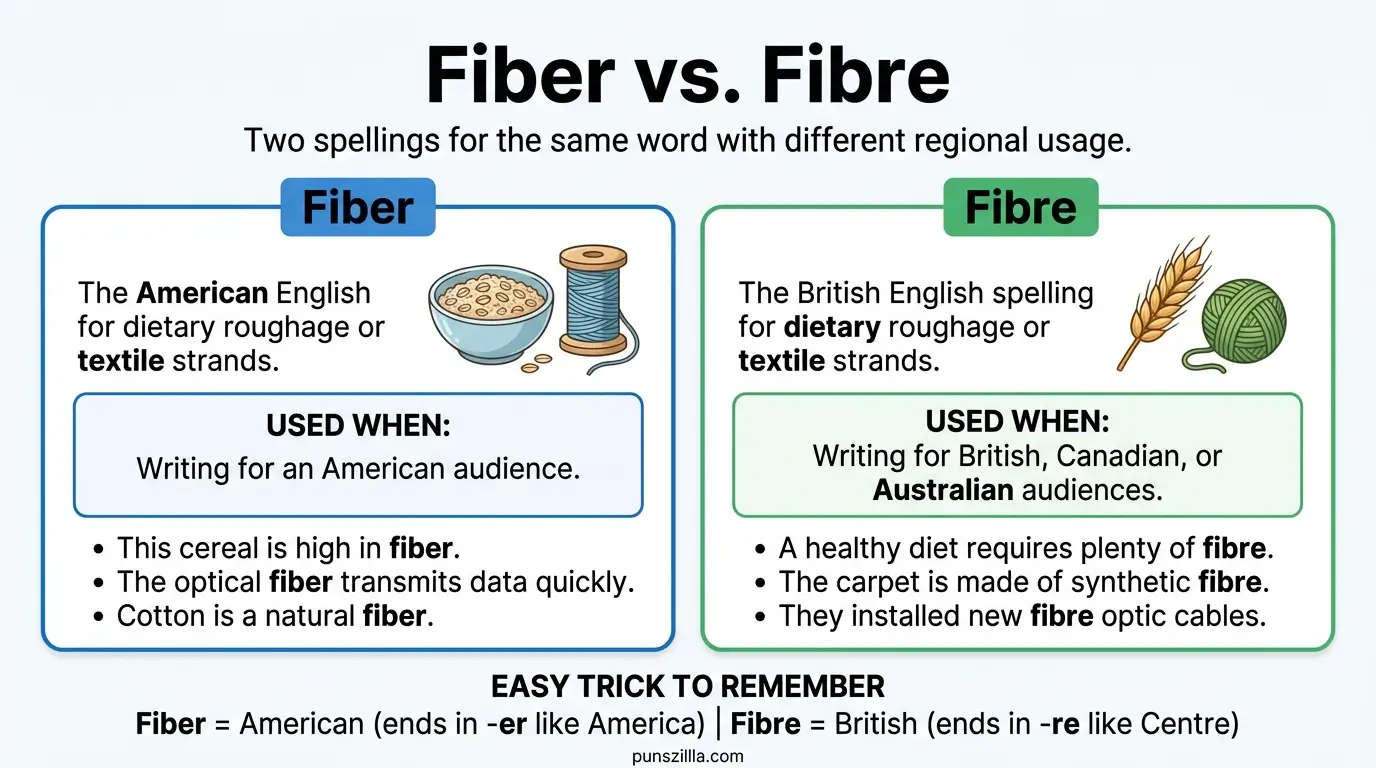
Fibre is the standard spelling in British English. Fiber is the standard spelling in American English. The two words have the same meaning and pronunciation in most contexts.
They can describe a thin strand in plants or materials, body tissue, or the part of plant foods that helps digestion.People search for “fibre or fiber” because English spelling changes across countries.
This can cause problems when writing emails, websites, school papers, reports, product descriptions, or social media posts. A writer may know the word but still wonder which spelling looks professional.
This guide gives you the quick answer first. It then explains the history behind the two spellings, compares British and American usage, and shows when to use each form.
You will also find examples, usage data, common mistakes, and FAQs.
By the end, choosing between fibre and fiber will be simple.
Fibre or Fiber Quick Answer
Fibre and fiber are two spellings of the same word.
- Fibre = British English
- Fiber = American English
Examples:
- British English: This cereal is high in fibre.
- American English: This cereal is high in fiber.
- British English: The shirt is made from natural fibre.
- American English: The shirt is made from natural fiber.
Neither spelling is wrong. The best choice depends on your audience and the English style you are following.
Other common examples of the same spelling pattern include:
| British English | American English |
| fibre | fiber |
| centre | center |
| metre | meter |
| theatre | theater |
| litre | liter |
| calibre | caliber |
The key rule is simple: use fibre for British English and fiber for American English.
The Origin of Fibre or Fiber
The word has a long history. Fiber and fibre come from the same linguistic root.
The English word came through French from the Latin fibra, meaning a filament or thread. Early English uses referred to parts of the body. Later, the word was used for plant material, textiles, and other thread-like structures.
The spelling fibre became associated with British English. In American English, fiber became the preferred form.
This change is part of a larger pattern in English spelling. American spelling often changed certain words ending in -re to -er. Noah Webster played an important role in promoting simplified and distinct American spellings in dictionaries and spelling books.
This is why British English uses forms such as centre, theatre, litre, and fibre, while American English usually uses center, theater, liter, and fiber.
The meaning did not change. Only the spelling became different.
Modern dictionaries still recognize both forms. Cambridge lists fiber as the US spelling of fibre, while Merriam-Webster describes fibre as chiefly a British spelling of fiber.
British English vs American English Spelling
The main difference is the ending.
British English often keeps -re in words of this type. American English generally uses -er.
| Meaning | British English | American English |
| Thread-like material | fibre | fiber |
| Place in a city | centre | center |
| Measurement | metre | meter |
| Performing arts building | theatre | theater |
| Volume measurement | litre | liter |
| Quality or standard | calibre | caliber |
Fibre in British English
British English examples include:
- The food contains a lot of dietary fibre.
- Natural fibre is often used in clothing.
- The doctor examined the nerve fibres.
- Optical fibre provides fast internet connections.
Fiber in American English
American English examples include:
- The food contains a lot of dietary fiber.
- Natural fiber is often used in clothing.
- The doctor examined the nerve fibers.
- Fiber optics provide fast internet connections.
The same spelling rule normally continues into plural forms:
- British: fibre → fibres
- American: fiber → fibers
The important point is consistency. Do not switch between styles without a reason.
Which Spelling Should You Use?
Your audience should decide the spelling.
If you write for the United States
Use fiber.
For example:
This product is a good source of dietary fiber.
This is the natural choice for US websites, American newspapers, schools, businesses, and customers.
If you write for the UK
Use fibre.
For example:
This product is a good source of dietary fibre.
This follows standard British English.
If you write for Commonwealth audiences
In countries such as the UK, Australia, and New Zealand, fibre is widely used. However, English usage can vary by country, industry, and publication.
India is a good example. Both forms appear in English writing, so the style guide or target audience should guide your choice.
If you write for a global audience
Choose one spelling system and use it consistently.
If your website targets international readers, fiber may appear more familiar to US readers, while fibre may be expected by UK and many Commonwealth readers.
For SEO, you can naturally mention both forms when the topic is specifically about spelling.
For example:
Is it fibre or fiber? Both spellings are correct. Fibre is standard in British English, while fiber is standard in American English.
This helps readers without making the writing feel unnatural.
Common Mistakes with Fibre or Fiber
Mistake 1: Thinking one spelling is wrong
Incorrect idea:
Fibre is wrong because the dictionary says fiber.
Correction:
Both spellings are correct. They belong to different English varieties.
Mistake 2: Mixing spelling styles
For example:
The centre sells high-fiber products.
This is not always wrong, but it mixes British centre with American fiber.
A consistent British version would be:
The centre sells high-fibre products.
A consistent American version would be:
The center sells high-fiber products.
Mistake 3: Using “fibres” in US writing
American English normally uses:
muscle fibers
British English normally uses:
muscle fibres
Mistake 4: Assuming the pronunciation changes
The spelling changes, but the word is pronounced essentially the same in the two major varieties.
Mistake 5: Changing the spelling inside a quotation
If you quote a British source in an American article, or an American source in a British article, keep the original spelling when accuracy matters.
Fibre or Fiber in Everyday Examples
The word appears in many types of writing.
In emails
British English:
Please check the fibre content before sending the report.
American English:
Please check the fiber content before sending the report.
In news articles
British-style news:
The new report examines the benefits of a high-fibre diet.
American-style news:
The new report examines the benefits of a high-fiber diet.
On social media
British:
Getting more fibre into your diet can be easier than you think.
American:
Getting more fiber into your diet can be easier than you think.
In formal writing
British:
The study examined the effect of dietary fibre on health.
American:
The study examined the effect of dietary fiber on health.
In technology
British:
Fibre broadband is available in many areas.
American:
Fiber internet is available in many areas.
This is an important example because technology companies may use different terms based on their market.
Fibre or Fiber Comparison Table
| Feature | Fibre | Fiber |
| Main English variety | British English | American English |
| Meaning | Same | Same |
| Pronunciation | Essentially the same | Essentially the same |
| Plural | fibres | fibers |
| Common food term | dietary fibre | dietary fiber |
| Common technology term | fibre optic / optical fibre | fiber optic / optical fiber |
| Common material term | natural fibre | natural fiber |
| Main audience | UK and many Commonwealth users | US users |
| Correct spelling? | Yes | Yes |
Fibre or Fiber Google Trends & Usage Data
Search interest reflects the same regional split seen in dictionaries and everyday writing.
Google Trends is useful for comparing relative search interest, but it does not provide a universal count of all words written or all searches made. Results can also change over time and depend on the country, search period, and search category.
The broad pattern is clear:
- Fiber is strongly associated with the United States.
- Fibre is strongly associated with the United Kingdom and other markets that commonly use British English.
- Both forms appear in countries with mixed or changing English conventions.
- Context matters. Searches about food, health, textiles, and internet services may show different patterns.
Country-level usage data also supports this regional difference. One recent usage comparison reports fiber as dominant in the US, while fibre is dominant in the UK, Australia, Ireland, and New Zealand.
It also shows more mixed usage in countries such as India and Canada.
Dictionary evidence points in the same direction. Cambridge labels fiber as the US spelling and fibre as the UK spelling. Collins likewise identifies fiber as the usual US spelling and fibre as the British form.
For SEO, this means you should consider your target market. A US health website will usually benefit from fiber, while a UK health website will normally use fibre.
Fibre vs Fiber: Variations Side by Side
| Phrase | British English | American English |
| Dietary fibre/fiber | dietary fibre | dietary fiber |
| High-fibre/fiber food | high-fibre food | high-fiber food |
| Natural fibre/fiber | natural fibre | natural fiber |
| Fibre/fiber content | fibre content | fiber content |
| Fibre/fiber optic | fibre optic | fiber optic |
| Optical fibre/fiber | optical fibre | optical fiber |
| Muscle fibre/fiber | muscle fibre | muscle fiber |
| Nerve fibre/fiber | nerve fibre | nerve fiber |
| Glass fibre/fiber | glass fibre | glass fiber |
| Carbon fibre/fiber | carbon fibre | carbon fiber |
FAQs About Fibre or Fiber
Is fibre or fiber correct?
Both are correct. Fibre is the standard British English spelling, while fiber is the standard American English spelling.
Is fibre British or American?
Fibre is mainly the British English spelling. It is also common in several countries that use British-based English.
Is fiber British or American?
Fiber is the standard American English spelling. It is also used in other countries, depending on local usage and context.
Do fibre and fiber mean the same thing?
Yes. They have the same basic meanings. The difference is spelling, not meaning.
Which spelling should I use for a US audience?
Use fiber. For example: This food is high in fiber.
Which spelling should I use for a UK audience?
Use fibre. For example: This food is high in fibre.
Is “fibre” wrong in American English?
No. It can be understood, but fiber is the normal American spelling. Using fiber is better when writing for a US audience.
Does the pronunciation change?
Usually, no. The spelling differs, but the pronunciation is essentially the same.
Conclusion
So, fibre or fiber? The answer is simple: both spellings are correct.
Use fibre when following British English. Use fiber when following American English. The difference comes from the wider spelling differences between British and American English, especially words ending in -re and -er.
The word itself has a long history. It comes from Latin fibra through French and entered English centuries ago.
Over time, British and American English developed different spelling preferences. The meaning stayed the same.
For professional writing, audience matters most. A US business should normally write fiber, while a UK business should write fibre.
If you write for an international audience, choose a clear English style and stay consistent.
For SEO, you can mention both forms when discussing the spelling difference. This helps readers who search for either term while keeping the main spelling suited to your target market.
The easiest rule to remember is:
British English = fibre. American English = fiber.
Once you know your audience, the choice is easy.