
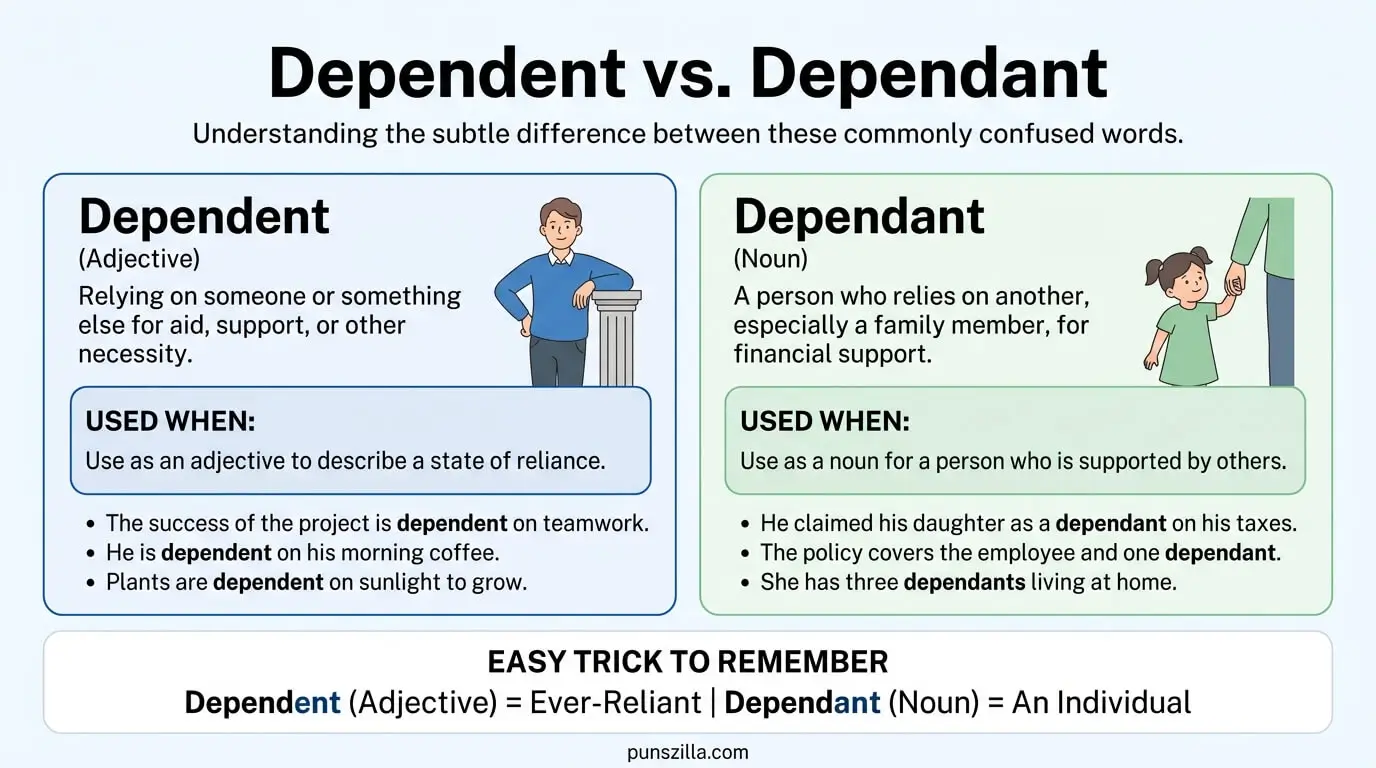
Dependant or Dependent? The Simple Guide to the Correct Spelling
Is it dependant or dependent? This small spelling difference causes a surprising amount of confusion. Both forms are correct, but they are not used in exactly the same way everywhere.
People often search for “dependant or dependent” when writing a CV, job application, visa form, tax document, school paper, or business email.
The problem is simple: British English and American English use different spelling patterns for this word.
In British English, dependant is usually the noun for a person who relies on someone else for support. In American English, dependent is normally used as both a noun and an adjective.
The word dependent is also an adjective in both varieties of English. For example, we can say, “Children are dependent on their parents.”
This guide gives you the quick answer first. It then explains the history behind both spellings, shows the difference between British and American usage, and gives practical examples.
By the end, you will know which spelling to choose and when.
Dependant or Dependent Quick Answer
Both dependant and dependent are correct spellings.
The main difference is British vs American English:
- Dependant: mainly a British English noun meaning a person who relies on another person.
- Dependent: the standard spelling in American English for both the noun and adjective.
- Dependent: also used as an adjective in British English.
Examples
British English:
She has two dependants.
American English:
She has two dependents.
Adjective in both varieties:
The child is dependent on her parents.
A simple rule is:
| Word | British English | American English |
| Person who relies on another | dependant | dependent |
| Relying on someone | dependent | dependent |
| Depending on something | dependent | dependent |
So, if you are writing for a US audience, dependent is the safest choice. If you are writing for a UK audience and mean a person supported by someone else, dependant is usually preferred.
The Origin of Dependant or Dependent
Both words come from the same root.
The English word developed from the Latin dependere, meaning “to hang from” or “to rely on.” It entered English through French and developed into words connected with relying on someone or something.
The spelling dependent has long been used in English. It reflects the Latin and French forms and remains common today.
The spelling dependant developed as a noun form in British English. English has many pairs where spelling helps distinguish a noun from an adjective.
For example:
- dependent — adjective
- dependant — noun
This distinction became useful in British usage. However, American English did not keep the same noun spelling distinction. It generally uses dependent for both roles.
That is why you may see:
The child is dependent on her parents.
and:
She has three dependants.
The first sentence uses dependent as an adjective. The second uses dependants as a British English noun.
The spelling difference is therefore not caused by a different meaning or different origin. It is mainly a difference in English usage and spelling conventions.
British English vs American English Spelling
The clearest difference is the noun.
In British English, dependant is commonly used for a person who depends on someone else financially or socially.
In American English, dependent is used for this meaning.
Comparison
| Meaning or use | British English | American English |
| A person supported by another | dependant | dependent |
| More than one supported person | dependants | dependents |
| Relying on someone | dependent | dependent |
| Relying on something | dependent | dependent |
| Family member supported financially | dependant | dependent |
Examples
UK:
You must list all your dependants on the form.
US:
You must list all your dependents on the form.
Both:
Young children are dependent on their parents.
This difference is similar to other British and American spelling differences.
However, it is important not to assume that every word ending in -ant in British English changes to -ent in American English. The spelling of dependant is a specific usage difference.
Which Spelling Should You Use?
Choose the spelling based on your audience.
Writing for a US audience
Use dependent.
This is the normal American spelling for both the noun and adjective.
For example:
Please provide the names of your dependents.
Use this form for American applications, websites, reports, and professional documents.
Writing for a UK audience
Use dependant when the word is a noun referring to a person.
For example:
The employee has one dependant.
Use dependent when the word is an adjective.
For example:
The employee has a dependent child.
Writing for Commonwealth audiences
Many Commonwealth varieties of English follow British usage, so dependant may be preferred as a noun. This can include contexts in countries such as Australia and New Zealand.
However, official style guides and institutions may have their own preferences. If you are completing an official form, follow the spelling used by that organisation.
Writing for a global audience
If you need one form that will be widely understood, dependent is often the easiest choice. It is also the dominant spelling in American English and is standard as an adjective in all major varieties.
For professional writing, consistency matters most. Pick the style required by your audience and use it throughout the document.
Common Mistakes with Dependant or Dependent
Mistake 1: Treating the words as completely different words
They are not completely different words. They share the same meaning when they refer to a person who relies on someone else.
Incorrect assumption:
Dependant and dependent have completely different meanings.
Better:
The noun spelling varies by English variety.
Mistake 2: Using dependant as an adjective
In standard modern English, dependent is the normal adjective.
Incorrect:
The child is dependant on her mother.
Correct:
The child is dependent on her mother.
Mistake 3: Mixing UK and US spelling
Avoid switching between styles in the same document.
For example:
The employee has two dependants. The form asks for the number of dependents.
This may look inconsistent if both sentences refer to the same type of person.
Choose one style and keep it consistent.
Mistake 4: Confusing dependent on with dependant
These forms have different grammatical jobs.
Dependent on describes reliance:
Success is dependent on good planning.
Dependant can name a person:
His wife is his dependant.
Mistake 5: Forgetting the plural
The plural forms are:
- dependant → dependants
- dependent → dependents
Examples:
She supports two dependants.
He claims two dependents.
Dependant or Dependent in Everyday Examples
The spelling can change depending on the country and type of writing.
In an email
British English:
Please confirm whether you have any dependants.
American English:
Please confirm whether you have any dependents.
In a news article
A British news article might say:
The policy could affect workers and their dependants.
An American article might say:
The policy could affect workers and their dependents.
On social media
People may write:
I added my dependants to my insurance plan.
or:
I added my dependents to my insurance plan.
Both are understandable. The preferred version depends on the writer’s English variety.
In formal writing
Formal British English:
The applicant must provide details of all dependants.
Formal American English:
The applicant must provide details of all dependents.
As an adjective
The spelling remains dependent:
The result is dependent on several factors.
Children may be financially dependent on their parents.
Dependant or Dependent Google Trends & Usage Data
Search interest for “dependant or dependent” comes largely from people trying to solve a spelling or grammar question.
This makes sense because the two forms look almost identical and both appear in real English.Search patterns can also vary by country.
British English users are more likely to encounter dependant in official documents, employment forms, benefits information, and other formal contexts. American users usually see dependent in the same situations.
Google Trends can help show these regional patterns, but search interest changes over time.
It should therefore be treated as a measure of search behavior, not as a complete measure of how often each spelling appears in written English.
For a practical decision, regional language standards are more useful than raw search volume:
- United States: dependent
- United Kingdom: dependant as a noun; dependent as an adjective
- Australia and New Zealand: often dependant as a noun
- International business writing: follow the target audience or house style
The context also matters. Searches may increase around tax deadlines, immigration applications, insurance forms, employment benefits, and other situations where people must list family members or other supported people.
Dependant vs Dependent Comparison Table
| Feature | Dependant | Dependent |
| Main use | British English noun | US noun and adjective |
| Refers to a person | Yes | Yes |
| Used as an adjective | Usually no | Yes |
| British English | Common noun form | Common adjective form |
| American English | Rare | Standard |
| Plural | dependants | dependents |
| Example | She has two dependants. | She has two dependents. |
| Adjective example | — | He is dependent on his parents. |
FAQs About Dependant or Dependent
Is dependant or dependent correct?
Both are correct. Dependant is mainly used as a noun in British English. Dependent is the standard noun spelling in American English and is also the adjective in both varieties.
Is dependant British English?
Yes. In British English, dependant is commonly used as a noun for a person who relies on someone else for support.
Is dependent American English?
Yes. Dependent is the standard American spelling for both the noun and adjective.
Is a child a dependant or dependent?
It depends on the English variety and grammatical use. In British English, a child can be a dependant when used as a noun. In American English, the noun is dependent.
Example:
She has two dependants. — UK
She has two dependents. — US
Should I write “financial dependant” or “financial dependent”?
For British English, financial dependant can be used when dependant is a noun.
For American English, use financial dependent.
However, financially dependent is often clearer when you are describing a person’s situation:
She is financially dependent on her parents.
Is “dependent on” correct?
Yes. Dependent on is the standard adjective phrase.
Example:
The company is dependent on foreign suppliers.
Which spelling is best for SEO?
Use the spelling that matches your target audience. If your page targets international or US readers, dependent has broad recognition. If you target British readers, include dependant where appropriate.
For SEO, it is also useful to mention both forms naturally, especially when the page answers a spelling question such as “dependant or dependent.”
Conclusion
So, is it dependant or dependent? The answer depends mainly on where and how you use the word.
In British English, dependant is commonly used as a noun for a person who relies on someone else. For example, “She has two dependants.” The adjective remains dependent, as in “The child is dependent on her parents.”
In American English, dependent is used for both the noun and adjective. For example, “She has two dependents” and “The child is dependent on her parents.”
The two forms come from the same word family and have the same basic idea of reliance. The spelling difference developed through different English usage traditions.
For professional writing, always consider your audience. Use dependent for US English, dependant as a noun in UK English, and follow the style of any official form or organisation.
Most importantly, do not confuse dependant with the adjective dependent. Once you know this simple rule, choosing the correct spelling becomes easy.