Ate or Eaten: What’s the Difference and When Should You Use Each?
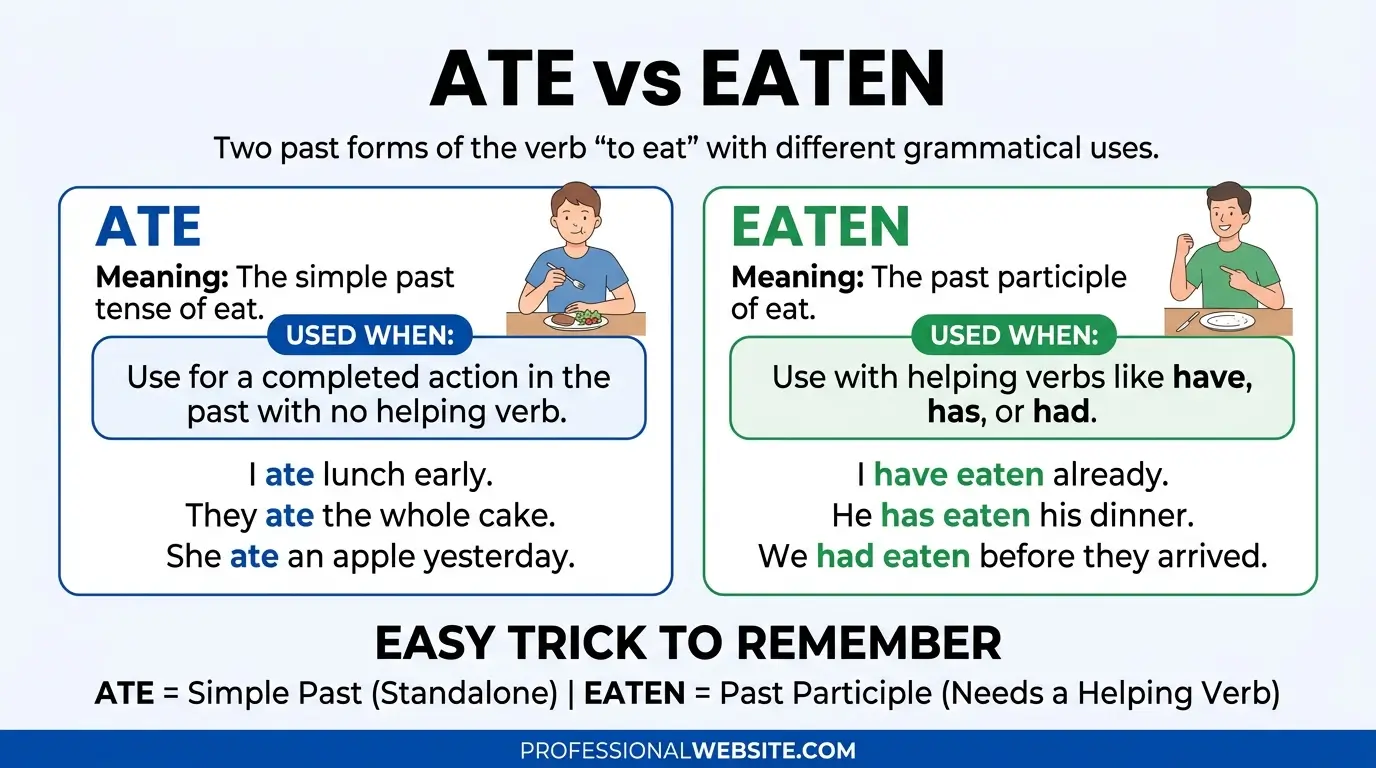
Ate is the simple past tense of eat, while eaten is the past participle used with have, has, or had. Example: I ate lunch vs. I have eaten lunch.
Should you say “I ate” or “I have eaten”? Many English learners and writers search for “ate or eaten” because both words come from the verb eat, but they are not used in the same way.
The simple answer is this: ate is the simple past tense, while eaten is the past participle. You can say, “I ate breakfast at 8 a.m.” But you would say, “I have eaten breakfast already.”
This small difference can cause big grammar mistakes. Using eaten alone in a simple past sentence sounds wrong. Using ate after have, has, or had is also incorrect.
The good news is that the rule is easy to learn. Once you understand the difference between the simple past and the past participle, you can use both words with confidence. This guide explains ate or eaten with simple rules, clear examples, common mistakes, everyday uses, and professional advice.
Ate or Eaten Quick Answer
Both ate and eaten are correct forms of the verb eat. The difference is how you use them.
- Ate = simple past tense
- Eaten = past participle
Examples
Correct:
- I ate pizza last night.
- She ate lunch at noon.
- I have eaten already.
- They had eaten before we arrived.
A simple rule to remember is:
Use ate for a finished action in the past. Use eaten with have, has, or had.
Quick Comparison
| Base Verb | Simple Past | Past Participle |
|---|---|---|
| Eat | Ate | Eaten |
The Origin of Ate or Eaten
The words ate and eaten both come from the old English verb eat. English has used different forms of this verb for a very long time.
Like many old English verbs, eat is an irregular verb. This means it does not form the past tense by simply adding -ed.
For example:
- Walk → walked → walked
- Play → played → played
But:
- Eat → ate → eaten
The verb changed forms over time, and these forms remained part of modern English.
There is no spelling difference between British and American English here. Both varieties use the same three main forms:
eat → ate → eaten
The confusion comes from grammar, not spelling.
British English vs American English Spelling
Unlike words such as colour/color or travelling/traveling, ate and eaten are spelled the same in British and American English.
The grammar rules are also the same.
| Form | British English | American English | Example |
|---|---|---|---|
| Base form | eat | eat | I eat breakfast. |
| Simple past | ate | ate | I ate breakfast. |
| Past participle | eaten | eaten | I have eaten breakfast. |
One Small Usage Difference
British and American English may sometimes prefer different verb tenses in conversation.
For example:
British English:
- Have you eaten yet?
American English:
- Did you eat yet?
Both are common and understandable. However, eaten is still the past participle, while ate remains the simple past form.
Which Spelling Should You Use?
Since ate and eaten are not spelling variations, your choice depends on grammar.
For US English
Use ate for the simple past.
- I ate dinner.
Use eaten with have, has, or had.
- I have eaten dinner.
For UK and Commonwealth English
Use the same grammar rules.
- She ate early.
- She has eaten already.
For a Global Audience
Follow the grammar rule, not the location.
If you are writing for an international audience, use:
- ate for the simple past
- eaten as the past participle
This rule works in professional, academic, and everyday English.
Common Mistakes with Ate or Eaten
Here are some common errors and their corrections.
Mistake 1: Using Eaten Alone
Incorrect: I eaten breakfast.
Correct: I ate breakfast.
Correct: I have eaten breakfast.
Why?
Eaten usually needs a helping verb such as have, has, or had.
Mistake 2: Using Ate After Have
Incorrect: I have ate dinner.
Correct: I have eaten dinner.
After have or has, use the past participle.
Mistake 3: Using Ate After Had
Incorrect: They had ate before the meeting.
Correct: They had eaten before the meeting.
After had, use eaten.
Mistake 4: Confusing the Time of the Action
Correct: I ate at 7 p.m.
This talks about a finished time in the past.
Correct: I have eaten.
This tells us the action is complete, often with a connection to the present.
Ate or Eaten in Everyday Examples
In Emails
- I ate before the meeting.
- I have eaten, so I am ready to start.
In News Writing
- The family ate dinner together before the event.
- Officials said the guests had eaten before leaving.
On Social Media
- I just ate the best burger ever!
- Finally, I have eaten after a long day.
In Formal Writing
- The participants ate lunch during the scheduled break.
- All guests had eaten before the presentation began.
At Work
- I ate before joining the call.
- I have already eaten, thank you.
Ate or Eaten Google Trends & Usage Data
Search interest in “ate or eaten” often comes from people trying to solve a grammar problem. Many users want to know which form is correct in a sentence.
The two words also appear in different contexts.
Ate is common when people talk about a specific past event:
- What did you eat?
- I ate pasta.
- She ate earlier.
Eaten is common in grammar questions and perfect tenses:
- Have you eaten?
- I have eaten.
- He had eaten before work.
Search patterns may vary by country because English learners often search for verb forms, while native speakers may search for complete phrases or grammar checks.
The key point is that ate and eaten are not competing spellings. They are different grammatical forms of the same verb.
Ate vs Eaten: Side-by-Side Comparison
| Feature | Ate | Eaten |
|---|---|---|
| Verb form | Simple past | Past participle |
| Used alone? | Yes | Usually no |
| Used with have/has? | No | Yes |
| Used with had? | No | Yes |
| Example | I ate lunch. | I have eaten lunch. |
| Example with past perfect | Incorrect: I had ate. | Correct: I had eaten. |
| British spelling | Ate | Eaten |
| American spelling | Ate | Eaten |
When to Use Ate
Use ate when the action happened and finished in the past.
Examples
- I ate breakfast this morning.
- She ate an apple.
- We ate at a new restaurant yesterday.
- They ate dinner late.
- He ate too much cake.
Ate often works with past time words such as:
- yesterday
- last night
- this morning
- two hours ago
- in 2025
Example:
I ate pizza yesterday.
When to Use Eaten
Use eaten as the past participle.
It often follows:
- have
- has
- had
Examples
- I have eaten lunch.
- She has eaten already.
- We had eaten before the movie started.
- Have you eaten yet?
- They have never eaten sushi.
You can also use eaten in passive structures.
Example:
- The cake was eaten before the party ended.
Ate or Eaten: A Simple Grammar Formula
Use these formulas to make the choice easy.
Simple Past
Subject + ate + object
- I ate dinner.
- She ate an orange.
Present Perfect
Subject + have/has + eaten
- I have eaten dinner.
- She has eaten an orange.
Past Perfect
Subject + had + eaten
- I had eaten dinner before he arrived.
- She had eaten before school started.
FAQs About Ate or Eaten
Is it correct to say “I have ate”?
No. The correct sentence is “I have eaten.”
Have needs the past participle eaten.
Is it correct to say “I eaten”?
No. Say “I ate” or “I have eaten.”
Eaten usually needs a helping verb.
What is the difference between ate and eaten?
Ate is the simple past tense. Eaten is the past participle.
Example:
- I ate lunch yesterday.
- I have eaten lunch.
Do British and American English use different spellings?
No. Both use:
eat → ate → eaten
There is no British vs American spelling difference.
Can I say “Have you ate?”
In standard English, “Have you eaten?” is correct.
However, “Did you eat?” is also correct.
Is “I had eaten” correct?
Yes. Had eaten is the past perfect tense.
Example:
- I had eaten before the meeting started.
Which one should I use: ate or eaten?
Use ate for a finished past action.
Use eaten after have, has, or had, or in some passive sentences.
Conclusion
The difference between ate or eaten is simple once you know their grammar roles. Both words come from the verb eat, but they cannot always replace each other.
Use ate as the simple past tense when you talk about something that happened and finished in the past. For example, you can say, “I ate dinner last night.”
Use eaten as the past participle. It usually follows helping verbs such as have, has, and had. For example, say, “I have eaten dinner,” or “I had eaten before the meeting.”
There is also no spelling difference between British and American English. Both use eat, ate, eaten. The main issue is grammar, not regional spelling.
When you are unsure, look at the words before the verb. If you see have, has, or had, choose eaten. If you are simply describing a finished action in the past, choose ate.
Remember this easy pattern: eat → ate → eaten. With this rule, you can choose the correct word in everyday, professional, and formal writing.