
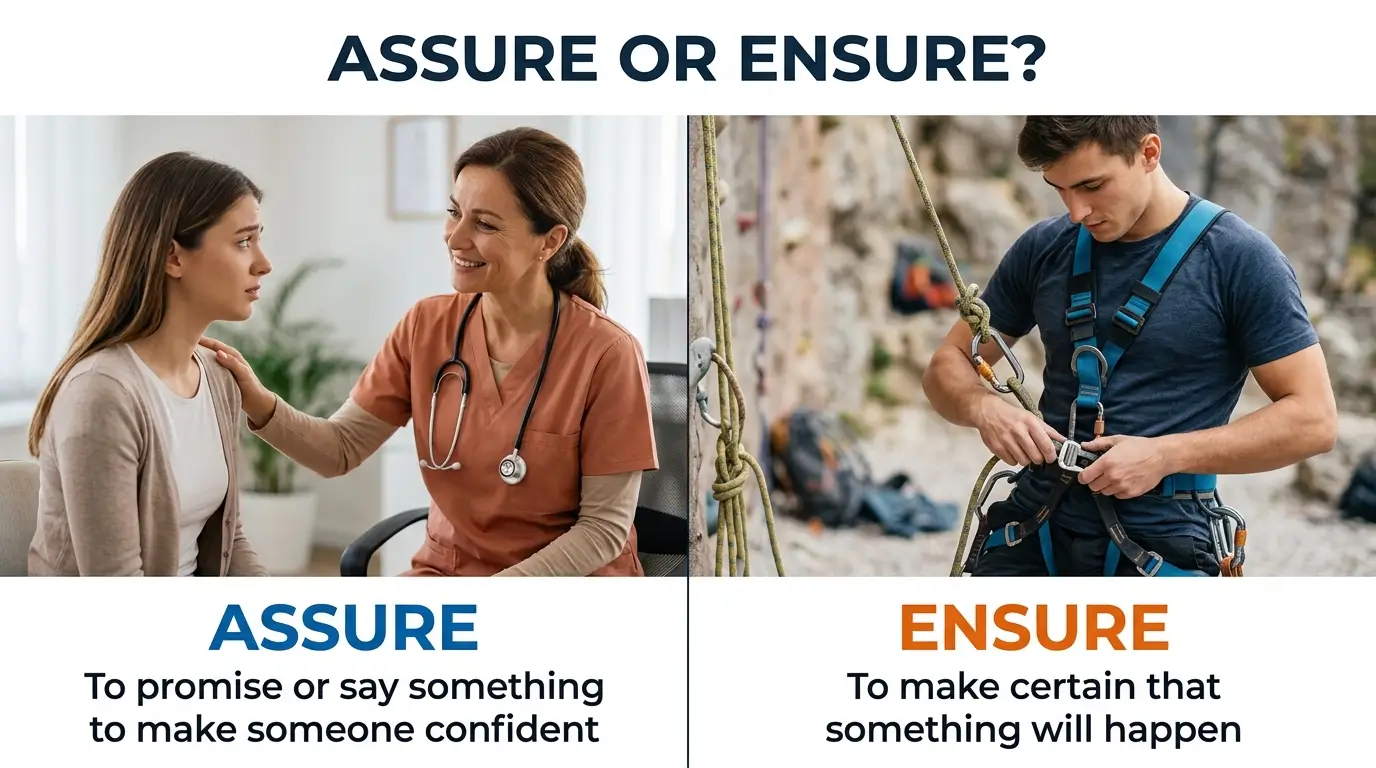
Assure or Ensure? The Simple Way to Never Mix Them Up Again
Assure vs. Ensure: Assure means to reassure a person, while ensure means to make sure something happens.
If you’ve ever stopped mid-sentence wondering whether to write “I assure you” or “I ensure you,” you’re not alone.
This is one of the most searched word mix-ups in English, right up there with affect vs effect. And here’s the twist: most people searching “assure or ensure” think they’re looking at a spelling difference, like color and colour. They’re not.
Assure and ensure are two different words with two different jobs. A third word, insure, often gets pulled into the mix too, and that’s where things really get confusing.
Mix them up in a work email or a report, and it can make you look careless, even if your grammar is otherwise sharp.
This guide clears it up in plain terms. You’ll get the quick answer first, then the deeper explanation: where these words came from, how British and American English treat them, the mistakes people make most often, and real examples from emails, news, and social media. By the end, you won’t need to guess again.
Assure or Ensure Quick Answer
Here’s the short version.
- Assure means to comfort someone or remove their doubt. You assure a person. Example: I assure you the flight will land on time.
- Ensure means to make something certain to happen. You ensure an outcome. Example: Please ensure the door is locked before you leave.
- Insure means to buy or provide financial insurance. You insure a thing of value. Example: We insured the car against theft.
A simple trick: if you’re talking to a person, use assure. If you’re talking about an insurance policy, use insure. Everything else is usually ensure.
The Origin of Assure or Ensure
These three words all trace back to the same root: the Latin word securus, meaning “free from care” or “safe.” That’s also where the word “secure” comes from.
From Latin, the word passed into Old French as asseurer, meaning “to make sure” or “to reassure.”
English borrowed this in the late 1300s as “assure.” Not long after, a second version showed up: “ensure,” built from the prefix en- (meaning “to make”) plus “sure.” Both words meant almost the same thing at first: to make certain or to comfort.
“Insure” is simply an old spelling variant of “ensure.” For centuries, English writers used insure and ensure to mean the same thing, switching between them freely.
It wasn’t until the 1600s that insure picked up a new, narrower job: describing financial insurance policies. Once the insurance industry grew, “insure” became the word tied to money and risk, while “ensure” kept the general meaning of “make certain.”
So the confusion isn’t random. These words used to overlap on purpose. English just slowly split one word into three separate jobs.
British English vs American English Spelling
People often assume this is a British vs American spelling issue, similar to “colour” vs “color.” It isn’t, not exactly.
All three words, assure, ensure, and insure, are spelled the same way in both British and American English. The difference is in usage, not spelling.
British English keeps a cleaner three-way split: ensure for general certainty, insure strictly for financial insurance, and assure for reassuring people (with one extra British twist: “assurance” can also mean life insurance).
American English is looser. Many US writers and even some dictionaries accept “insure” as a stand-in for “ensure” in general writing, not just insurance contexts. This is one reason the mix-up shows up so often in American business writing.
| Word | British English Use | American English Use |
|---|---|---|
| Assure | Reassure a person; remove doubt | Same, plus sometimes used loosely for “convince” |
| Ensure | Make an outcome certain (strict, preferred) | Make an outcome certain (preferred, but sometimes swapped with insure) |
| Insure | Strictly financial insurance | Financial insurance, but sometimes used for general certainty too |
Which Spelling Should You Use?
This depends less on your accent and more on your audience and context.
If you write for a US audience: Ensure is still the safer, clearer choice for “make certain.” Save insure strictly for insurance topics, even though some American style guides allow overlap. Clarity beats flexibility here.
If you write for a UK, Australian, or Commonwealth audience: Stick to the strict three-way split. Editors and readers in these regions notice when insure is used outside a financial context, and it can read as a mistake.
If you write for a global or mixed audience (which covers most SEO and blog content): Use the strict rule everywhere. Ensure for outcomes, assure for people, insure for insurance. This version works correctly no matter who’s reading, and it’s the version grammar checkers and style guides agree on.
If you work in finance, legal, or insurance content: Precision matters even more here. Courts and insurers treat “insure” and “ensure” as legally distinct in contracts, so swapping them isn’t just a style slip, it can change the meaning of a clause.
Common Mistakes with Assure or Ensure
Mistake 1: Using “assure” when you mean “ensure.” Wrong: Please assure the report is finished by Friday. Right: Please ensure the report is finished by Friday. (You’re not comforting the report. You’re making sure it happens.)
Mistake 2: Using “ensure” when you mean “assure.” Wrong: I ensure you this won’t happen again. Right: I assure you this won’t happen again. (You’re reassuring a person, not guaranteeing an outcome.)
Mistake 3: Using “insure” for general certainty. Wrong: We will insure the meeting starts on time. Right: We will ensure the meeting starts on time. (No insurance policy is involved here.)
Mistake 4: Thinking “assurance” is only about emotions. In British English, “assurance” can mean a type of life insurance (as in “life assurance”). This trips up American readers who only know the emotional sense of the word.
Mistake 5: Treating all three as interchangeable. They overlap in history, not in modern meaning. Swapping them at random is the single most common error in business writing, resumes, and SEO content.
Assure or Ensure in Everyday Examples
In emails: “I assure you your order will ship today. We’ve also taken steps to ensure this delay doesn’t happen again.”
In news writing: “Officials moved to assure the public that the water supply was safe, while new inspections aim to ensure it stays that way.”
On social media: “Just want to assure everyone we’re back online. Working to ensure it stays stable this time 🙏”
In formal or legal writing: “The contractor shall ensure all work meets code. The property owner is required to insure the building against fire and flood.”
Notice the pattern: assure shows up when someone is speaking to comfort a person. Ensure shows up when the sentence is about an action or outcome. Insure shows up only near money, property, or policies.
Related Post: Faze or Phase? The Simple Way to Never Mix Them Up Again
Assure or Ensure Google Trends & Usage Data
Search interest for “ensure vs insure,” “assure vs ensure,” and similar comparison terms stays consistently high year-round, which tells you this isn’t a seasonal question, it’s a recurring one that new writers, students, and non-native English speakers run into constantly.
A few patterns show up clearly:
- US searches lean toward “ensure vs insure,” reflecting how loosely the two get used in American business and everyday writing.
- UK, Australian, and Canadian searches lean more toward “assure vs ensure,” since insure is already well understood as strictly financial in those regions.
- Search intent is mostly corrective, not educational. Most people typing this phrase already used one of the words and want to double check, often while writing an email, essay, or article in real time.
- Grammar and writing tool sites (Grammarly, Merriam-Webster, Dictionary.com) dominate the top results, which signals Google treats this as a “quick answer” query. Content that gives the answer fast, high on the page, tends to perform best.
| Term | Typical Region | Common Context |
|---|---|---|
| Assure | Global, slightly higher in UK/Commonwealth | Reassuring people, customer service |
| Ensure | Global, most commonly searched of the three | Guarantees, instructions, outcomes |
| Insure | Higher in US search volume | Insurance, finance, property |
| Assurance | UK/Commonwealth | Can mean confidence OR life insurance |
| Insurance | Global | Financial protection only |
Frequently Asked Questions
Is it “I assure you” or “I ensure you”?
It’s “I assure you.” You’re reassuring a person, not guaranteeing an outcome. “I ensure you” is a common mistake because ensure sounds more formal, but it’s grammatically off here.
What is the difference between assure, ensure, and insure in one sentence?
Assure a person, ensure an outcome, insure a valuable thing. If you remember that one line, you’ll get it right almost every time.
Can “insure” and “ensure” be used interchangeably?
In American English, some style guides allow it in casual writing, but it’s not recommended. In British English and in formal or legal writing anywhere, they are not interchangeable. Ensure means “make certain.” Insure means “provide financial insurance.”
Is “ensure” British or American spelling?
Neither. Ensure is spelled the same in both. The difference is how often and where it’s used, not how it’s spelled.
Why do assure, ensure, and insure sound so similar?
Because they all come from the same Latin root, securus (“safe” or “free from care”), through the same Old French word. They split into separate meanings over centuries, but the shared origin is why they still look and sound alike.
Which word should I use in a business email?
Use ensure when confirming an outcome (“I’ll ensure this is fixed by Monday”) and assure when reassuring the reader (“I assure you we’re on it”). Use insure only if you’re actually discussing an insurance policy.
Is “assurance” the same as “insurance”?
Not quite. In American English, assurance usually means confidence or a promise. In British English, “assurance” can also refer to a type of insurance, particularly life assurance, which covers an event that will definitely happen (death) rather than one that might happen.
What’s an easy way to remember the difference?
Think of the letter each word starts with as a clue: Assure = a person (comfort them). Ensure = an event or outcome (guarantee it). Insure = an item of value (protect it financially).
Conclusion
Assure, ensure, and insure aren’t spelling variants, they’re three separate words that grew out of the same Latin root and slowly split into different jobs.
Assure is about people: you assure someone to ease their doubt. Ensure is about outcomes: you ensure something happens. Insure is about money: you insure something valuable against loss.
The confusion is understandable given their shared history, but the modern rule is simple once you see the pattern. Use assure when you’re speaking to a person.
Use ensure when you’re guaranteeing a result. Use insure when a policy or financial coverage is involved.
This holds true whether you’re writing for a US, UK, or global audience, the spelling never changes, only the usage does.
Next time you catch yourself pausing over “assure or ensure,” run it through that one-line test: person, outcome, or policy. Get that right, and you’ll never second guess the sentence again.