I or Me? The Simple Grammar Rule for Choosing the Right Pronoun
Have you ever stopped while writing a sentence and asked, “Should I use I or me?” You are not alone. This is one of the most common English grammar questions because I and me both refer to the speaker, but they do different jobs in a sentence.
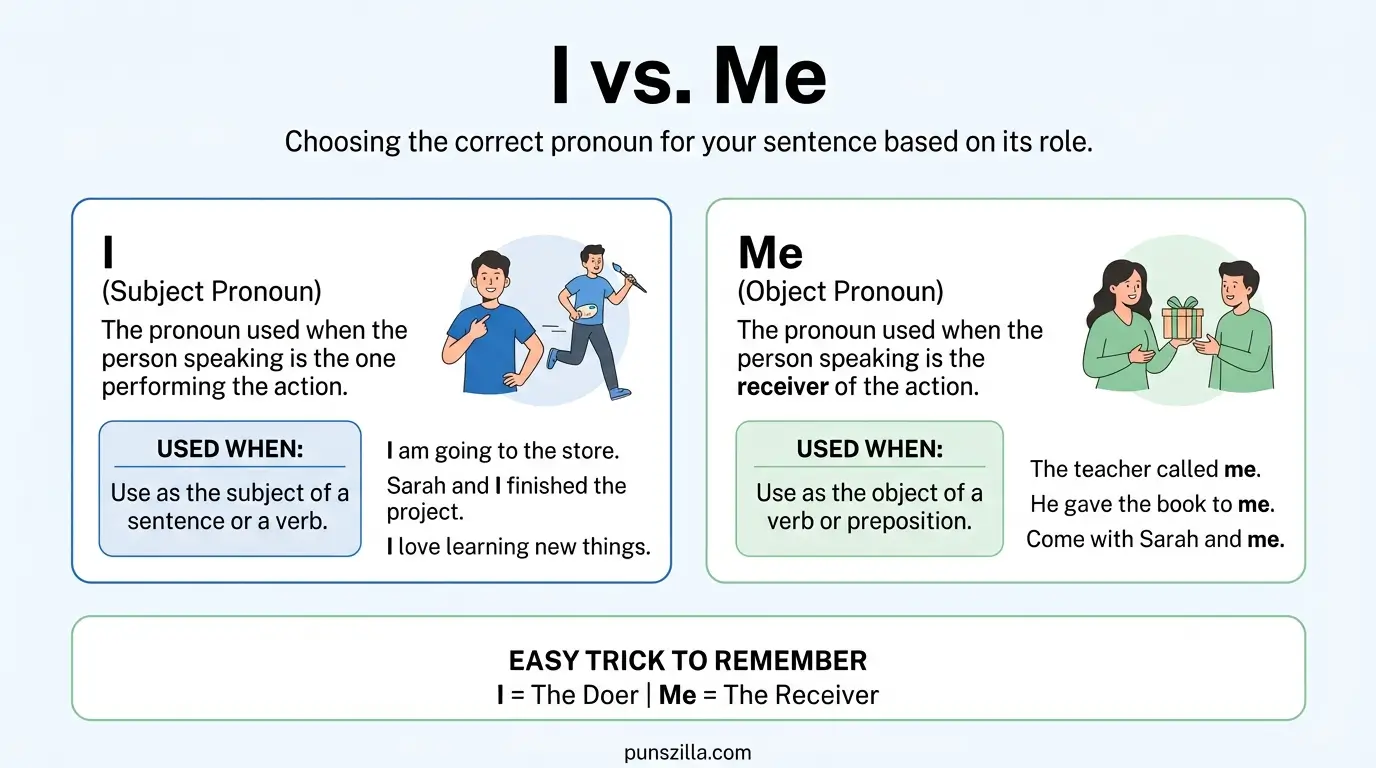
The good news is that the rule is simple. Use I when you are the subject—the person doing the action. Use me when you are the object the person receiving the action.
For example, “I called Sarah” is correct, while “Sarah called me” is correct.
People search for “I or me” when writing emails, essays, job applications, social media posts, and everyday messages.
The biggest confusion often appears when another person is included: “John and I” or “John and me?” This guide gives you a quick answer, clear rules, useful examples, and professional advice.
It also explains an important point: I and me are not British and American spelling variants. They are different grammatical forms used in both varieties of English.
I or Me Quick Answer
The easiest rule is:
- Use I when you are the subject of the verb.
- Use me when you are the object of the verb or a preposition.
Examples
I went to the store.
The teacher praised me.
Sarah and I finished the project.
The manager thanked Sarah and me.
A useful test is to remove the other person’s name.
- “John and I went home.” → “I went home.” ✓
- “She called John and me.” → “She called me.” ✓
This simple test is also recommended by grammar and writing resources.
| Variation | Function | Example |
| I | Subject pronoun | I wrote the email. |
| me | Object pronoun | She emailed me. |
| John and I | Compound subject | John and I attended. |
| John and me | Compound object | She invited John and me. |
The Origin of I or Me
The words I and me have a long history in English. They come from different forms of the first-person singular pronoun in Old English.
Old English used ic as the subject form. This developed into modern I. Forms such as me and mec were used for the object.
Over time, English lost many of its older grammatical endings, but it kept different forms for some personal pronouns.
This is why English still has pairs such as:
- I / me
- he / him
- she / her
- we / us
- they / them
Modern grammar describes I as a subject form and me as an object form.
An important point is that I and me are not spelling differences. They are separate grammatical forms. This is different from spelling pairs such as “color” and “colour.”
The capital letter in I is also standard English spelling. English normally writes the first-person singular pronoun with a capital I, even when it appears in the middle of a sentence.
British English vs American English Spelling
There is no British-versus-American spelling difference between I and me.
British English uses:
- I
- me
American English uses:
- I
- me
The grammar rule is also the same. I functions as a subject, while me functions as an object. Cambridge and the British Council both give the same basic distinction.
| Feature | British English | American English |
| Subject form | I | I |
| Object form | me | me |
| “I went home.” | Correct | Correct |
| “She called me.” | Correct | Correct |
| “John and I went.” | Correct | Correct |
| “She called John and me.” | Correct | Correct |
| Main rule | Subject = I | Subject = I |
| Main rule | Object = me | Object = me |
There can be differences in informal speech. For example, speakers may say “Me and Tom went shopping.”
This can occur in everyday speech, but standard formal English prefers “Tom and I went shopping.” Cambridge notes that informal spoken English can sometimes use me in subject positions.
Which Spelling Should You Use?
The better question is not “Which spelling?” but “Which pronoun should I use?”
For a US audience
Use the standard rule:
- I = subject
- me = object
Example:
My brother and I are visiting New York.
Please contact my brother and me.
For a UK or Commonwealth audience
Use exactly the same basic rule.
Example:
My colleague and I will attend the meeting.
Please send the details to my colleague and me.
For a global audience
Use the same standard forms. There is no need to change I to me, or vice versa, based on the country of your reader.
For professional writing, academic work, reports, applications, and formal emails, standard grammar is the safest choice.
Common Mistakes with I or Me
1. “Me and John went…”
❌ Me and John went to the office.
✅ John and I went to the office.
Why? John and I are doing the action.
2. “She called John and I”
❌ She called John and I.
✅ She called John and me.
Why? John and me receive the action of “called.”
3. “Between you and I”
❌ Between you and I, this is a bad idea.
✅ Between you and me, this is a bad idea.
The preposition between takes an object form, so me is correct.
4. Using “I” because it sounds formal
Some people think I always sounds more educated or professional. That is not true.
❌ The manager spoke to Sarah and I.
✅ The manager spoke to Sarah and me.
Using the wrong form does not make a sentence more formal.
5. Using “me” as the subject in formal writing
❌ Me and my team completed the report.
✅ My team and I completed the report.
Informal speech may use the first version, but the second is better for professional writing.
I or Me in Everyday Examples
The difference becomes easy when you see it in real situations.
In Emails
Subject: Meeting Update
James and I will join the meeting at 10 a.m.
Please contact James or me if you need help.
In News Writing
The minister and I discussed the new policy.
Reporters interviewed me after the event.
News writing normally follows standard grammar, although quoted speech may reflect how someone actually spoke.
On Social Media
Informal posts may include:
My sister and I had a great day!
You may also see:
Me and my sister had a great day!
The second form is common in casual speech and online writing, but my sister and I is the standard choice for polished writing. Cambridge notes that this informal subject use of me occurs in spoken English.
In Formal Writing
My research partner and I completed the study.
The professor asked my research partner and me to present the results.
The same subject-object rule works in essays, reports, applications, and business documents.
I or Me Google Trends & Usage Data
Search interest in “I or me” reflects a clear grammar problem: people want a fast answer when they are unsure which first-person pronoun belongs in a sentence.
However, Google Trends should be read carefully. A Trends graph shows relative search interest, not the total number of searches or the number of people who use a grammar form. Search data also changes with country, language, season, and related queries.
The topic appears across English-learning markets, including the US, UK, Canada, Australia, India, and Pakistan. Grammar resources also report that the question is common among both English learners and native speakers.
The search intent usually falls into these groups:
| Search context | Likely reason |
| Students | Homework and grammar tests |
| English learners | Understanding subject and object pronouns |
| Professionals | Checking emails and reports |
| Job seekers | Writing applications correctly |
| Social media users | Checking captions and posts |
| Native speakers | Confirming a sentence before publishing |
A useful SEO point is that “I or me” has strong informational intent. Someone searching the phrase usually wants a direct grammar answer, examples, and a simple rule rather than a long theory lesson.
I or Me Comparison Table
| Point | I | me |
| Pronoun type | Subject | Object |
| Main job | Does the action | Receives the action |
| Common position | Before the verb | After the verb |
| After a preposition | Usually no | Yes |
| Example | I called him. | He called me. |
| With another person | Sarah and I | Sarah and me |
| British spelling | I | me |
| American spelling | I | me |
| Formal writing | Correct when used as subject | Correct when used as object |
| Informal speech | Common | Common |
The fastest memory trick
Ask:
Am I doing the action?
If yes → I
Am I receiving the action or following a preposition?
If yes → me
Examples:
I helped Tom.
Tom helped me.
Sarah and I helped Tom.
Tom helped Sarah and me.
FAQs About I or Me
Is “I” or “me” correct?
Both are correct. The choice depends on the job the pronoun does. Use I as a subject and me as an object.
Should I say “John and I” or “John and me”?
Use John and I when they are the subject.
John and I went shopping.
Use John and me when they are the object.
She invited John and me.
Is “Me and John went” grammatically correct?
It is common in informal speech, but standard formal English prefers:
John and I went.
Is “between you and I” correct?
No, not in standard English. Use:
Between you and me.
Is “me” always informal?
No. Me is completely standard and formal when it is used correctly.
Please send the document to me.
Can a sentence start with “me”?
Yes, in some informal expressions or sentence fragments:
Me too!
But for a normal formal sentence, use I when you are the subject:
I agree.
Is there a British spelling of “I” and an American spelling of “me”?
No. Both British and American English use I and me. The difference is grammatical, not regional spelling.
Conclusion
Choosing between I or me is easier once you understand one simple idea: I is the subject, while me is the object. Use I when you perform the action, as in “I wrote the report.” Use me when the action happens to you, as in “She called me.”
The same rule applies when another person is included. Say “Sarah and I went home” because Sarah and I are the subjects. Say “She invited Sarah and me” because Sarah and me are the objects.
British and American English do not use different spellings for these pronouns. Both varieties use I and me in the same basic way. Informal speech may sometimes bend the rule, but professional writing should follow standard grammar.
When in doubt, remove the other person’s name. If “I” works alone, use I. If “me” works alone, use me. This quick test works well for emails, essays, reports, applications, social media, and everyday writing.