
Wean or Ween: Which Spelling Is Correct? Meaning, Usage, and Examples
Have you ever typed “wean or ween” and stopped because both words sound the same? You are not alone. This is a common spelling question, especially when writing about babies, food, medicine, habits, or dependence.
The good news is simple: wean is the standard modern English word for gradually stopping a baby from breast milk or helping someone stop depending on something.
Ween is a real English word, but it has a different meaning and is now considered archaic.The confusion happens because wean and ween have the same pronunciation in modern English.
Their spellings also look almost identical. Searchers may see both forms online and wonder whether British and American English use different spellings.
They do not. There is no normal US-versus-UK spelling difference here. Wean is the correct choice in both varieties when you mean “gradually stop using or depending on something.”
This guide explains the difference, history, usage, common mistakes, and the best spelling for professional writing.
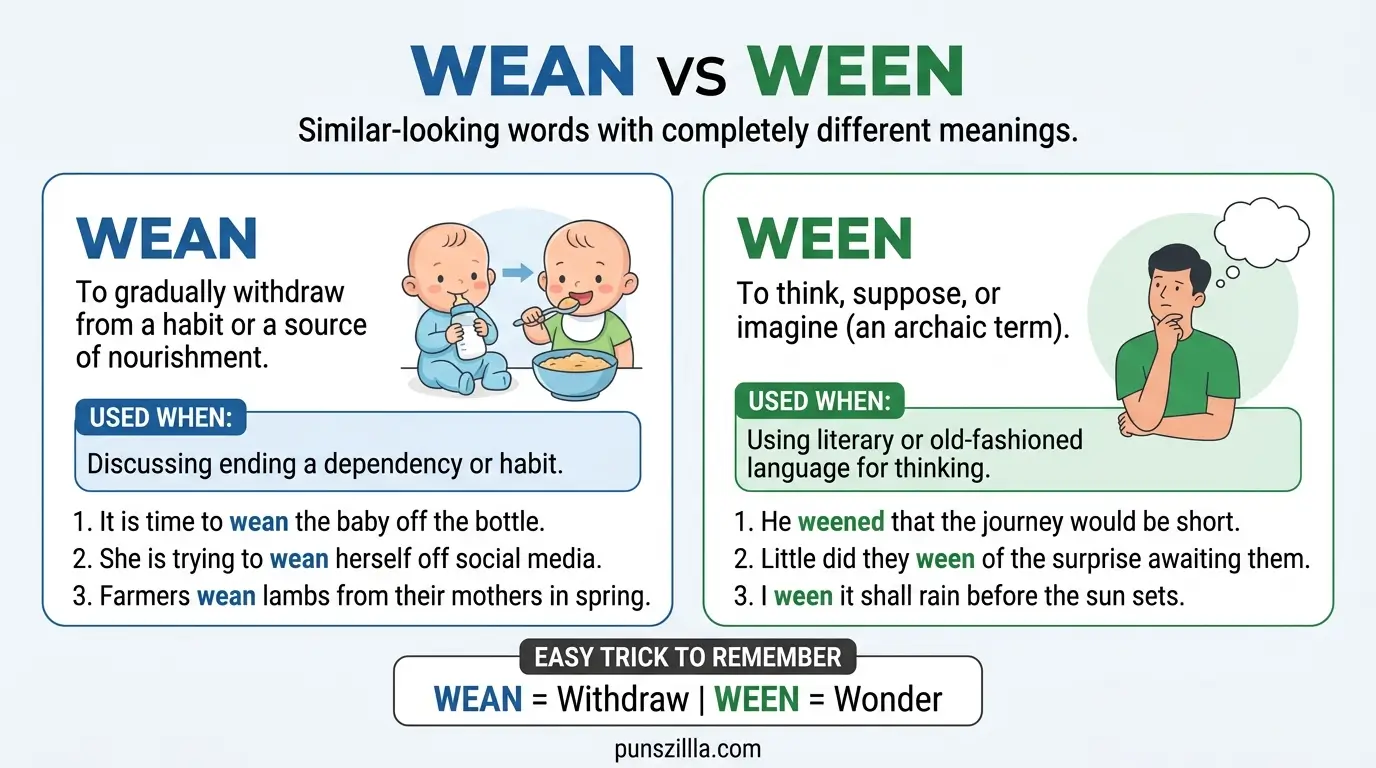
Wean or Ween Quick Answer
Use “wean” when you mean:
- To gradually stop a baby from breast milk.
- To move a young animal from its mother’s milk to other food.
- To gradually stop someone from depending on something.
- To reduce dependence on a medicine, habit, product, or activity.
Examples
- We plan to wean the baby onto solid food.
- The doctor helped him wean off the medicine.
- She is trying to wean herself from social media.
- The farmer began to wean the calves.
Ween is also a dictionary word, but it is archaic. It means “to think,” “suppose,” or “believe.”
For example:
“I ween it will rain.”
This style belongs mainly to old literature or deliberately old-fashioned writing.
Quick comparison
| Word | Meaning | Modern use |
| wean | Gradually stop a dependence or milk feeding | Common |
| ween | Think, suppose, or believe | Archaic |
So, if you are writing about a baby, medication, food, technology, or a habit, wean is almost certainly the word you need.
The Origin of Wean or Ween
The two words look alike because both have very old Germanic roots. However, they developed from different Old English words and meanings.
Where “wean” comes from
Wean comes from Middle English forms such as wenen and Old English wenian, meaning “to accustom,” “to train,” or “to make used to.”
Over time, the word became linked with getting a child or young animal used to food other than its mother’s milk.
The word is very old. Merriam-Webster gives its first known use as before the 12th century.
The modern meaning also expanded beyond babies and animals. Today, you can wean someone off a habit, treatment, product, or other source of dependence.
For example:
- Wean a baby from breast milk.
- Wean a patient off medication.
- Wean a company off fossil fuels.
- Wean yourself off social media.
Where “ween” comes from
Ween comes from a different Old English verb, wēnan, meaning “to expect,” “hope,” “suppose,” or “think.” It was common in earlier forms of English but became archaic centuries ago.
The word can still appear in poetry, historical texts, or literary writing:
- “I ween he knows the truth.”
- “Little did she ween what would happen.”
The spelling similarity is therefore historical, not a British-versus-American spelling rule.
British English vs American English Spelling
One important point is often missed: British English and American English spell “wean” the same way.
| Meaning | British English | American English |
| Stop a baby from breast milk | wean | wean |
| Gradually stop a dependence | wean | wean |
| Past tense | weaned | weaned |
| -ing form | weaning | weaning |
| Archaic “think/suppose” | ween | ween |
Oxford lists wean as the modern verb for gradually stopping milk feeding and also records its use with “off,” “from,” and “onto.” Collins likewise lists wean in British English with these meanings.
So there is no standard rule such as:
British = wean
American = ween
That is incorrect.
Instead:
wean = modern word for gradually stopping dependence
ween = archaic word meaning think or suppose
Wean or Ween Comparison Table
| Feature | Wean | Ween |
| Pronunciation | /wiːn/ | /wiːn/ |
| Main meaning | Gradually stop a dependence | Think or suppose |
| Modern English | Yes | Rare/archaic |
| Used for babies | Yes | No |
| Used with medication | Yes | No |
| Used with habits | Yes | No |
| British spelling | Wean | Ween |
| American spelling | Wean | Ween |
| Example | “Wean the baby onto solids.” | “I ween it is true.” |
| Best choice for normal writing | Yes | Usually no |
Which Spelling Should You Use?
The answer depends on what you mean, not where your readers live.
For US readers
Use wean for modern writing:
The doctor advised him to wean himself off the medication.
Do not use ween as a spelling variation of wean.
For UK and Commonwealth readers
Use wean too:
The parents started weaning their baby onto solid food.
British English does not normally replace wean with ween.
For a global audience
Choose wean whenever you mean gradual separation from milk, a habit, treatment, product, or dependence.
This is the safest choice for:
- Websites
- Business writing
- Emails
- Medical content
- Parenting articles
- News articles
- Academic writing
- Social media
Use ween only when you intentionally mean the archaic verb “to think” or “to suppose.”
Common Mistakes with Wean or Ween
Mistake 1: Writing “ween the baby”
Incorrect:
We need to ween the baby.
Correct:
We need to wean the baby.
Mistake 2: Writing “ween off medication”
Incorrect:
The doctor will ween him off the drug.
Correct:
The doctor will wean him off the drug.
The phrase wean off is common modern English. Oxford lists “wean somebody off” as a standard usage.
Mistake 3: Assuming “ween” is the American spelling
Incorrect idea:
British: wean
American: ween
Correct:
British: wean
American: wean
The spelling does not change by region.
Mistake 4: Using “ween” because it sounds right
Both words are pronounced alike, so pronunciation cannot help you choose.
Remember:
Wean = reduce dependence.
Ween = think or suppose, in archaic English.
Mistake 5: Treating “ween” as a normal modern synonym
Modern dictionaries label ween as archaic. Merriam-Webster defines it as “to hold as an opinion,” “suppose,” or “believe.”
For everyday writing, use think, believe, or suppose instead.
Wean or Ween in Everyday Examples
In emails
Correct:
We are trying to wean the team off the old software before the end of the year.
This means the team is gradually moving away from the software.
In news writing
Correct:
The government wants to wean the economy off imported fuel.
News writing commonly uses wean off in the figurative sense of reducing dependence. Current dictionary examples include this broader use with economies, energy, and other forms of dependence.
In social media
Correct:
I am trying to wean myself off my phone.
This means gradually reducing dependence on the phone.
In parenting content
Correct:
Many parents begin weaning their babies onto solid foods during infancy.
The verb wean is the standard word for this process.
In formal writing
Correct:
The organization aims to wean itself from fossil fuels over the next decade.
This use is figurative but fully standard.
In historical or literary writing
Ween can be correct when used in its old sense:
“I ween the traveler knew the road.”
Here, ween means “I suppose” or “I think.”
Wean or Ween Google Trends & Usage Data
Search interest in “wean or ween” is mainly driven by spelling confusion. People often search the two forms together because they sound identical.
A key limitation is that Google Trends reports relative search interest, not a fixed number of searches. Interest can also change by country, time period, and search context. Search results for wean are strongly connected to modern topics such as babies, medicine, habits, food, and dependence. Dictionary and language sites also show ween as an archaic word rather than a modern spelling alternative.
The main usage pattern is:
| Search/context | Likely word | Why |
| Baby feeding | wean | Modern standard term |
| Solid foods | wean | Modern standard term |
| Medication | wean | Gradual reduction |
| Addiction or habits | wean | Gradual reduction in dependence |
| Fossil fuels | wean | Figurative dependence |
| Old literature | ween | Archaic “think/suppose” |
| “Which spelling is correct?” | wean or ween | Spelling confusion |
| British vs American spelling | wean | No normal regional spelling difference |
Search behavior can also be affected by proper names. For example, Ween is the name of an American rock band, which can create search interest unrelated to the verb.
For SEO content, the safest approach is to target the exact phrase “wean or ween” while clearly explaining that the two words have different meanings.
Wean or Ween: Side-by-Side Examples
| Wean | Ween |
| We need to wean the baby. | I ween that he is correct. |
| She is weaning her child onto solid food. | “I ween it shall be so.” |
| He is trying to wean himself off coffee. | The old writer weened it was true. |
| The company wants to wean itself off oil. | This use is now archaic. |
| Weaned is the correct past form. | Weened is the past form of archaic ween. |
FAQs About Wean or Ween
Is it “wean” or “ween”?
Use wean when you mean to gradually stop a baby from breast milk or reduce dependence on something. Ween is a separate, archaic word meaning “think” or “suppose.”
Is “ween” a real word?
Yes. Ween is a real English word, but it is archaic. Modern dictionaries define it as meaning “to think,” “suppose,” or “believe.”
Is “wean” British or American?
Wean is used in both British and American English. There is no standard regional spelling difference.
Is it “wean off” or “ween off”?
The correct modern phrase is wean off.
Example:
She is trying to wean herself off social media.
Is “weaning” spelled with an A?
Yes. The correct form is weaning.
Example:
The baby is starting the weaning process.
Can “ween” mean “wean”?
No. Although the words sound the same, they have different meanings. Ween is not the normal modern spelling of wean.
Why do “wean” and “ween” sound the same?
Both words developed with the long “ee” sound. Their similar pronunciation does not mean they have the same meaning.
Their historical roots are also different, even though both are very old Germanic words.
Which word should I use in professional writing?
Use wean when discussing gradual withdrawal from milk, medicine, habits, products, technology, or other forms of dependence.
Avoid ween unless you are discussing historical language or deliberately using an archaic style.
Conclusion
The answer to “wean or ween” is simple once you know the meanings. Wean is the standard modern English word.
Use it when you mean to gradually stop a baby from breast milk, move a young animal to other food, or reduce someone’s dependence on a medicine, habit, product, or activity.
Ween is also a real word, but it is archaic. It means “to think,” “suppose,” or “believe,” and you are most likely to see it in old literature, poetry, or intentionally old-fashioned writing.
There is also no British-versus-American spelling difference between the two. Both British and American English use wean for the modern meaning.
For emails, websites, news articles, academic work, medical content, parenting guides, and social media, choose wean when talking about gradual withdrawal or reduced dependence.
If you remember one rule, remember this: wean means gradually stop; ween means think or suppose in archaic English.