
Sunburnt or Sunburned: Which Is Correct?
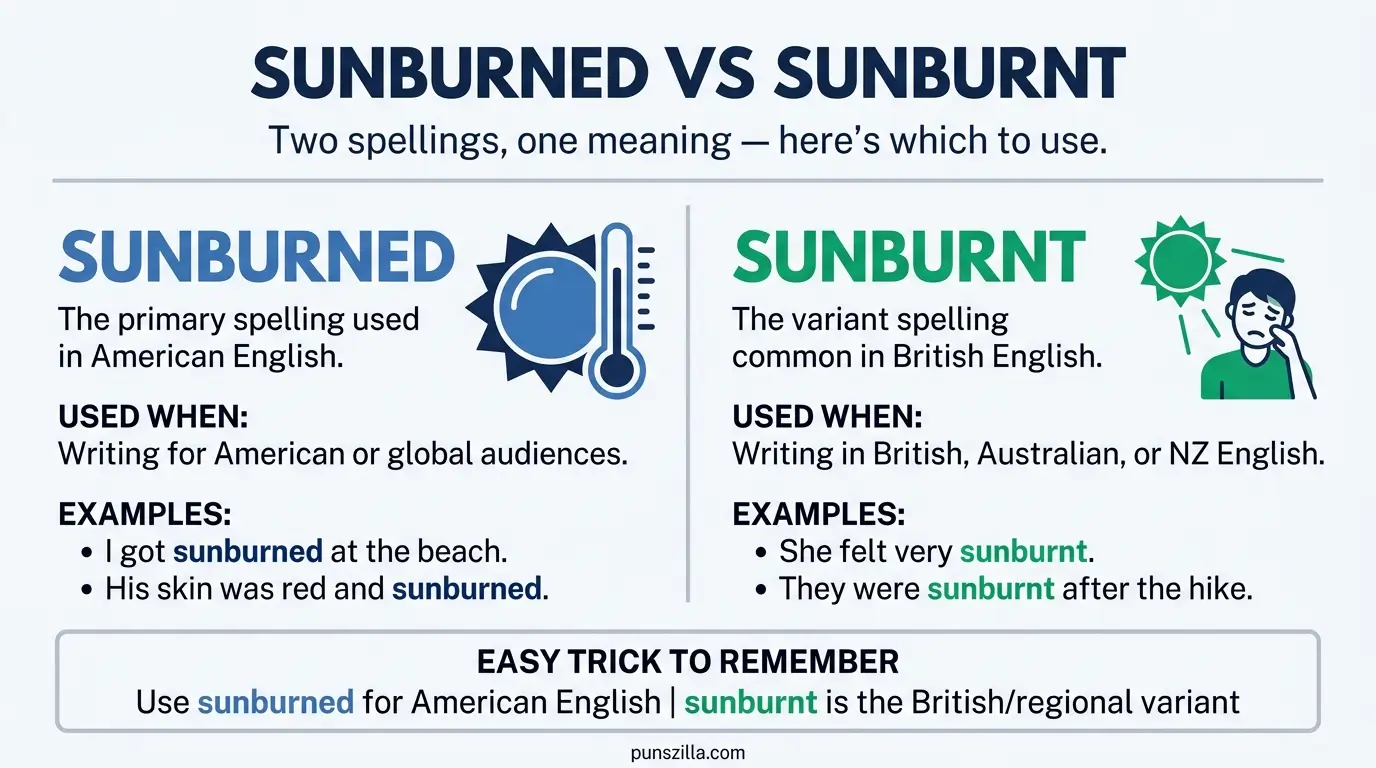
Sunburnt or sunburned: Both spellings are correct. Sunburned is more common in American English, while sunburnt is often preferred in British English.
Have you ever wondered whether to write sunburnt or sunburned? Both spellings are correct. The main difference comes from regional preferences in English.
You might see sunburned in American writing. Meanwhile, sunburnt often appears in British English. Both words describe skin affected by too much sunlight.
This difference can confuse English learners. It can also cause problems when writing school assignments, emails, or online articles. You may wonder whether one spelling is wrong or sounds more natural.
The good news is that you can use either spelling correctly. However, your audience and writing style can help you choose the better option.
In this guide, you will learn the meaning of both words. You will also discover their origins and common uses. Simple examples will show you how each word works in everyday sentences.
We will also explain regional spelling preferences and how to stay consistent. By the end, you will know which form suits your writing.
The easiest rule is simple: use sunburned for American English and sunburnt for British English, while remembering that both are correct.
Sunburnt or Sunburned Quick Answer
Quick Answer: Both sunburnt and sunburned are correct spellings. They describe skin affected by too much sunlight.
American English usually favors sunburned, while British English often favors sunburnt. Choose the form that suits your audience, and use it consistently throughout your writing.
Examples of Sunburned
- My shoulders were badly sunburned after the beach trip.
- He forgot his sunscreen and became sunburned.
- Her sunburned face looked red and painful.
Examples of Sunburnt
- I got sunburnt while swimming outdoors.
- His sunburnt nose hurt when he touched it.
- We returned home with sunburnt shoulders.
Both forms communicate the same basic idea. Neither spelling is inherently wrong.
For a US audience, sunburned is usually the safer choice. For a British audience, sunburnt often sounds more familiar.
The Origin of Sunburnt or Sunburned
The difference between sunburnt and sunburned comes from English verb forms. Both words relate to the verb sunburn.
The word sunburn combines sun and burn. It describes skin damage caused by too much exposure to sunlight.
English has more than one way to form the past tense of some verbs. The endings -ed and -t appear in different verb forms.
For example, consider these words:
| Base verb | Form ending in -ed | Form ending in -t |
|---|---|---|
| Learn | Learned | Learnt |
| Dream | Dreamed | Dreamt |
| Burn | Burned | Burnt |
| Sunburn | Sunburned | Sunburnt |
These pairs show a pattern found in English. However, not every verb allows both forms in every context.
Sunburned uses the common -ed ending. Sunburnt follows the shorter -t pattern found in burnt.
Both forms developed within English usage. Their acceptance does not mean one is a misspelling of the other.
Modern dictionaries recognize both sunburned and sunburnt. Their regional labels and examples can help you decide which form fits your writing.
For a reliable definition, consult the Cambridge Dictionary entry for sunburned or the Oxford Learner’s Dictionaries entry.
British English vs American English Spelling
The main difference between sunburnt and sunburned is regional preference. Both forms are correct, but one may sound more natural to a particular audience.
American English
In American English, sunburned is generally the more familiar choice.
You may see it in newspapers, health articles, school assignments, and everyday conversations.
Examples:
- I got sunburned during our family vacation.
- His sunburned skin felt sore.
- She was sunburned after spending the afternoon outside.
American writers generally use burned rather than burnt in many everyday contexts. However, burnt is also a recognized English word.
British English
In British English, sunburnt is a familiar and often preferred form.
It appears in everyday speech, travel writing, and descriptions of people who spent too much time outdoors.
Examples:
- We became sunburnt during our holiday.
- His sunburnt face showed how long he had been outside.
- She returned from the beach sunburnt and tired.
British English also accepts sunburned. Therefore, British writers do not need to treat it as an error.
Comparison Table
| Word | Use when | Example sentence |
|---|---|---|
| Sunburned | Writing for a US audience | I was sunburned after the picnic. |
| Sunburnt | Writing for a UK audience | I was sunburnt after the picnic. |
| Sunburned | Describing skin affected by sunlight | His shoulders were sunburned. |
| Sunburnt | Describing skin affected by sunlight | Her nose was sunburnt. |
Remember: The meaning stays the same. The preferred spelling depends mainly on regional usage and writing style.
Which Spelling Should You Use?
Choosing between sunburnt and sunburned is simple when you know your audience.
If You Write for American Readers
Choose sunburned in most cases. It is a natural choice for US websites, schoolwork, business writing, and general publications.
For example:
“The children became sunburned after playing outside.”
This spelling fits common American usage.
If You Write for British Readers
Choose sunburnt when it matches your publication’s style. It is familiar in British English and works well in everyday and formal writing.
For example:
“The children became sunburnt after playing outside.”
This sentence is correct and natural in British English.
If You Write for Commonwealth Readers
Commonwealth English includes several regional varieties. Usage can differ between countries, publications, and individual writers.
British spelling conventions may be useful in some contexts. However, do not assume every Commonwealth country follows exactly the same preferences.
Check your local dictionary or publication’s style guide when consistency matters.
If You Write for a Global Audience
Either spelling works for an international audience. The most important thing is clarity.
Choose one form and use it throughout your article. Avoid switching between sunburnt and sunburned without a reason.
What About IELTS and TOEFL?
Both spellings are standard English. The key is to use correct, consistent language.
For IELTS writing, either form can work. Follow the English variety you are comfortable using, and keep your spelling consistent.
TOEFL candidates should also focus on clear writing and accurate spelling. Neither word is automatically better in every situation.
What About Business Emails?
Use the form that matches your workplace or reader.
For an American company, sunburned is a practical choice. For a British publication, sunburnt may fit better.
You usually will not need either word in a formal email. However, if you mention a sunburn, both forms are acceptable.
Common Mistakes with Sunburnt or Sunburned
Both spellings are correct, but writers sometimes use them incorrectly. These mistakes are easy to avoid.
| Wrong | Right | Why |
|---|---|---|
| Sunburnt is always wrong. | Both forms are correct. | Dictionaries recognize both spellings. |
| Sunburned is always wrong in British English. | Both forms can be used. | British English also accepts sunburned. |
| I was sunburn. | I was sunburned. | The adjective describes the condition of your skin. |
| She got sunburnted. | She got sunburnt. | Sunburnted is not the standard form. |
| He is sunburned yesterday. | He was sunburned yesterday. | Use the past tense for a past event. |
| The sunburnt and sunburned spellings have different meanings. | They generally have the same meaning. | The difference is mainly regional preference. |
Mistake 1: Treating One Form as Incorrect
Neither spelling is a misspelling. Both are accepted English forms.
Mistake 2: Mixing Spelling Styles
Switching between the two forms can make an article look inconsistent. Choose one spelling for the whole piece.
Mistake 3: Using the Wrong Verb Form
Remember that sunburn is the base verb. Its accepted past forms include sunburned and sunburnt.
Mistake 4: Adding an Extra Ending
Avoid forms such as sunburnted. They are not standard English.
Mistake 5: Confusing a Sunburn With a Tan
A sunburn usually involves skin redness and soreness. A tan refers to darker skin after sun exposure. These terms do not always describe the same condition.
Sunburnt or Sunburned in Everyday Examples
Both spellings work in different types of writing. The examples below show how to use them naturally.
| Context | Example |
|---|---|
| I became sunburned during the weekend trip. | |
| I may need to avoid direct sunlight today because I am sunburnt. | |
| News headline | Tourists Return Home Sunburned After Beach Weekend |
| News headline | Sunburnt Visitors Seek Shade During Summer Heat |
| Social media | Forgot my sunscreen. Now I am sunburned! |
| Social media | A lovely beach day, but my shoulders are sunburnt. |
| Formal writing | The patient had visibly sunburned skin after prolonged sun exposure. |
| Formal writing | The report described several sunburnt visitors following the outdoor event. |
These examples show that both words fit casual and formal contexts.
However, always consider your publication’s preferred spelling. A US newspaper may favor sunburned, while a British publication may prefer sunburnt.
Sunburnt or Sunburned Google Trends & Usage Data
People search for sunburnt or sunburned because they want to know which spelling is correct. They may also want to understand regional differences.
Without a verified comparison of search data, it would be misleading to claim exact search volumes or declare a worldwide winner based on statistics.
Dictionary usage notes provide a useful starting point. The Cambridge Dictionary recognizes both forms and identifies sunburned as a US-preferred form in its American entry. Its British entry also recognizes sunburnt.
Regional and Contextual Usage
- United States: Sunburned is generally the more familiar choice.
- United Kingdom: Sunburnt is often preferred, though sunburned is also correct.
- Australia and New Zealand: Sunburnt is familiar in Commonwealth-style English, but preferences may vary.
- News and formal writing: Either form can appear. Publication style guides influence the choice.
- Casual speech and social media: Both forms are understandable and widely recognized.
These are general usage patterns, not a measured ranking of every country’s searches.
Usage Comparison Table
| Word | More common in | Where you see it |
|---|---|---|
| Sunburned | American English | US articles, health writing, everyday communication |
| Sunburnt | British English | UK writing, travel descriptions, everyday communication |
Check It Yourself
You can investigate these spellings with two useful tools.
- Open Google Trends and compare the terms for the United States and United Kingdom. Choose the same time range for both.
- Change the region and compare the results. Remember that Google Trends may not show spelling variants as a single combined topic.
 Trends Help+1
- Visit Google Books Ngram Viewer and compare the phrases to explore their frequency in published books over time.
Google Trends measures relative search interest, not the total number of searches. Google Books Ngram Viewer reflects words in its book collection, not all everyday English.
Comparison Table: Sunburnt or Sunburned
| Word | Type/Meaning | Region | Example | Formality | Memory trick |
|---|---|---|---|---|---|
| Sunburned | Skin affected by too much sun | Common in the US | My face is sunburned. | Formal or informal | Think of the regular -ed ending. |
| Sunburnt | Skin affected by too much sun | Common in the UK | My face is sunburnt. | Formal or informal | Remember the shorter -t form. |
The table highlights the key point: both words describe the same condition. Regional preference helps you choose between them.
FAQs About Sunburnt or Sunburned
Is sunburnt or sunburned correct?
Both sunburnt and sunburned are correct. They describe skin affected by too much sunlight. American English generally favors sunburned, while British English often favors sunburnt.
Choose the spelling that matches your audience and use it consistently.
Is sunburnt British or American English?
Sunburnt is especially familiar in British English. American English generally favors sunburned. However, both forms are recognized in dictionaries, so the distinction is a regional preference rather than a strict rule.
Is sunburned more common in America?
Yes, sunburned is generally the more familiar choice in American English. It appears in everyday speech, health information, and general writing. For a specific publication or region, check a current dictionary or style guide.
Do sunburnt and sunburned mean the same thing?
Yes, they generally have the same meaning. Both describe skin affected by excessive sunlight. The main difference is spelling preference. Context determines whether the word describes painful redness or, in some uses, a sun-darkened appearance.
Can I use sunburnt in formal writing?
Yes, sunburnt is acceptable in formal writing. You can use it in reports, articles, and school assignments. Just follow your organization’s spelling rules and avoid switching between sunburnt and sunburned without a clear reason.
Which spelling should I use in an IELTS essay?
Either spelling is acceptable. Choose the form that fits the English variety you normally use, then remain consistent. IELTS writing rewards clear communication and accurate language, not an automatic preference for one of these two accepted spellings.
Is sunburnted a real word?
No, sunburnted is not a standard English form. Use sunburned or sunburnt instead. For example, write “I got sunburned yesterday” or “I got sunburnt yesterday.” Both sentences are correct.
Conclusion
Key Takeaways:
- Both sunburnt and sunburned are correct English spellings.
- Sunburned is generally preferred in American English.
- Sunburnt is often preferred in British English.
- Choose one spelling and use it consistently.
The choice between sunburnt and sunburned is easier than it first appears. Both words describe skin affected by too much sunlight. Neither spelling is automatically wrong.
If you write for American readers, sunburned is usually the simplest choice. If your audience is British, sunburnt may sound more natural. Readers in other English-speaking countries may encounter both forms.
For international websites, consistency matters more than choosing one form over the other. Use the spelling that best matches your audience, publication, or preferred English style.
Remember that accepted spelling variants are not the same as spelling mistakes. Learning this difference can improve your writing and help you avoid unnecessary corrections.
The simple rule to remember is this: American English usually favors sunburned, while British English often favors sunburnt. Both are correct, so choose the one that suits your readers.