
Doggie or Doggy: Which Spelling Is Correct?
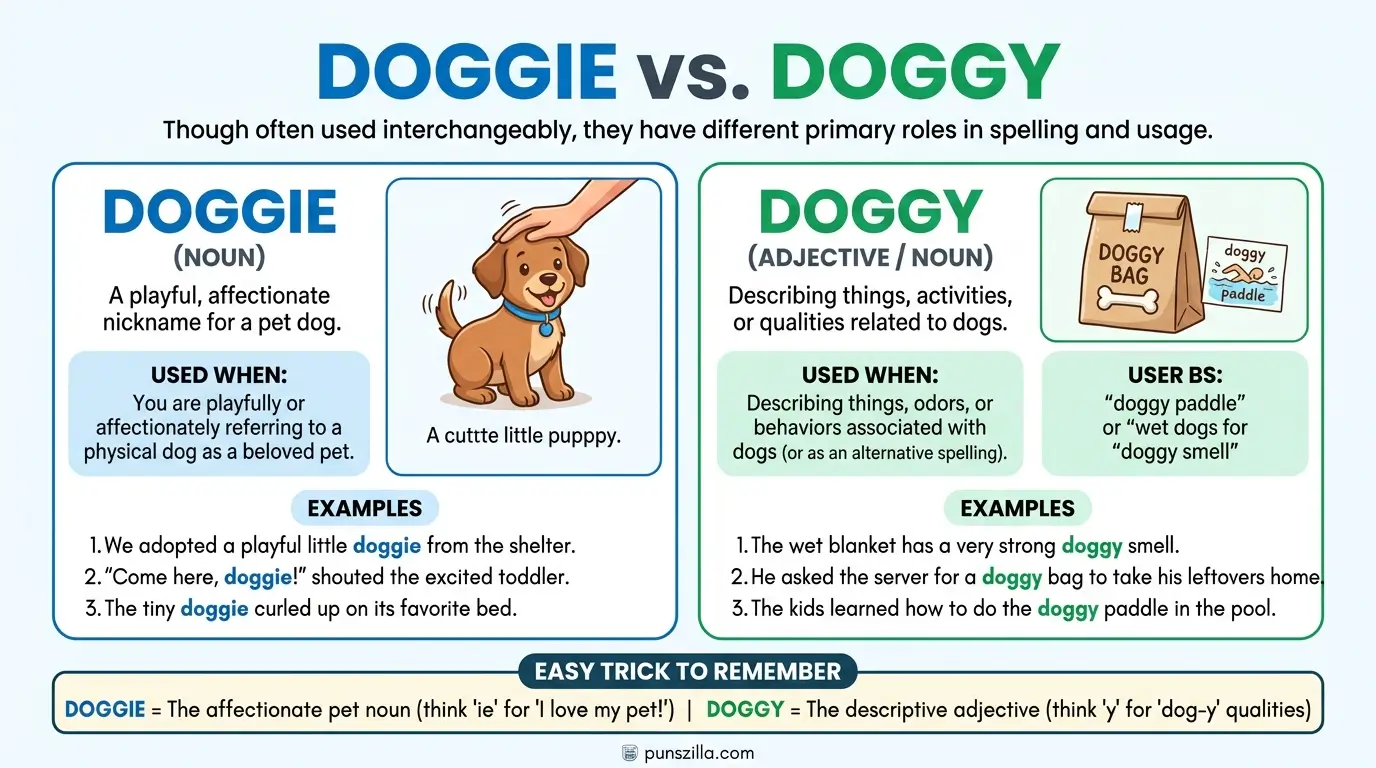
Doggy and doggie are both correct spellings for an informal or affectionate word for a dog, but doggy is generally more common.
If you are unsure whether to write “doggie” or “doggy,” you are not alone. Both spellings appear frequently when people talk about dogs in a cute, affectionate, or informal way.
This makes the choice confusing, especially when writing social media posts, messages, stories, or other content.
The good news is that both “doggie” and “doggy” are correct spellings. They are alternative forms of the same informal word for a dog.
However, “doggy” is generally more common, while “doggie” is also widely accepted and can sometimes sound more affectionate or childlike.
Understanding the difference can help you choose the spelling that best fits your audience and writing style.
Whether you are writing about a family pet, creating a social media caption, or preparing formal content, knowing when to use each version makes your writing clearer.
In this guide, we will explain the meaning, origins, spelling differences, regional preferences, common mistakes, and everyday usage of doggie or doggy.
Doggie or Doggy Quick Answer
“Doggie” and “doggy” are both correct. They are informal terms meaning a dog, especially when speaking affectionately or to children.
Examples:
- Look at that cute doggy!
- The little doggie is sleeping.
- My daughter loves every doggy she sees.
- The child asked to pet the doggie.
If you want the more commonly used spelling, doggy is usually the safer choice.
Quick rule: Use doggy for general informal writing, while doggie is also correct and may sound more cute or affectionate.
The Origin of Doggie or Doggy
Both doggy and doggie developed from the word dog by adding a diminutive ending. A diminutive form often makes a word sound smaller, cuter, or more affectionate.
The spelling doggy uses the ending -y, while doggie uses -ie. English has several examples of this type of spelling variation.
For example:
- dog → doggy
- dog → doggie
- kitty → kitty
- bird → birdie
- cookie → cookie
The two forms do not have different basic meanings. Both can refer to a dog in an informal and affectionate way.
Over time, doggy became a particularly familiar spelling in everyday English, while doggie remained a common alternative. The difference is therefore mainly one of spelling and style rather than meaning.
British English vs American English Spelling
There is no major British-versus-American spelling rule that makes one form exclusively British or American.
Both doggy and doggie can be found in English varieties around the world. However, usage can vary depending on the writer, publication, age group, and context.
| Spelling | British English | American English | Meaning |
|---|---|---|---|
| doggy | Correct | Correct | An informal word for a dog |
| doggie | Correct | Correct | An informal word for a dog |
| dog | Correct | Correct | Standard word for the animal |
Unlike differences such as colour/color or centre/center, the choice between doggy and doggie is not primarily a regional spelling difference.
For professional writing, however, dog is normally preferable because doggy and doggie are informal.
Which Spelling Should You Use?
Your choice depends mainly on your audience and writing style.
For American English
Doggy is a safe and familiar choice for informal American English.
Example:
The children were excited to see the friendly doggy.
Doggie is also acceptable, particularly in affectionate or child-focused writing.
For British English
British English also uses both forms. Doggy is a natural choice in many informal contexts, but doggie is not incorrect.
For Commonwealth English
Readers in countries such as Australia, Canada, and New Zealand will generally understand both spellings.
For Global Audiences
If your content is intended for an international audience, doggy is a straightforward choice.
For formal writing, use dog instead of either informal form.
Common Mistakes with Doggie or Doggy
Here are some common mistakes writers make.
Mistake 1: Thinking Doggie Is Wrong
Incorrect assumption: “Doggie” is a misspelling.
Correction: Doggie is a legitimate spelling and can be used in informal English.
Mistake 2: Thinking Doggy Is Only for Children
Although doggy is common in speech directed toward children, adults also use it casually.
Example:
That doggy has such a friendly personality.
Mistake 3: Using Doggy in Formal Writing
“Doggy” is informal. In academic, legal, scientific, or professional writing, dog is usually better.
Instead of:
The doggy was examined by the veterinarian.
Write:
The dog was examined by the veterinarian.
Mistake 4: Assuming the Words Have Different Meanings
In most everyday contexts, doggy and doggie mean the same thing.
Doggie or Doggy in Everyday Examples
The best spelling can depend on the context.
In Emails
Informal:
My daughter loved meeting your doggy yesterday.
Professional:
Thank you for providing information about your dog.
In News Writing
News articles generally use the standard word dog rather than the informal forms.
Example:
A local dog was rescued after becoming trapped in a house.
On Social Media
Both spellings work well.
Examples:
Look at this adorable doggy! 🐶
My little doggie is ready for a walk!
In Formal Writing
Use dog instead.
Example:
The study examined the behavior of domestic dogs.
In Children’s Writing
Both doggy and doggie can work particularly well.
Example:
The little doggie wagged its tail and ran toward Mia.
Doggie or Doggy Google Trends & Usage Data
Search interest for doggy and doggie can vary by country, time period, and context. People may search for these spellings when writing captions, children’s stories, pet-related content, or informal messages.
In general, doggy is the more familiar spelling and tends to be the safer choice when you want a broadly recognizable informal term.
Search behavior does not necessarily mean that one spelling is grammatically correct while the other is wrong. Both forms are established English spellings.
For current search-interest comparisons, Google Trends can be used to compare the terms by country and time period.
Doggie vs Doggy: Side-by-Side Comparison
| Feature | Doggy | Doggie |
|---|---|---|
| Correct spelling | Yes | Yes |
| Meaning | Informal term for a dog | Informal term for a dog |
| Formal writing | Usually avoid | Usually avoid |
| Informal writing | Common | Common |
| Children’s language | Common | Common |
| Social media | Very suitable | Very suitable |
| Affectionate tone | Yes | Yes |
| Best general choice | Yes | Also acceptable |
FAQs About Doggie or Doggy
Is “doggy” a correct word?
Yes. Doggy is a correct informal word meaning a dog, often used affectionately.
Is “doggie” spelled correctly?
Yes. Doggie is also a correct spelling and is an alternative form of doggy.
Which is more common, doggy or doggie?
Doggy is generally the more familiar and commonly preferred spelling, although doggie is also widely understood.
Is doggie more correct than doggy?
No. Neither spelling is inherently more correct. Both are accepted informal forms.
Should I use doggy or doggie in formal writing?
For formal writing, it is better to use dog rather than either doggy or doggie.
Are doggy and doggie pronounced the same?
Yes. In ordinary English pronunciation, doggy and doggie are generally pronounced the same way.
Can I use doggy in a professional article?
You can use it when discussing informal language or when the tone is intentionally casual. Otherwise, dog is more appropriate for professional writing.
Conclusion
So, doggie or doggy? The answer is simple: both are correct. They are informal, affectionate terms for a dog, and neither spelling is considered a standard spelling error.
Doggy is generally the safer choice if you want the more familiar spelling. It works naturally in casual conversations, children’s language, social media captions, and informal writing.
Doggie is equally understandable and can give the word a slightly more affectionate or childlike feel.
The important point is that this is not mainly a British-versus-American spelling difference. Both forms can be found across different varieties of English.
Your choice should depend on your audience, tone, and context.
For formal, academic, scientific, or professional writing, the simplest option is usually dog. For casual and affectionate situations, either doggy or doggie works.
If you need one spelling for general informal use, choose doggy. But don’t worry if you prefer doggie—it is also a perfectly valid spelling.