Counselor or Counsellor: Which Spelling Is Correct?
Counselor is the American spelling, while counsellor is the British spelling; both are correct and mean someone who gives advice or guidance.
If you have ever written “counselor” or “counsellor” and stopped to wonder which spelling is right, you are not alone.
Both forms are correct, but the preferred spelling depends on the type of English you are using.
This small spelling difference can be confusing, especially for students, writers, job seekers, and people writing professional documents.
The word refers to a person who gives advice, guidance, or professional counseling.
The main difference is the extra “l” in counsellor, which is common in British English and many other varieties of English. American English usually uses counselor with one “l.”
Knowing this difference can help you avoid spelling mistakes and make your writing fit your audience.
Whether you are writing an email, application, article, school assignment, or professional document, choosing the correct form makes your writing look polished and consistent.
In this guide, you will learn when to use counselor and counsellor, where the spellings come from, and which version is best for your readers.
Counselor or Counsellor Quick Answer
Counselor and counsellor are both correct spellings.
- Counselor → American English
- Counsellor → British English and commonly used in other varieties influenced by British English
Examples:
- US: I spoke with my school counselor.
- UK: I spoke with my school counsellor.
The meaning is the same. The only difference is the spelling.
The Origin of Counselor or Counsellor
The word counselor/counsellor comes from counsel, meaning advice or guidance. The word ultimately traces back through Old French to Latin roots associated with giving advice or deliberating.
The spelling difference developed as English spelling conventions evolved in different regions.
American English often uses a single l in words such as:
- counselor
- traveler
- canceled
British English often keeps a double l in comparable forms:
- counsellor
- traveller
- cancelled
These differences are part of the wider spelling differences between American and British English.
British English vs American English Spelling
The main distinction is simple:
| English Variety | Preferred Spelling | Example |
|---|---|---|
| American English | counselor | school counselor |
| British English | counsellor | school counsellor |
| Canadian English | counsellor is common | career counsellor |
| Australian English | counsellor | student counsellor |
| New Zealand English | counsellor | guidance counsellor |
American English generally prefers counselor, while British English and several Commonwealth varieties generally prefer counsellor.
The key rule is to stay consistent with the English variety you are using.
Which Spelling Should You Use?
Your choice should depend on your audience.
Use “Counselor” for American Audiences
Choose counselor if you are writing for readers in the United States.
Example:
She works as a school counselor in Texas.
This spelling is standard in American English.
Use “Counsellor” for British Audiences
Choose counsellor when writing for people in the United Kingdom.
Example:
She works as a school counsellor in London.
What About Global Writing?
If your website targets a global audience, either spelling can be correct. However, you should consider your main audience and use one spelling consistently.
For a US-focused website, use counselor.
For a UK-focused or Commonwealth-focused website, counsellor may be more appropriate.
Common Mistakes with Counselor or Counsellor
Here are some common mistakes:
1. Mixing Both Spellings
Avoid using both forms in the same article unless you are discussing the spelling difference.
Incorrect:
Our school counselor works with every student. The counsellor also provides career advice.
Better:
Our school counselor works with every student. The counselor also provides career advice.
2. Assuming One Spelling Is Wrong
Neither spelling is wrong. The preferred form depends on the variety of English.
3. Using “Councellor”
Councellor is not the standard spelling.
Correct forms are:
- counselor
- counsellor
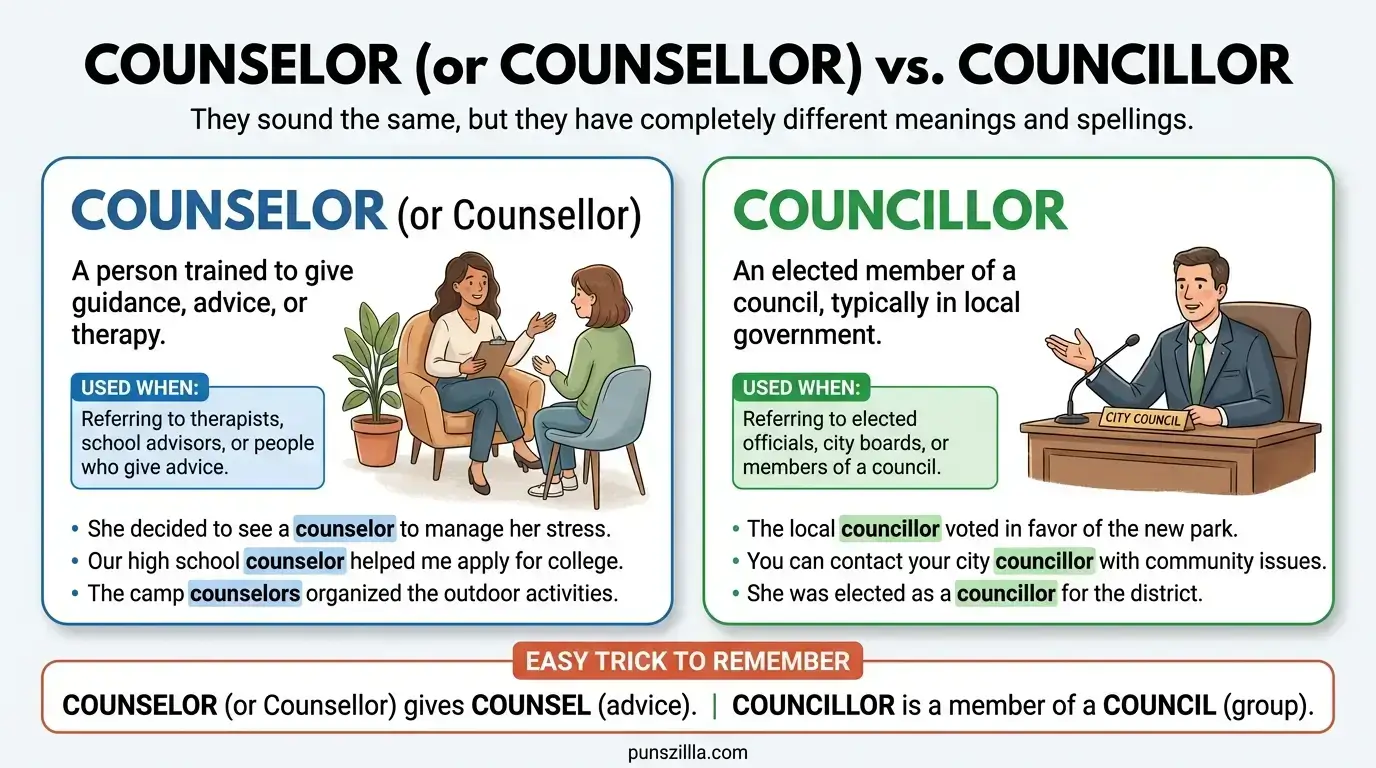
4. Confusing Counselor with Councilor
These words have different meanings.
Counselor/counsellor usually refers to someone who provides advice or guidance.
Councilor/councillor usually refers to a member of a council.
For example:
The school counselor helped me choose my subjects.
The city councilor attended the meeting.
Counselor or Counsellor in Everyday Examples
In Emails
American English:
Dear Counselor,
I would like to arrange a meeting to discuss my academic progress.
British English:
Dear Counsellor,
I would like to arrange a meeting to discuss my academic progress.
In News Writing
American:
The counselor spoke to students after the event.
British:
The counsellor spoke to students after the event.
On Social Media
I finally talked to a counselor about my career plans.
Or:
I finally talked to a counsellor about my career plans.
Both are correct when matched to the appropriate English variety.
In Formal Writing
American English:
The counselor provided guidance to students.
British English:
The counsellor provided guidance to students.
Counselor or Counsellor Google Trends & Usage Data
Search interest can vary by country because people normally search using the spelling used in their local form of English.
Counselor is especially common in the United States, while counsellor is more common in the United Kingdom and countries that generally follow British spelling conventions.
Search volume can also change based on context. For example, people may search for terms such as:
- school counselor
- career counselor
- mental health counselor
- school counsellor
- career counsellor
- guidance counsellor
For current regional search-interest comparisons, you can check Google Trends.
Remember that Google Trends measures search interest rather than proving that one spelling is universally more correct.
Counselor vs Counsellor: Comparison Table
| Feature | Counselor | Counsellor |
|---|---|---|
| Meaning | Person who gives advice or guidance | Person who gives advice or guidance |
| US English | ✅ Preferred | Less common |
| UK English | Less common | ✅ Preferred |
| Canadian English | Sometimes used | Common |
| Australian English | Less common | ✅ Preferred |
| Spelling | One “l” | Two “l”s |
| Correct? | Yes | Yes |
FAQs About Counselor or Counsellor
Is “counselor” or “counsellor” correct?
Both are correct. Counselor is the standard American spelling, while counsellor is the standard British spelling.
Is “counsellor” British English?
Yes. Counsellor is the usual British English spelling.
Is “counselor” American English?
Yes. Counselor is the standard spelling in American English.
Which spelling should I use in the UK?
Use counsellor when writing in British English.
Which spelling should I use in the US?
Use counselor when writing in American English.
Is “councellor” correct?
No. Councellor is a common misspelling. The correct forms are counselor and counsellor.
Are counselor and counsellor pronounced differently?
Usually, no. The two spellings generally have the same pronunciation. The main difference is the spelling.
Conclusion
The choice between counselor and counsellor is mainly a matter of regional spelling. Both words have the same meaning and refer to someone who provides advice, guidance, or professional support.
The important difference is where the spelling is normally used.
Use counselor when writing in American English, especially for readers in the United States.
Use counsellor when writing in British English and many Commonwealth varieties, including Australian and New Zealand English.
Neither spelling is universally better. The best choice depends on your audience and the style of English you are following.
If you are writing for a specific country, follow that country’s standard spelling. If you are writing for a global audience, choose one form and use it consistently throughout your content.
Most importantly, avoid the common misspelling councellor. Once you know the regional difference, choosing between counselor and counsellor becomes simple.