
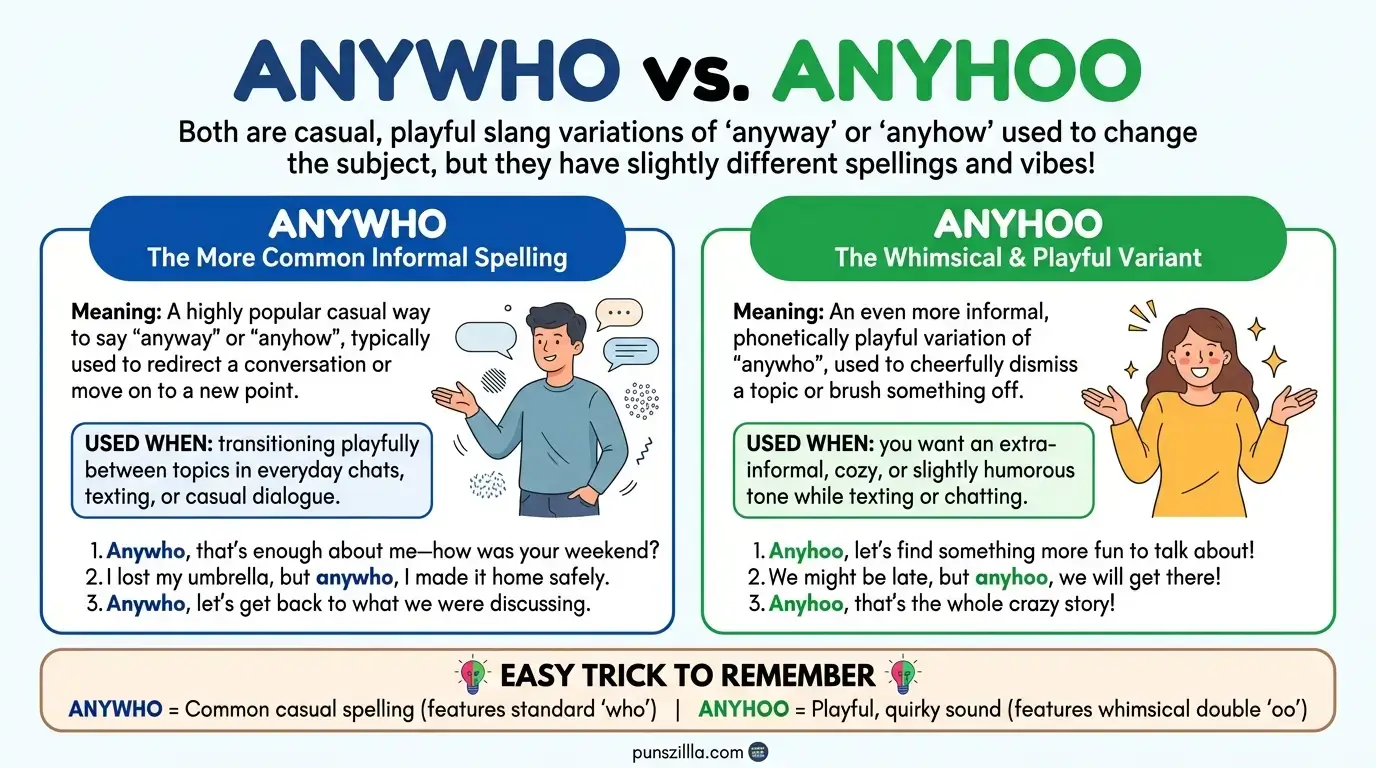
Anywho or Anyhoo: Which Spelling Is Correct?
You are texting a friend. You want to change the subject in a fun way. You reach for a casual word that means “anyway.” Then you stop. Is it anywho or anyhoo?
It is a tiny word with a big question. People say it all the time. But when they write it, they freeze. Both spellings look odd. Both sound the same. So which one is right?
That is why people search for “anywho or anyhoo.” They want a fast answer. They also want to know if the word is real, and if it is safe to use at work.
This guide answers all of it. You get the quick answer first. Then you learn where the word came from. You see how US and UK writers use it. You also get common mistakes, real examples, and answers to common questions.
By the end, you will know which spelling to pick and when to use it.
Anywho or Anyhoo Quick Answer
Both spellings are accepted. Anyhoo is the more common one.
Merriam-Webster lists “anyhoo” as the main entry and “anywho” as a less common variant. It marks the word as informal, humorous, and mostly American. Dictionary.com also lists both, and defines the word as a casual form of “anyhow.”
The word means “anyway” or “in any case.” People use it to change the subject or get back to the point.
Examples:
- “Anyhoo, back to the meeting.”
- “Anywho, how was your weekend?”
- “Anyhoo, I should go.”
Short rule: Use anyhoo if you want the safer pick. Use anywho if you like it better. Never use either one in formal writing.
The Origin of Anywho and Anyhoo
Both words are playful twists on “anyhow.” Someone changed the ending to make it sound silly and warm.
The exact start of the word is not clear, and sources do not agree. Merriam-Webster says it probably began as a joking use of a Scots and Ulster word, “onie-hoo,” meaning “anyhow.”
It gives 1850 as the first known use. Wayword Radio also says the word started in Ireland and is simply a variant of “anyhow.” Dictionary.com dates its first record to the years 1945 to 1950.
So the word is older than many people think. It is not just a modern internet slang term.
Why are there two spellings?
The word was spoken long before it was written. Speakers said “ennee-hoo.” Writers had to guess how to spell the ending. Some picked -hoo. Others picked -who. Neither group was wrong. No rule picked a winner, so both stayed in use.
British English vs American English Spelling
Here is a surprise. This is not like “color” and “colour.” There is no US spelling and no separate UK spelling. Both spellings are used in both places.
The real difference is how often people use the word. Merriam-Webster labels it “chiefly US.” But British writers use it too. The Guardian, a UK newspaper, appears in Merriam-Webster’s examples with the “anyhoo” spelling.
| Feature | American English | British / Commonwealth English |
| Accepted spellings | Anyhoo, anywho | Anyhoo, anywho |
| More common spelling | Anyhoo | Anyhoo |
| How common is the word? | More common in speech | Less common, but understood |
| Tone | Casual, humorous | Casual, humorous |
| Safe in formal writing? | No | No |
| Safer choice | Anyway | Anyway |
The lesson: Do not worry about country. Worry about tone.
Which Spelling Should You Use?
Pick based on your reader.
US audience: Both work in casual writing. Choose anyhoo because it is the main dictionary spelling. Choose anywho if it fits your voice.
UK and Commonwealth audience: Readers will understand both. The word may feel more American to them. Use it only when you want a light, chatty tone.
Global audience: Skip it. Not every reader knows slang. Use “anyway” instead. It is clear everywhere.
Quick guide by setting:
- Texts and chats: either spelling
- Social media: either spelling
- Blog posts with a friendly voice: anyhoo
- Business emails: use “anyway”
- Academic or legal writing: use “anyway” or “regardless”
Stay consistent. Pick one spelling and use it every time in the same piece.
Common Mistakes with Anywho and Anyhoo
Mistake 1: Splitting it into two words.
- Wrong: “Any who, let’s go.”
- Right: “Anywho, let’s go.”
“Any who” is two words. It can appear in a real sentence like “Any who want to come are welcome.” But that is a different meaning.
Mistake 2: Mixing the spellings.
- Wrong: “Anyhoo, I told her. Anywho, she left.”
- Right: Use one spelling in the whole piece.
Mistake 3: Using it in formal writing.
- Wrong: “Anyhoo, we request your payment by Friday.”
- Right: “Anyway, we request your payment by Friday.”
Mistake 4: Forgetting the comma.
- Wrong: “Anyhoo I think we should go.”
- Right: “Anyhoo, I think we should go.”
Mistake 5: Confusing it with “anyone.”
- Wrong: “Anywho can join.”
- Right: “Anyone can join.”
Mistake 6: Using “anyways” as if it were the same. “Anyways” is a different informal word. It is not a spelling of “anyhoo.”
Anywho and Anyhoo in Everyday Examples
Email (friendly, to a coworker you know well):
“Thanks for the update. Anyhoo, can we talk Monday?”
News and magazines:
Writers use anyhoo to sound light and fun. It often shows up in entertainment pieces and columns. Dictionary.com shows examples from the Los Angeles Times and Slate.
Social media:
“Rough Monday. Anywho, coffee is helping.”
Text message:
“Anyhoo, see you at 6!”
Formal writing (what to do instead):
“In any case, we will review the report on Friday.”
Anywho or Anyhoo Google Trends & Usage Data
Search tools show that people look up this word because they are unsure of the spelling. That pattern is common with slang words.
What to expect:
- United States: Highest interest. The word is most at home here.
- Canada, UK, Australia: Steady interest from people who hear it in shows and online.
- Other countries: Lower interest. Often learners of English asking what it means.
Where people use it:
- Spoken English and casual chats
- Social media posts and comments
- Light, funny articles and columns
You can check the latest numbers yourself on Google Trends. Type in “anyhoo” and “anywho,” then compare them by country and by date.
Quick Comparison Table: Keyword Variations
| Word | Meaning | Formal? | Spelling status | Example |
| Anyhoo | Anyway | No | Main dictionary spelling | “Anyhoo, let’s start.” |
| Anywho | Anyway | No | Accepted variant | “Anywho, I’m tired.” |
| Anyhow | Anyway, in any case | Semi-formal | Standard word | “Anyhow, we left.” |
| Anyway | In any case | Yes | Standard word | “Anyway, we left.” |
| Anyways | Anyway | No | Informal, nonstandard | “Anyways, I’m out.” |
| Any who | Any people | Yes (different meaning) | Two words | “Any who wish may join.” |
FAQs About Anywho and Anyhoo
Is “anywho” a real word?
Yes. It is an informal word found in major dictionaries as a variant of “anyhoo.”
Which is correct, anywho or anyhoo?
Both. Anyhoo is the more common spelling.
What does anyhoo mean?
It means “anyway” or “anyhow.” People use it to change the subject or return to a point.
Is anyhoo British or American?
It is mostly American. Merriam-Webster labels it “chiefly US.” Still, British writers use it too.
Can I use anywho in an email?
Only in a casual email to someone you know well. For work emails, use “anyway.”
Is anyhoo slang?
Yes. It is informal and a little humorous.
Is “any who” the same as “anywho”?
No. “Any who” is two words with a different meaning. “Anywho” is one word and means “anyway.”
Where did anyhoo come from?
It is a playful form of “anyhow.” Merriam-Webster says it likely came from a Scots and Ulster word, “onie-hoo.”
Conclusion
Here is what to remember.
Both spellings are correct. Anyhoo is the more common one. Anywho is also accepted. Both mean “anyway.”
It is a casual word. It started as a playful twist on “anyhow.” It has been around for a long time. Merriam-Webster says the first known use was in 1850. Other sources give later dates, so the exact start is still debated.
There is no US or UK spelling. The word is more common in American speech, but both countries understand it.
Match the word to the moment. Use it in texts, social posts, and friendly blogs. Skip it in business, school, and legal writing. Use “anyway” there.
Stay consistent. Pick one spelling and stick with it. Add a comma after it. Do not split it into two words.
When you are unsure, pick “anyway.” It is always safe. But when you want a warm, playful voice, anyhoo is a fun choice.