Divet or Divot: Which Spelling Is Correct?
Have you ever written “divet” and wondered if it should be “divot” instead? You are not alone. This spelling confusion is common because both forms look and sound very similar.
If you are writing about golf, sports, gardening, or a small hollow in the ground, choosing the right word matters.
The correct spelling is divot. Divet is generally considered a misspelling of divot.
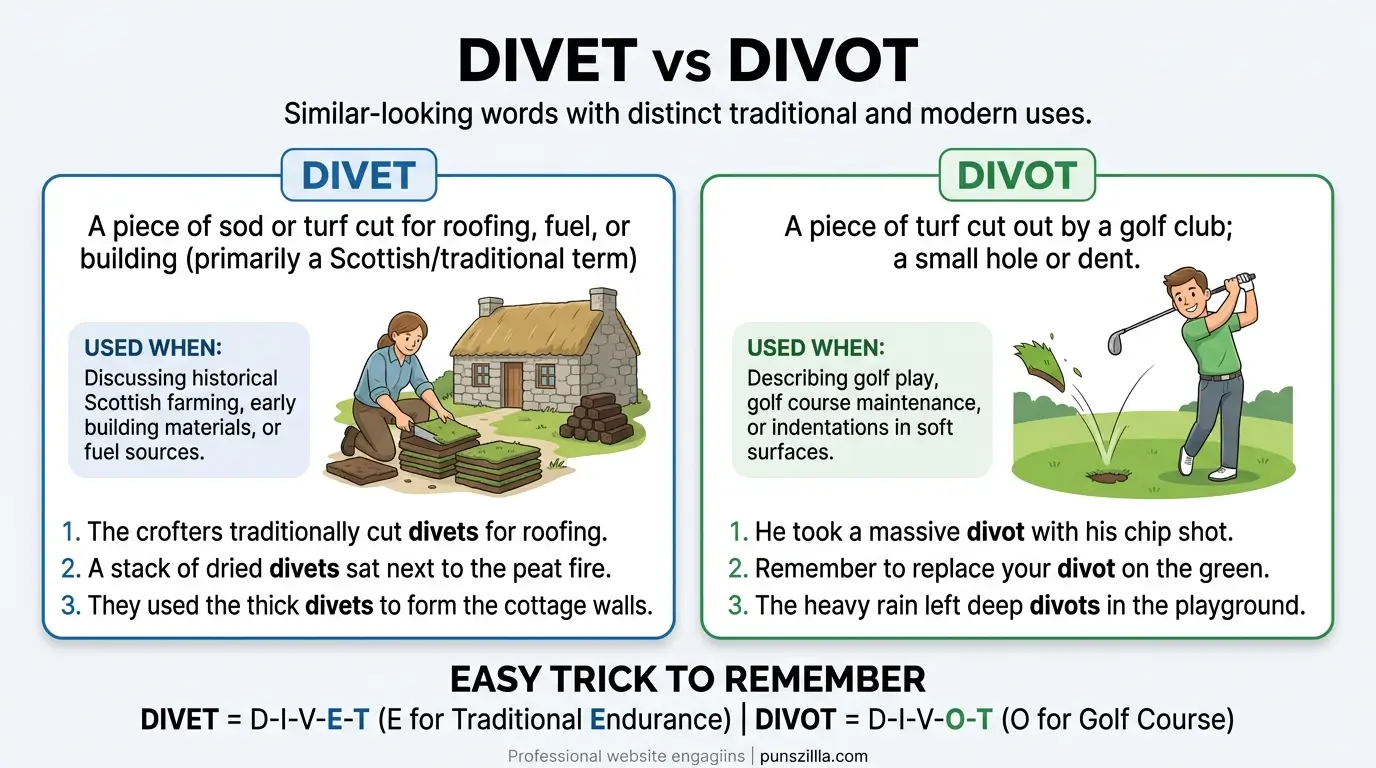
A divot is a small piece of turf or soil that is cut or lifted from the ground, especially when a golfer hits the ground with a club.
For example, you might say, “The golfer made a large divot on the fairway.”
People often search for “divet or divot” because the word is easy to spell incorrectly.
This guide explains the difference, gives simple examples, and shows how to use divot correctly in everyday and formal writing.
Whether you are writing an email, article, social media post, or school assignment, you will know which spelling to choose.
Divet or Divot Quick Answer
Divot is the correct spelling.
Divet is a common spelling mistake and should generally be avoided in standard English.
A divot is a small piece of grass, soil, or turf that is removed from the ground.
Example:
- Correct: The golfer made a deep divot on the fairway.
- Incorrect: The golfer made a deep divet on the fairway.
Quick Rule
Remember:
Divot = correct
Divet = incorrect
The word divot is especially common in golf, where a club can remove a piece of grass and soil from the ground.
The Origin of Divet or Divot
The correct word divot has been used in English for centuries. It originally referred to a piece of turf or a small piece of earth cut from the ground.
The exact history of the word is not completely certain, but divot is linked to older Scottish and northern English forms.
Over time, it became widely used in English, especially in descriptions of turf and later in golf.
The spelling divet likely appears because of pronunciation and the way people expect similar words to be spelled. Since the final sound can be easy to mishear, some writers replace the o in divot with e.
However, standard dictionaries recognize divot as the established spelling.
Today, divot is most strongly associated with golf, but it can also describe a piece of turf or a small patch of ground removed from a surface.
British English vs American English Spelling
Unlike some English words that have different British and American spellings, divot does not normally change between British and American English.
Both varieties use:
divot
The spelling divet is not the standard British or American form.
| English Variety | Correct Spelling | Common Incorrect Form |
|---|---|---|
| American English | divot | divet |
| British English | divot | divet |
| Canadian English | divot | divet |
| Australian English | divot | divet |
| Global English | divot | divet |
Examples
American English:
The golfer replaced the divot after taking the shot.
British English:
The player repaired the divot on the course.
The spelling stays the same in both examples.
Which Spelling Should You Use?
Use divot regardless of whether you are writing for an American, British, or international audience.
For a US Audience
Use divot in golf articles, sports reports, emails, and general writing.
Example:
The course requires players to repair their divots.
For a UK or Commonwealth Audience
Use divot as well.
Example:
He replaced the divot before walking to the next hole.
For a Global Audience
Divot is the safest and standard choice. There is no need to change the spelling based on the country.
If you are unsure, simply remember that the correct word is divot, with an o.
Common Mistakes with Divet or Divot
Here are some common mistakes writers make.
1. Writing “divet”
Incorrect:
The golf ball landed near a divet.
Correct:
The golf ball landed near a divot.
2. Using “divet” in formal writing
Because divet is not the standard spelling, avoid it in schoolwork, professional documents, articles, and reports.
3. Confusing a divot with a hole
A divot is usually a piece of turf or soil removed from the ground. It does not necessarily mean a large hole.
Example:
The club lifted a small divot from the grass.
4. Forgetting the plural form
The plural of divot is divots.
Singular:
The golfer made a divot.
Plural:
The golfer made several divots.
Divet or Divot in Everyday Examples
Understanding how divot works in real sentences makes the spelling easier to remember.
In an Email
Please repair any divots you make on the practice area.
In News Writing
The golf course was damaged by several large divots after the tournament.
On Social Media
I took a great swing, but I left a huge divot behind!
In Formal Writing
Players should replace divots to help maintain the condition of the course.
In Sports Writing
The club struck the ground and sent a large divot flying toward the edge of the fairway.
In Everyday Conversation
There is a divot in the lawn where someone stepped.
Divet or Divot Google Trends & Usage Data
Search interest for “divet or divot” usually comes from people checking which spelling is correct. The confusion is understandable because divet looks like a possible English spelling.
The standard word, however, is divot.
Searches for divot are also strongly connected with golf, sports, turf, lawns, and ground surfaces. Golf is one of the main contexts where people encounter the word.
The spelling question can appear in different English-speaking regions, including the United States, United Kingdom, Canada, and Australia.
Since divot keeps the same spelling across these varieties, there is no British-versus-American spelling issue to resolve.
For SEO and professional writing, using divot consistently is important. If your target keyword is “divet or divot,” you can mention the incorrect form when explaining the spelling, but use divot for the correct word throughout the main content.
Divet vs Divot: Comparison Table
| Feature | Divot | Divet |
|---|---|---|
| Correct spelling | Yes | No |
| Standard English | Yes | No |
| Meaning | Piece of turf or soil removed from the ground | No standard meaning in this context |
| Golf usage | Very common | Incorrect |
| British English | Correct | Incorrect |
| American English | Correct | Incorrect |
| Plural | Divots | — |
| Recommended in formal writing | Yes | No |
FAQs About Divet or Divot
Is “divet” or “divot” correct?
Divot is correct. Divet is generally a misspelling.
What does divot mean?
A divot is a small piece of grass, turf, or soil removed from the ground. The word is especially common in golf.
Is “divet” a real word?
Divet is not the standard spelling for the golf or turf-related word. Use divot instead.
Is divot British or American?
Divot is used in both British and American English. The spelling does not normally change between them.
What is the plural of divot?
The plural is divots.
Example:
The fairway had several divots.
How do you remember the spelling of divot?
Remember that the correct spelling has an o: divot. Think of golf → divot.
What is an example of divot in a sentence?
The golfer replaced the divot after hitting the ball.
Conclusion
When choosing between divet or divot, the answer is simple: divot is the correct standard spelling.
It refers to a small piece of turf, grass, or soil removed from the ground and is especially common in golf.
The spelling divet is a common mistake caused by the similar sound of the word. However, it is not the standard form you should use in professional, academic, or everyday English.
Unlike words such as colour and color, divot does not have separate British and American spellings. Writers in both regions use divot. The plural form is divots.
If you are writing about golf, lawns, sports, or damaged turf, choose divot every time. A simple way to remember it is to associate the word with golf: a golf club can create a divot when it strikes the ground.
Once you remember the o, this spelling choice becomes easy.