Countries or Country’s: What’s the Difference and Which One Is Correct?
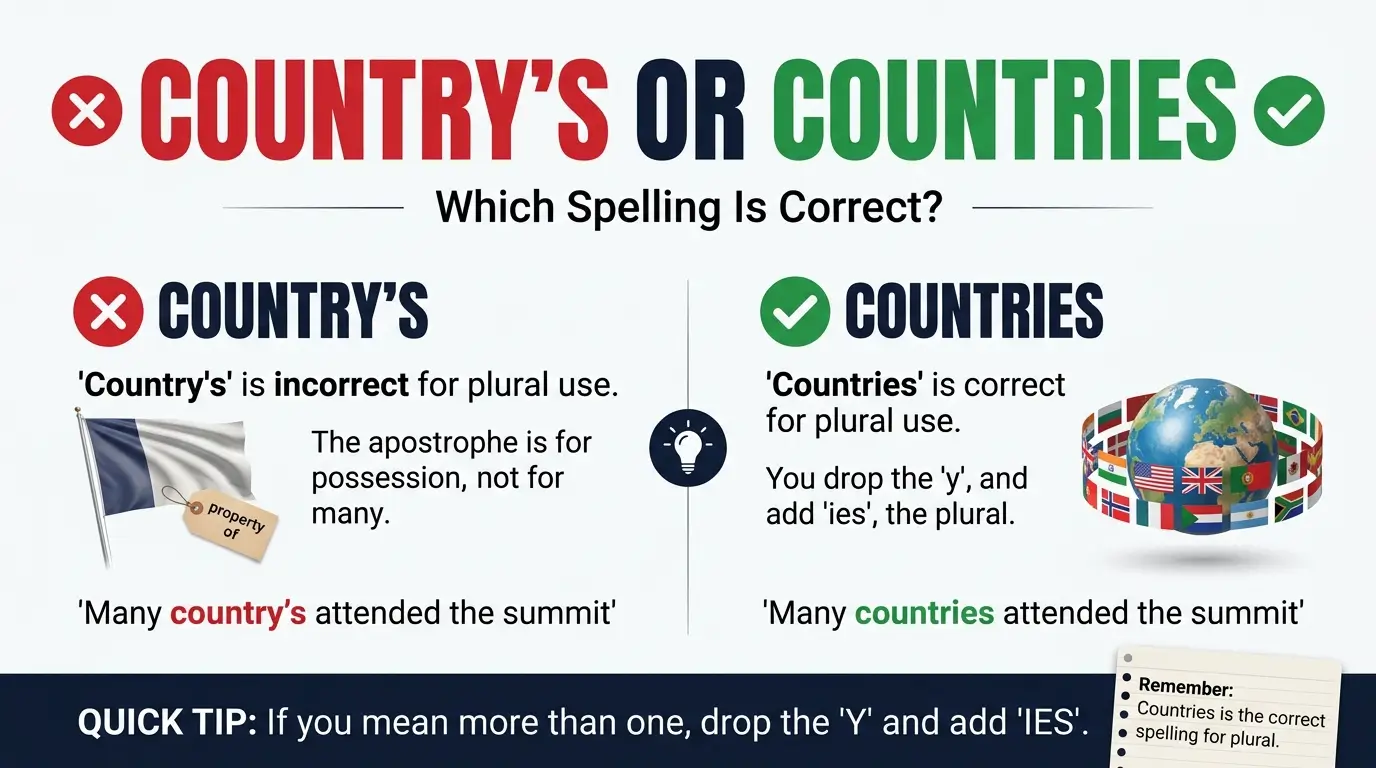
Countries or Country’s? Use countries when you mean more than one country: Many countries joined the meeting. Use country’s when something belongs to one country: The country’s economy is growing.
Countries or country’s may look almost the same, but they have very different meanings. This small spelling difference can change the whole meaning of a sentence.
Many people search for this keyword because they are unsure when to use countries without an apostrophe and when to use country’s with an apostrophe.
The good news is that the rule is simple. Countries is the plural form of country. It means more than one country. For example: Many countries joined the meeting.
On the other hand, country’s is the singular possessive form. It means something belongs to one country. For example: The country’s economy is growing.
The confusion often comes from the apostrophe. Some writers add it when they simply want to make country plural. That is incorrect. An apostrophe does not usually make a noun plural. It shows possession or ownership.
This guide explains the difference between countries and country’s with simple rules, examples, common mistakes, and professional writing advice.
Countries or Country’s Quick Answer
The quick answer is simple:
- Countries = more than one country.
- Country’s = something that belongs to one country.
Examples
Countries:
- Many countries use English.
- European countries work together.
- She has visited five countries.
Country’s:
- The country’s population is increasing.
- The country’s economy is improving.
- We discussed the country’s future.
The Easy Rule
Ask yourself:
Do I mean more than one country?
Use countries.
Do I mean something belonging to one country?
Use country’s.
| Word | Meaning | Example |
|---|---|---|
| Country | One nation | This country is large. |
| Countries | More than one nation | Many countries attended. |
| Country’s | Belonging to one country | The country’s laws changed. |
| Countries’ | Belonging to several countries | The countries’ leaders met. |
The last form, countries’, is also important. It shows possession by more than one country.
The Origin of Countries or Country’s
The word country has a long history. It came into English through Old French and Latin roots connected to land, region, and native territory.
Over time, English developed different forms of the word:
- Country became the singular noun.
- Countries became the plural form.
- Country’s became the possessive form for one country.
- Countries’ became the possessive form for more than one country.
The confusion does not come from British and American spelling. Instead, it comes from English grammar rules about plural nouns and possessive nouns.
English usually adds -s or -es to make a noun plural:
- city → cities
- company → companies
- country → countries
To show that one noun owns or has something, English usually adds ‘s:
- country’s population
- company’s profits
- city’s history
To show possession by a plural noun ending in s, the apostrophe comes after the s:
- countries’ borders
- companies’ employees
- cities’ populations
So, the position of the apostrophe matters.
British English vs American English Spelling
Unlike words such as colour/color or organisation/organization, there is no major spelling difference between British English and American English for countries and country’s.
Both forms follow the same grammar rules in:
- American English
- British English
- Canadian English
- Australian English
- Other forms of standard English
Comparison Table
| Meaning | American English | British English | Example |
|---|---|---|---|
| One country | Country | Country | This country is beautiful. |
| More than one country | Countries | Countries | Several countries agreed. |
| Belonging to one country | Country’s | Country’s | The country’s flag changed. |
| Belonging to several countries | Countries’ | Countries’ | The countries’ leaders met. |
Important Point
The difference is grammatical, not regional.
Whether you write for readers in the United States, the United Kingdom, Canada, Australia, or elsewhere, the same rule applies.
Which Spelling Should You Use?
Your choice depends on what you want to say.
For a US Audience
Use:
- countries for more than one country
- country’s for something belonging to one country
- countries’ for something belonging to several countries
Example:
The countries discussed the country’s new policy.
This sentence may sound complex, but it is grammatically correct. Countries means several nations, while country’s refers to something belonging to one nation.
For a UK or Commonwealth Audience
Use the exact same rules.
Example:
Several countries supported the country’s decision.
The spelling does not change between British and American English.
For a Global Audience
Keep your writing simple and clear. If a sentence has several possessives, consider rewriting it.
Instead of:
The countries discussed the country’s government’s policy.
Write:
Several countries discussed the government’s policy.
Clear writing is often better than complicated grammar.
Common Mistakes with Countries or Country’s
Here are some of the most common errors.
Mistake 1: Using an Apostrophe for a Plural
Incorrect:
Many country’s joined the event.
Correct:
Many countries joined the event.
Why? You are talking about more than one country.
Mistake 2: Forgetting the Apostrophe for Possession
Incorrect:
The countries economy is growing.
Correct:
The country’s economy is growing.
Why? The economy belongs to one country.
Mistake 3: Using Country’s for Several Countries
Incorrect:
The country’s leaders met for talks.
If you mean leaders from several countries, use:
Correct:
The countries’ leaders met for talks.
Mistake 4: Confusing Countries and Countries’
Countries means more than one country.
The countries signed the agreement.
Countries’ shows possession by more than one country.
The countries’ agreement was signed yesterday.
The apostrophe changes the meaning.
Mistake 5: Adding an Apostrophe Automatically
Some writers think every word ending in s needs an apostrophe. This is not true.
Plural: countries
Possessive plural: countries’
Always check the meaning before adding punctuation.
Countries or Country’s in Everyday Examples
In Emails
Countries:
Our company now works with clients in 15 countries.
Country’s:
Please review the country’s new business rules.
Countries’:
We compared the countries’ tax systems.
In News Writing
Several countries announced new plans.
The country’s president spoke to the public.
The countries’ leaders met during the summit.
Each version has a different meaning.
On Social Media
How many countries have you visited?
This country’s food looks amazing!
The countries’ teams are ready for the match.
Short posts can still need correct grammar.
In Formal Writing
The countries signed an international agreement.
The country’s legal system was reviewed.
The countries’ shared interests shaped the decision.
Formal writing often uses possessive forms, so checking apostrophes is important.
Countries or Country’s Google Trends & Usage Data
Search interest in countries is usually much broader than interest in country’s because countries is a common plural noun. People use it when searching for travel, geography, politics, history, population, and world facts.
For example, people may search for:
- countries in Europe
- countries by population
- safest countries
- richest countries
- how many countries are there
The search country’s is often linked to grammar questions or phrases where users want to check apostrophe use.
Common searches may include:
- country’s or countries
- countries or country’s
- country’s vs countries’
- when to use country’s
Usage can vary by country because search topics change by region. However, the grammar rule remains the same everywhere.
Quick Usage Comparison
| Variation | Main Use | Example |
|---|---|---|
| Country | One nation | One country changed its rules. |
| Countries | More than one nation | Five countries joined. |
| Country’s | Possession by one country | The country’s economy grew. |
| Countries’ | Possession by many countries | The countries’ borders changed. |
The key factor is not popularity. It is the meaning of your sentence.
Countries or Country’s: Full Comparison Table
| Word | Grammar Type | Meaning | Correct Example |
|---|---|---|---|
| Country | Singular noun | One nation | The country is large. |
| Countries | Plural noun | More than one nation | Many countries voted. |
| Country’s | Singular possessive | Belonging to one country | The country’s people voted. |
| Countries’ | Plural possessive | Belonging to many countries | The countries’ leaders voted. |
Simple Memory Trick
- No apostrophe: Think more than one → countries
- ‘s after country: Think one country owns something → country’s
- Apostrophe after countries: Think many countries own something → countries’
Frequently Asked Questions
Is it countries or country’s?
Use countries when you mean more than one country. Use country’s when something belongs to one country.
Is countries plural or possessive?
Countries is the plural form of country. It does not show possession.
What does country’s mean?
Country’s means something belongs to or is connected with one country.
What is the plural possessive of country?
The plural possessive form is countries’.
Is “the countries’ leaders” correct?
Yes. It means the leaders belong to or represent several countries.
Why does countries have “ies” instead of “ys”?
When a word ends in a consonant plus y, English often changes y to ies to make it plural: country → countries.
Is there a British and American spelling difference?
No. Countries, country’s, and countries’ follow the same rules in British and American English.
Can I use country’s to mean many countries?
No. Country’s refers to one country. Use countries or countries’, depending on whether you need a plural or plural possessive.
Conclusion
The difference between countries or country’s is simple once you know what the apostrophe does. Use countries when you are talking about more than one country.
For example, Many countries attended the meeting. Use country’s when something belongs to one country, such as The country’s economy is growing.
There is also a third form to remember: countries’. This is the plural possessive form. It shows that something belongs to several countries, as in The countries’ leaders met to discuss the issue.
These forms are the same in British English and American English. This is not a spelling difference between regions. It is a grammar rule based on meaning and possession.
Before choosing a form, ask one simple question: Am I talking about one country, many countries, or something that belongs to one or many countries?
Your answer will tell you which form to use. Once you follow this rule, choosing between countries, country’s, and countries’ becomes quick, clear, and easy.