
Ye or Nay: Which Spelling Is Correct? Meaning, Origin, and Usage
If you have searched for “ye or nay,” you are probably wondering whether this is the correct spelling or whether you should write “yea or nay.”
The confusion is easy to understand because yea, yay, and ye sound similar in some contexts, but they do not mean the same thing.
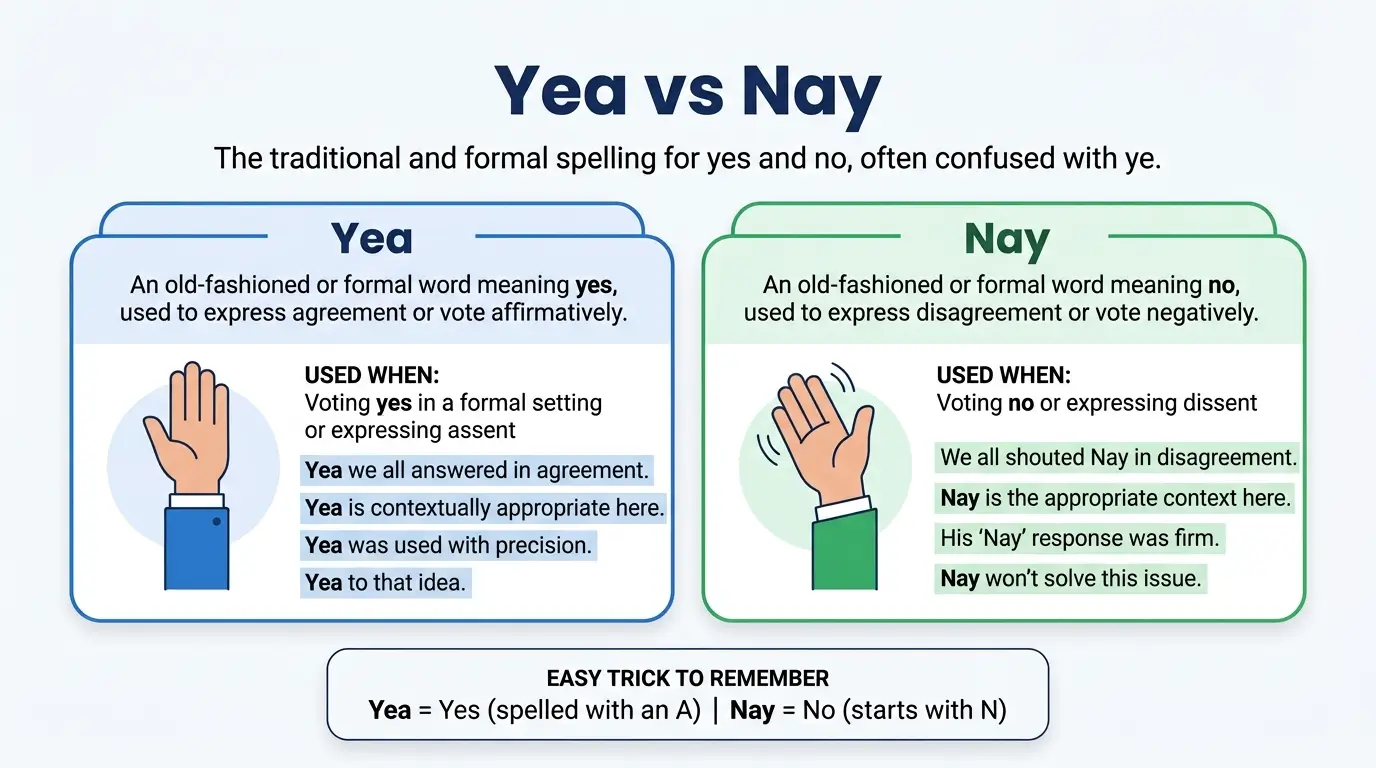
The standard phrase is “yea or nay,” meaning “yes or no.” It is most often used for voting, formal decisions, debates, and traditional or historical writing.
The spelling “ye or nay” does appear in older English texts, but it is not the normal modern spelling. Historical records show forms such as “ye or nay,” while modern dictionaries list yea as the standard word for an affirmative vote.
This guide explains the difference between ye, yea, yay, and nay, so you can choose the right form with confidence.
Ye or Nay Quick Answer
If you mean “yes or no,” the correct modern phrase is:
Yea or nay = yes or no
- Yea = yes, approval, or an affirmative vote.
- Nay = no, rejection, or a negative vote.
- Ye = an older form that can appear in historical English, but it is not the standard modern spelling for an affirmative vote.
Example:
“The committee must decide yea or nay.”
So, if you are writing modern English, choose “yea or nay,” not “ye or nay.” Merriam-Webster defines yea as “yes” and also as a vote in favor of something.
The Origin of Ye or Nay
The phrase “yea or nay” has a long history in English.
The word yea comes from Middle English forms such as ye and ya, which trace back to Old English gēa, meaning “yes.” Merriam-Webster records yea as being in use before the 12th century.
Nay has a different history. It developed from older Germanic forms and is related to Old Norse nei, meaning “not ever.” The word became established in English during the Middle English period.
Older English records show forms such as “ye or nay.” The World English Historical Dictionary includes examples from the Middle English period, including phrases using ye alongside nay.
Over time, yes and no became much more common in everyday English. However, yea and nay survived in voting, government, formal writing, literature, and traditional language.
Why Do People Write “Ye” Instead of “Yea”?
The confusion comes partly from historical spelling.
Older English used several forms, including ye, ya, and other spellings. Modern English settled on yea for the word meaning an affirmative vote or “yes.”
Therefore:
- Historical: ye or nay can be found in old texts.
- Modern standard: yea or nay
- Excitement: yay!
- Everyday agreement: yes
British English vs American English Spelling
Unlike colour/color or organise/organize, yea and nay do not have a major British-versus-American spelling difference.
Both British and American English use yea and nay. The main difference is usage and context, not spelling.
| Form | British English | American English | Meaning |
|---|---|---|---|
| yea | Used, but formal/old-fashioned | Common in formal voting | Yes/approval |
| nay | Used, but formal/old-fashioned | Used in formal voting | No/rejection |
| ye | Mainly historical | Mainly historical | Old English form |
| yay | Informal | Informal | Excitement |
| yes | Very common | Very common | Agreement |
| no | Very common | Very common | Disagreement |
In the United States, yea and nay are still strongly associated with formal voting. Merriam-Webster gives examples of yea as a vote in favor and nay as a vote against.
In British parliamentary language, aye is also important as an affirmative voting term. Thus, British readers may see aye or no in parliamentary contexts.
Which Spelling Should You Use?
The best choice depends on your audience and purpose.
For American English
Use yea or nay when discussing:
- Government votes
- Congressional votes
- Formal meetings
- Historical writing
- Traditional voting language
For normal conversation, yes or no is usually better.
For British English
British readers understand yea or nay, but it can sound formal, old-fashioned, or literary.
For everyday writing, use yes or no.
For parliamentary contexts, aye may be more natural.
For Global English
If your audience is international, yes or no is the clearest option.
Use yea or nay when you specifically want a formal, traditional, or voting-related tone.
Simple Rule
Use “yea or nay” for formal decisions. Use “yes or no” for everyday communication.
Common Mistakes with Ye or Nay
1. Writing “ye” when you mean “yea”
❌ “The members voted ye or nay.”
✅ “The members voted yea or nay.”
Ye can appear in historical English, but yea is the normal modern word for an affirmative vote.
2. Confusing “yea” with “yay”
❌ “Yea! We won!”
✅ “Yay! We won!”
Yea means yes or approval.
Yay expresses happiness or excitement.
3. Confusing “yea” with “yeah”
❌ “Yeah or nay” in a formal voting context.
✅ “Yea or nay.”
Yeah is an informal form of “yes.” It is not the standard spelling for a formal affirmative vote.
4. Using “nay” as if it means “neigh”
❌ “The horse said nay.”
✅ “The horse said neigh.”
Nay means no.
Neigh is the sound made by a horse.
5. Using “yea or nay” in every situation
“Yea or nay” is correct, but it can sound old-fashioned.
Instead of:
“Yea or nay, are you coming?”
Modern English would usually say:
“Are you coming, yes or no?”
Ye or Nay in Everyday Examples
Although yea or nay is formal, you may still see it in several types of writing.
In an Email
Please give me a yea or nay on the proposal by Friday.
This works, but yes or no may sound more natural in a normal business email.
In News Writing
Lawmakers recorded 52 yea votes and 48 nay votes.
This is appropriate when reporting a formal vote.
On Social Media
New logo: yea or nay?
This can work as a playful poll. The old-fashioned phrase gives the post a fun tone.
In Formal Writing
Each member was asked to cast a yea or nay vote.
This is clear and appropriate for a formal voting context.
In Everyday Conversation
Do you want to go? Yes or no?
This sounds much more natural than:
Do you want to go? Yea or nay?
Ye or Nay Google Trends & Usage Data
Search interest in “ye or nay” and related forms is mainly driven by spelling and meaning questions. People often search for the phrase after seeing it in politics, books, historical writing, or online polls.
Google Trends reports relative search interest, rather than giving a fixed worldwide number of searches. Search interest can also change by country, time period, and search wording.
The broader phrase “yea or nay” is more useful for modern English research because it is the standard spelling. Usage is especially linked to:
- United States: politics, government, voting, and law
- United Kingdom: parliamentary, historical, and literary contexts
- Canada: formal and historical usage
- Australia and New Zealand: mostly formal, literary, or historical usage
The phrase is much less common in ordinary conversation than “yes or no.” Modern writing guides also note that yea and nay are mainly associated with formal voting and older language.
Ye or Nay: Keyword Variations Compared
| Variation | Meaning | Correct Modern Use? | Best Context |
|---|---|---|---|
| yea or nay | yes or no | ✅ Yes | Voting/formal writing |
| ye or nay | historical form of yes or no | ⚠️ Historical | Older texts |
| yes or no | yes or no | ✅ Yes | Everyday English |
| yay or nay | excitement or no | ⚠️ Usually avoid | Informal/playful use |
| yea | yes/approval | ✅ Yes | Voting |
| nay | no/rejection | ✅ Yes | Voting/formal writing |
| yay | excitement | ✅ Yes | Informal speech |
| yeah | informal yes | ✅ Yes | Casual conversation |
FAQs About Ye or Nay
Is “ye or nay” correct?
It can be found in historical English, but “yea or nay” is the standard modern phrase when you mean “yes or no.”
What does “yea or nay” mean?
Yea or nay means yes or no. It is often used when asking for an approval or rejection, especially in voting.
Is “yea” the same as “yay”?
No. Yea means yes or approval. Yay expresses excitement or happiness.
Is “yea or nay” formal?
Yes. It often sounds formal, traditional, or old-fashioned. It is especially common in voting and official contexts.
Should I use “yes or no” instead of “yea or nay”?
Usually, yes, when writing for everyday readers. Yes or no is simpler and more natural.
Is “yea or nay” British or American?
Both British and American English use yea or nay. The spelling is the same. Usage varies by context.
What is the difference between “yea” and “nay”?
Yea means yes or approval. Nay means no or rejection.
How do you pronounce “yea”?
Yea is pronounced like “yay” and rhymes with “day.”
Can “yea” be used in an email?
Yes. For example: “Please give me a yea or nay by Friday.” However, yes or no is often clearer for everyday business emails.
Conclusion
The key point is simple: if you mean “yes or no,” the standard modern phrase is “yea or nay,” not “ye or nay.” The shorter form ye has a place in historical English, and old records show that forms such as “ye or nay” were once used.
Today, yea means an affirmative answer or vote, while nay means a negative answer or vote. These words are still used in formal voting, government, legal, historical, and literary contexts. Merriam-Webster confirms yea as both an affirmative response and a vote in favor.
Do not confuse yea with yay. Yea means yes; yay expresses excitement. Likewise, yeah is an informal form of yes.
For everyday writing, yes or no is usually the clearest choice. For voting or a formal traditional tone, yea or nay is the better phrase.