
Rabi or Rabbi: Which Spelling Is Correct?
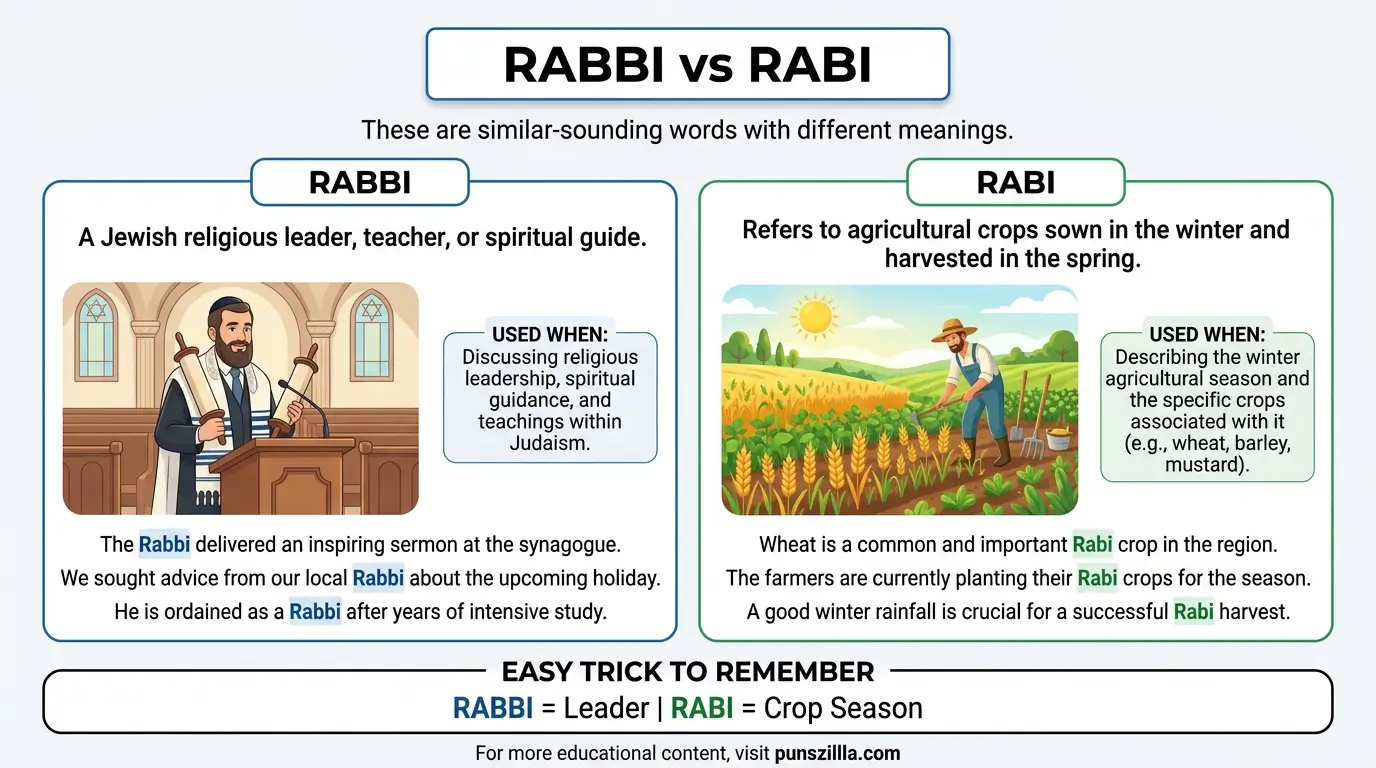
Rabi refers to the winter crop season in South Asia, when crops such as wheat, barley, gram, peas, and mustard are planted in winter and harvested in spring.
When you come across rabi or rabbi, it is easy to wonder whether one is simply a misspelling of the other. The two words look almost identical, but the extra b changes the meaning.
This spelling question often appears in searches because people may hear the word before seeing it written, or they may be unsure how to spell a religious title correctly.
The correct spelling depends on what you mean. Rabbi is the standard English spelling for a Jewish religious teacher or leader.
Rabi can also be a correct word, but it has different uses and meanings. For example, Rabi is commonly used in South Asian English to refer to the Rabi crop season, especially crops planted in winter and harvested in spring.
Understanding the difference helps you avoid mistakes in schoolwork, articles, emails, news writing, and everyday communication.
In this guide, we will explain rabi or rabbi, their origins, meanings, spelling differences, common mistakes, and examples so you can confidently choose the right word.
Rabi or Rabbi Quick Answer
Rabbi is correct when referring to a Jewish religious teacher or leader.
Rabi is correct in certain contexts, especially in South Asian usage, such as the Rabi crop season.
Examples:
- Rabbi is a Jewish religious leader.
- The farmers planted Rabi crops in November.
- She spoke with the rabbi at the synagogue.
- Wheat is an important Rabi crop in Pakistan and India.
So, if you mean the Jewish religious title, use rabbi with two b’s.
The Origin of Rabi or Rabbi
The words rabi and rabbi have different origins and uses.
Rabbi
Rabbi comes from Hebrew. It is related to the Hebrew word rav, meaning something like “master” or “teacher.” The term developed as a title for Jewish teachers and scholars.
In English, rabbi became the established spelling for a Jewish religious teacher or leader.
Rabi
Rabi has a different history in South Asian usage. The word is associated with the agricultural season known as the Rabi season. The term ultimately relates to an Arabic word connected with spring.
Rabi crops are generally planted during the cooler months and harvested in spring. Common examples include wheat, barley, peas, and mustard.
Because these words developed in different linguistic and cultural contexts, rabi and rabbi should not normally be treated as alternative spellings of the same word.
British English vs American English Spelling
There is no major British-versus-American spelling difference between rabi and rabbi.
In both British and American English:
- Rabbi = Jewish religious teacher or leader
- Rabi = used in specific contexts, especially agriculture in South Asian English
The spelling rabbi remains standard in both varieties of English when referring to the Jewish title.
| Meaning | British English | American English |
|---|---|---|
| Jewish religious teacher | Rabbi | Rabbi |
| South Asian agricultural season | Rabi | Rabi, when discussing the term |
| Winter-grown South Asian crops | Rabi crops | Rabi crops |
| Jewish religious title | Rabbi | Rabbi |
Unlike words such as colour/color or centre/center, rabi or rabbi is not mainly a British-versus-American spelling issue.
Which Spelling Should You Use?
Choose the spelling based on your meaning and audience.
For US English
Use rabbi when discussing a Jewish religious leader.
Example:
“The rabbi gave a speech at the synagogue.”
If you are discussing South Asian agriculture, Rabi is appropriate when referring to the crop season.
For UK and Commonwealth English
The same basic rule applies. Use rabbi for the Jewish religious title and Rabi for the agricultural term.
For Global English
Always consider the context before choosing the spelling. If your article is about Judaism, rabbi is almost certainly the word you need. If you are discussing farming in countries such as Pakistan or India, Rabi may be the correct term.
Common Mistakes with Rabi or Rabbi
1. Writing “rabi” for the Jewish title
Incorrect:
The rabi spoke to the congregation.
Correct:
The rabbi spoke to the congregation.
2. Writing “rabbi crops”
If you mean the South Asian agricultural season, the usual spelling is Rabi crops, not rabbi crops.
Correct:
Wheat is one of the major Rabi crops.
3. Treating them as simple spelling variants
Rabi and rabbi are not simply two spellings of the same word. Their meanings differ.
4. Capitalizing every use of Rabbi
When rabbi is used as a general title, it is often lowercase.
Example:
The rabbi answered the question.
When used directly before a person’s name as a title, capitalization may be appropriate depending on the style being followed.
Example:
Rabbi David Cohen spoke at the event.
Rabi or Rabbi in Everyday Examples
In Emails
Rabbi:
Dear Rabbi Cohen,
Thank you for speaking with our group.
Rabi:
The report includes information about Rabi crops.
In News Writing
Rabbi:
The rabbi addressed the community during the ceremony.
Rabi:
Farmers are preparing their fields for the Rabi season.
On Social Media
Rabbi:
We learned a lot from the rabbi’s talk today.
Rabi:
Wheat is one of the most important Rabi crops in the region.
In Formal Writing
Rabbi:
The rabbi serves as a teacher and spiritual leader within the Jewish community.
Rabi:
Rabi crops are generally cultivated during the cooler part of the year.
Rabi or Rabbi Google Trends & Usage Data
Search interest for rabi and rabbi can vary greatly depending on country and context.
The term rabbi has broad international use because it refers to a Jewish religious title. It is therefore likely to appear in searches related to Judaism, synagogues, Jewish history, religious studies, and community leaders.
Rabi has a more specialized use. In South Asian contexts, it commonly appears in searches about agriculture, farming seasons, wheat production, weather, and crop cultivation.
Google Trends can show different patterns by country because the same spelling may be associated with different subjects.
For example, searches from South Asian regions may include Rabi crop or Rabi season, while searches elsewhere may focus more heavily on rabbi and Jewish religious topics.
Because search interest changes over time, location, and search intent, Google Trends data should be viewed as a snapshot rather than a permanent measure of word popularity.
Rabi vs Rabbi: Comparison Table
| Word | Meaning | Common Context | Example |
|---|---|---|---|
| Rabbi | Jewish religious teacher or leader | Judaism | The rabbi spoke to the congregation. |
| Rabi | Agricultural season | South Asian agriculture | Wheat is a major Rabi crop. |
| Rabbi | Religious title | Synagogue/community | She met the rabbi after the service. |
| Rabi | Crop-growing season | Farming | Farmers prepare for the Rabi season. |
FAQs About Rabi or Rabbi
Is “rabbi” the correct spelling?
Yes. Rabbi is the standard English spelling for a Jewish religious teacher or leader.
Is “rabi” a word?
Yes. Rabi is used in specific contexts, especially to describe the agricultural season and crops grown during that season in South Asia.
Is rabi or rabbi correct for a Jewish religious leader?
Rabbi is correct. The word normally contains two b’s.
Is Rabi a crop?
Rabi refers to an agricultural season, not one specific crop. Wheat, barley, peas, and mustard are examples of Rabi crops.
Why does rabbi have two b’s?
The English spelling rabbi developed from the Hebrew religious title. The double b is part of the established English spelling.
Is “Rabi” the British spelling of “Rabbi”?
No. Rabi is not a British spelling variant of rabbi. They have different meanings.
Should Rabbi be capitalized?
It depends on how it is used and the style guide being followed. As a general title, it is often lowercase: the rabbi. Before a person’s name, it can be capitalized: Rabbi David Cohen.
Conclusion
The difference between rabi or rabbi is more than one letter. Rabbi is the standard English spelling for a Jewish religious teacher or leader, while Rabi is commonly used in South Asian agricultural contexts to describe a farming season and its crops.
If you are writing about Judaism, a synagogue, Jewish religious studies, or a religious leader, choose rabbi. If you are discussing crops such as wheat that are grown during the South Asian winter agricultural season, Rabi is the appropriate term.
The two words should not normally be treated as interchangeable spellings. Their meanings come from different linguistic and cultural backgrounds.
Remembering this simple distinction will help you avoid spelling errors in academic writing, news articles, emails, social media posts, and professional content.
When in doubt, look at the meaning of the sentence first: rabbi relates to Jewish religious leadership, while Rabi commonly relates to agriculture.