
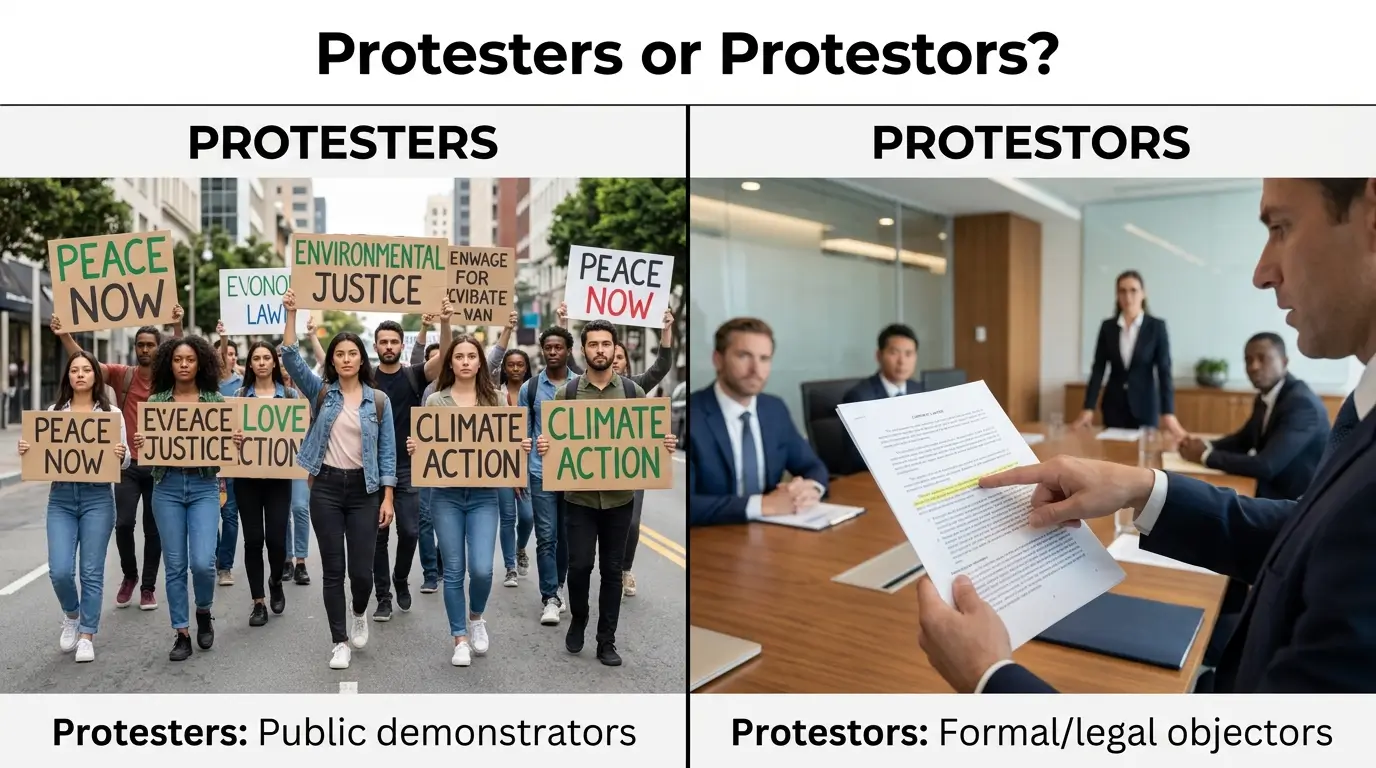
Protesters or Protestors: Which Spelling Is Correct?
Protesters or Protestors: Both are correct, but “protesters” is more common and the best choice for most writing.
If you have ever stopped while writing the word protesters or protestors, you are not alone. Both spellings appear in dictionaries, newspapers, websites, and everyday writing. But which one should you use?
The short answer is simple: both “protesters” and “protestors” are correct. However, protesters is much more common in modern English, especially in American English and general international writing.
Protestors is also accepted, but it is less common and may appear more often in some formal, legal, or British contexts.
People often search for this spelling because the word “protest” can take more than one ending. The question is whether the person who protests should be called a protester or a protestor.
This guide explains the difference, where each spelling comes from, and when to use each one.
Whether you are writing an email, school assignment, news article, website, or formal document, this guide will help you choose the spelling that sounds natural and professional.
Protesters or Protestors Quick Answer
Protesters and protestors are both correct spellings for people who take part in a protest.
However, protesters is the more common spelling and is usually the best choice for general writing.
Examples
- Correct: Thousands of protesters gathered outside the building.
- Correct: Thousands of protestors gathered outside the building.
- Most common choice: Thousands of protesters gathered outside the building.
The words have the same meaning. There is no major difference in what they describe.
| Spelling | Correct? | Meaning | Commonness |
| Protester | Yes | A person who protests | More common |
| Protestor | Yes | A person who protests | Less common |
| Protesters | Yes | More than one person who protests | More common |
| Protestors | Yes | More than one person who protests | Less common |
Quick tip: When in doubt, use protester. It is widely understood and is the standard choice in most modern writing.
The Origin of Protesters or Protestors
The word protester comes from the verb protest, which has roots in Latin.
The English word protest developed from the Latin protestari, meaning “to declare publicly” or “to make a statement.” Over time, protest became associated with expressing disagreement or opposition.
English often creates nouns for people by adding endings such as -er or -or.
For example:
- teach → teacher
- write → writer
- drive → driver
- act → actor
- inspect → inspector
This helps explain why both protester and protestor exist.
The -er ending is very productive in English. It commonly forms a noun for someone who performs an action. Therefore, protest + er naturally gives us protester.
The -or ending also forms nouns referring to people who perform an action. This pattern appears in words such as actor, creator, and operator. As a result, protestor developed as another acceptable form.
Over time, protester became much more widely used.
British English vs American English Spelling
There is no strict rule saying that British English must use protestor and American English must use protester.
In fact, protester is common in both British and American English.
The main difference is usage frequency rather than a fixed spelling rule.
| English variety | More common form | Alternative |
| American English | Protester | Protestor |
| British English | Protester | Protestor |
| Canadian English | Protester | Protestor |
| Australian English | Protester | Protestor |
| International English | Protester | Protestor |
American English
American publications generally favor protester.
Example:
Protesters marched through the city center.
British English
British English also commonly uses protester.
Example:
Protesters gathered outside Parliament.
Therefore, it is incorrect to assume that protestors is the British spelling and protesters is the American spelling. Both forms can be found in different varieties of English.
Which Spelling Should You Use?
For most writers, protester is the safest choice.
Use “protester” when:
- You are writing for a general audience.
- You are writing in American English.
- You are writing for an international audience.
- You want the more common spelling.
- You are writing an SEO article or website content.
- You want your wording to sound natural to most readers.
When can you use “protestor”?
Protestor is still correct. You may see it in newspapers, legal writing, academic material, or organizations that have chosen that spelling as part of their style.
The key is consistency. If your publication, organization, or client prefers protestor, there is no grammatical error in following that preference.
For general-purpose writing, however, protester is usually the better option.
Common Mistakes with Protesters or Protestors
Mistake 1: Thinking one spelling is completely wrong
Some writers believe protestor is incorrect.
That is not true. Both protester and protestor are accepted words.
Correct:
The protesters gathered peacefully.
Also correct:
The protestors gathered peacefully.
Mistake 2: Assuming “protestors” is only British
This is another common misunderstanding.
British writers can use protesters, and American writers can encounter or use protestors.
There is no simple US-versus-UK rule here.
Mistake 3: Changing the meaning
The two words do not normally have different meanings.
Protester = a person who protests.
Protestor = a person who protests.
Mistake 4: Mixing spellings in the same article
Avoid switching between forms without a reason.
For example:
The protesters entered the square. Later, the protestors spoke to reporters.
This is not grammatically wrong, but it can look inconsistent.
A better approach is:
The protesters entered the square. Later, the protesters spoke to reporters.
Protesters or Protestors in Everyday Examples
Both spellings can work in many types of writing.
In an email
Several protesters gathered near the main entrance.
In a news article
Police said the protesters remained peaceful throughout the demonstration.
On social media
Thousands of protesters joined today’s march.
In formal writing
The report examined the actions of protesters during the demonstration.
With “protestor”
The organization issued a statement supporting the protestors.
Again, both forms are grammatically acceptable. Protesters is simply the more familiar choice for most readers.
Protesters or Protestors Google Trends & Usage Data
Search interest and published usage show an important point: protesters is generally more popular than protestors.
The difference can vary by country, publication, time period, and context. News organizations may also follow their own editorial style.
The word protesters is especially common in:
- News reports
- General websites
- American English
- International news
- Everyday writing
- Search queries
Protestors appears less often but remains recognizable and correct.
Google Trends can help show relative search interest over a selected period and location. However, Google Trends measures search interest, not the total number of times a word appears in written English.
Search popularity should therefore not be treated as a complete measure of language usage.
For SEO content, protesters is usually the stronger primary spelling because it is more familiar and commonly used. You can mention protestors naturally as the alternative spelling to capture related searches.
Protesters vs Protestors: Comparison Table
| Feature | Protesters | Protestors |
| Correct spelling | Yes | Yes |
| Meaning | People who protest | People who protest |
| Commonness | More common | Less common |
| US English | Common | Used |
| UK English | Common | Used |
| Formal writing | Suitable | Suitable |
| News writing | Very common | Less common |
| SEO use | Strong primary choice | Useful variant |
| Best general choice | Yes | Alternative |
FAQs About Protesters or Protestors
Is “protesters” or “protestors” correct?
Both protesters and protestors are correct. However, protesters is the more common spelling.
Is protestor a real word?
Yes. Protestor is a real and accepted English word meaning a person who protests.
Is “protester” more common than “protestor”?
Yes. Protester is generally much more common in modern English.
Is protestor British English?
Not exclusively. Protestor can be used in British English, but protester is also very common in Britain.
Should I use protesters in American English?
Yes. Protesters is the usual and safest choice in American English.
Do protesters and protestors mean the same thing?
Yes. In normal usage, both words mean a person or people who take part in a protest.
Which spelling is better for SEO?
Protesters is usually the better primary keyword because it is more common. You can also mention protestors naturally as a spelling variant.
Conclusion
When choosing between protesters or protestors, there is no need to worry about a major grammar mistake. Both spellings are correct, and both refer to people who protest.
The main difference is popularity. Protester and protesters are much more common in modern English, making them the best choices for most general, professional, academic, and online writing. Protestor and protestors are also valid, but they are less frequently used.
There is no strict rule that assigns one spelling to American English and the other to British English. Writers in both varieties may use either form.
If you are writing for a broad audience, the simplest advice is to choose protester. It is familiar, clear, and widely accepted. If your employer, publication, or style guide prefers protestor, you can use it without concern.
Most importantly, stay consistent throughout your writing. Choose one form and use it naturally rather than switching between the two.
Related Posts: Afternoon or Evening? How to Know the Difference (With Clear Time Ranges)