
Might or May: Which Is Correct?
You are writing an email. You want to say something is possible. Then you stop. Do you write “might” or “may”?
Many writers freeze at this point. Both words look right. Both talk about possibility. So why do grammar guides treat them as two different words?
That is why people search “might or may” every day. They want a fast, clear answer. They do not want a long lecture on modal verbs.
This guide gives you that answer. You will learn when each word fits best. You will see simple rules, real examples, and a memory trick. You will also learn the small cases where only one word works.
Whether you write essays, work emails, or social posts, this guide helps. No grammar degree is needed. Each rule is short and easy to test.
By the end, you will choose between might and may with confidence.
Might or May Quick Answer
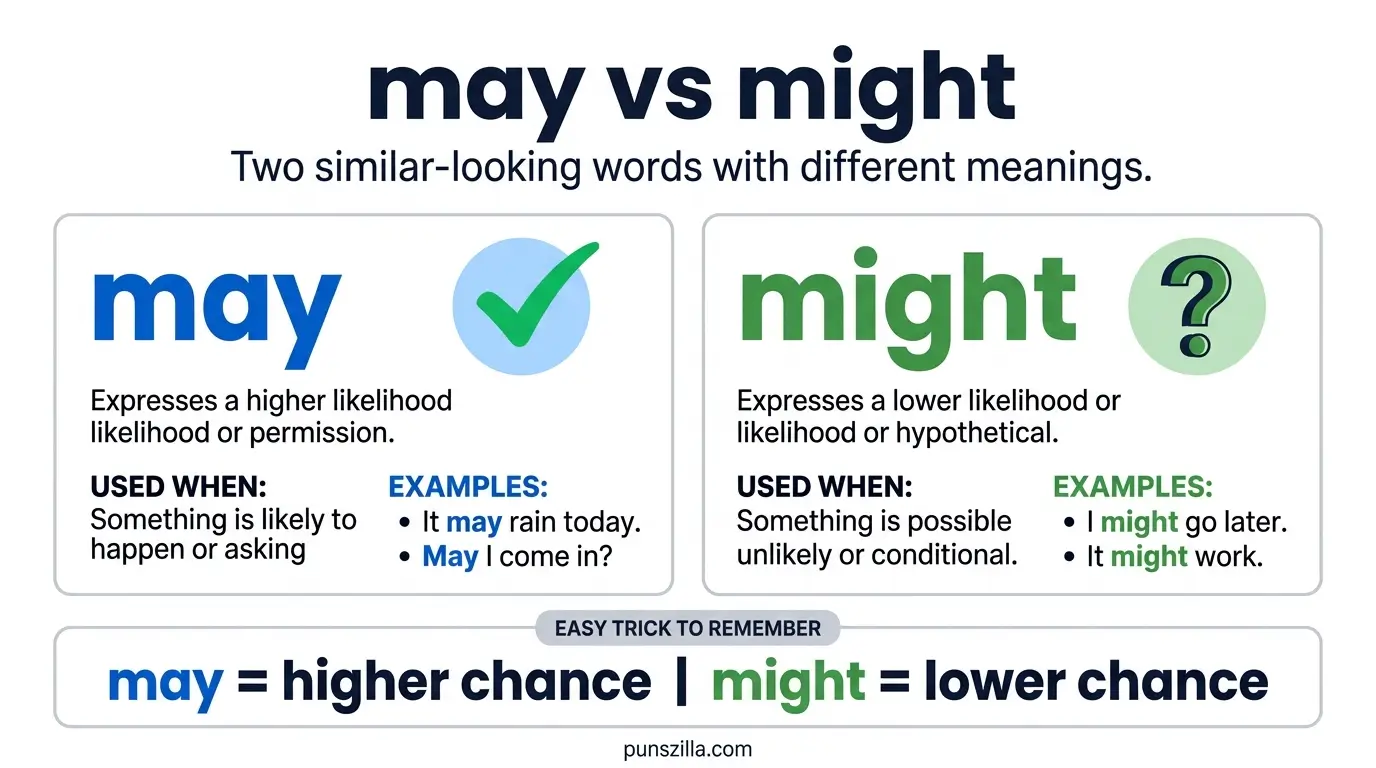
Quick Answer: Use “may” for permission and for a real chance that something happens. Use “might” for a smaller chance, an unreal situation, or a polite, formal request.
In everyday speech, the two often swap places for simple possibility. Only “might” works for things that did not happen.
Examples with “may”:
- You may leave early today.
- It may rain this afternoon.
- She may join us for dinner.
Examples with “might”:
- It might rain, but I doubt it.
- If I had more time, I might learn Spanish.
- He said he might be late.
The Origin of Might or May
Might began as the past form of may. Over time, the two words took on different jobs.
May stayed with the present and future. Might kept some past uses. It also grew into a word for weak or unreal possibility.
Both words belong to a small group called modal verbs. Can, could, will, and would are in the same group. Modal verbs add meaning such as permission, ability, or chance.
Because the two words share a source, they still overlap today. That overlap is why many writers mix them up.
For a full word history, see the dictionary entry for may.
Difference Between Might and May
Think of may and might as two tools. They look alike, but each has a best use.
Rule 1: Permission → use may. Use may when you allow or ask for something. “May I sit here?” is polite and standard.
Rule 2: Real chance → may fits well. “The meeting may start late.” The chance feels real.
Rule 3: Small chance → might fits well. “The meeting might start late, but I doubt it.”
Rule 4: Unreal situations → use might. “If I had more time, I might learn French.”
Rule 5: Reported speech → use might. “She said she might come.”
Rule 6: Past events that did not happen → use might have. “If you had asked, I might have helped.”
In many everyday sentences, the may vs might choice makes little difference.
| Word | Use when | Example sentence |
|---|---|---|
| may | You give or ask for permission | May I borrow your pen? |
| may | The chance feels real | The store may be open now. |
| might | The chance feels small | We might win, but it is unlikely. |
| might | You imagine an unreal situation | If I were taller, I might play basketball. |
| might | You report what someone said | He said he might call later. |
| might have | A past event did not happen | I might have missed the train, but I ran. |
Which Word Should You Use?
Choose by context, not by region. Here is one simple rule to remember:
May = allowed or likely. Might = unlikely or imaginary.
In casual talk: Might sounds natural for guesses. “I might order pizza tonight.”
In rules and notices: Use may. “Visitors may enter after 9 a.m.”
In imagined situations: Use might. “If it snowed, we might stay home.”
Exam advice (IELTS and TOEFL): Use may for permission and likely results. Use might for doubt and unreal ideas. Keep your meaning clear in every sentence. Clear meaning matters most in any test.
Business email advice: “May I” sounds polite and professional. “We might consider a new plan” softens a suggestion. Avoid “Might I” unless your tone is very formal.
Common Mistakes with Might or May
| Wrong | Right | Why |
|---|---|---|
| I may have won if I had practiced. | I might have won if I had practiced. | The win did not happen, so use might have. |
| If I had a car, I may drive to work. | If I had a car, I might drive to work. | An imagined situation needs might. |
| It might rains tomorrow. | It might rain tomorrow. | Use the base verb after a modal verb. |
| He may of left already. | He may have left already. | Write “have,” not “of,” after may or might. |
| You might not enter this room. | You may not enter this room. | May not often signals a rule. |
| Might I go to the restroom? (in class) | May I go to the restroom? | Might sounds too stiff for everyday permission. |
Might or May in Everyday Examples
| Context | Example |
|---|---|
| May I schedule a call for Monday? | |
| We might need more time to finish the report. | |
| News headline | Storm May Reach Coast by Friday |
| News headline | Prices Might Rise Next Month, Experts Say |
| Social media post | Might order pizza tonight. Who’s in? |
| Social media post | You may not like this take, but it is true. |
| Formal writing | Visitors may enter only with a valid pass. |
| Formal writing | Further research might reveal different results. |
Might or May Google Trends & Usage Data
Both words are very common in English. Neither one is rare. Usage can vary by topic, writer, and setting. [VERIFY which form is more common overall]
Regional differences are small. Both words appear in US, UK, and global English. Usage can vary, so check the tools below.
| Word | More common in | Where you see it |
|---|---|---|
| may | Formal writing, rules, polite requests | Signs, policies, emails, textbooks, news reports |
| might | Casual talk, storytelling, imagined situations | Conversations, social media, fiction, opinion pieces |
Check It Yourself:
- Open Google Trends and add “may have” and “might have” as two search terms.
- Change the country and time range to see how interest differs.
- Open the Google Books Ngram Viewer and type “may have,might have” to compare use in books.
Comparison Table
| Word | Type/Meaning | Region | Example | Formality | Memory trick |
|---|---|---|---|---|---|
| may | Permission; real chance | All English regions | You may sit here. | More formal | “Mother, may I?” = permission |
| might | Small chance; unreal situations; reported speech | All English regions | I might go, but I doubt it. | Neutral; very formal in “Might I…?” | Might = minor chance |
FAQs
Can I use might and may interchangeably?
Yes, in many everyday sentences. “It may rain” and “it might rain” both work. They differ when you give permission or talk about unreal situations. In those cases, pick the word that fits the rule.
Which shows more doubt, might or may?
Might usually shows more doubt. It suggests a smaller chance than may. However, speakers do not always follow this pattern, so tone and context matter. If you want to sound careful, might is a safe choice.
Is “may” or “might” correct for permission?
May is correct for permission. “May I leave early?” is polite and standard. “Might I leave early?” sounds very formal and old-fashioned to many readers. In daily talk, “can” is also common but less formal.
Is “might” the past tense of “may”?
Historically, yes. Might began as the past form of may. Today it mostly works as its own word. You still see it in reported speech, such as “She said she might call.”
What is the difference between “may have” and “might have”?
Both can show a past possibility when facts are unknown. “She may have left” and “she might have left” are both fine. Only “might have” works when the event did not happen, as in “If I had tried, I might have won.”
Does “may not” mean the same as “might not”?
No, they often differ. “You may not enter” usually means you are not allowed. “It might not rain” means dry weather is possible. Context decides, because “may not” can also show doubt.
Which should I use in formal writing?
Use may for permission and likely possibility in formal writing. Use might for weaker or unreal possibility. Academic writers often use both to sound careful. Pick the word that matches your meaning, not your mood.
Conclusion
Key Takeaways:
- Use may for permission and a good chance.
- Use might for a small chance or an imagined situation.
- Only might have fits events that did not happen.
- For simple possibility, both words often work.
The choice between might or may is smaller than it looks. In many sentences, both words work well. The difference grows when you give permission, set a rule, or imagine something unreal. Those cases need care.
Here is the simple rule. May means allowed or likely. Might means unlikely or imaginary.
Next time you write an email, test your sentence. Ask one question. Am I giving permission, or am I guessing? If you give permission, pick may. If you guess about something doubtful, pick might.
Use the Trends and Ngram steps above to compare real usage. Then trust your ear and keep your meaning clear. Good writing is not about hard rules. It is about clear choices readers understand at once.
Keep this guide handy for your next email, essay, or exam.