
Dilemna or Dilemma: Which Is Correct?
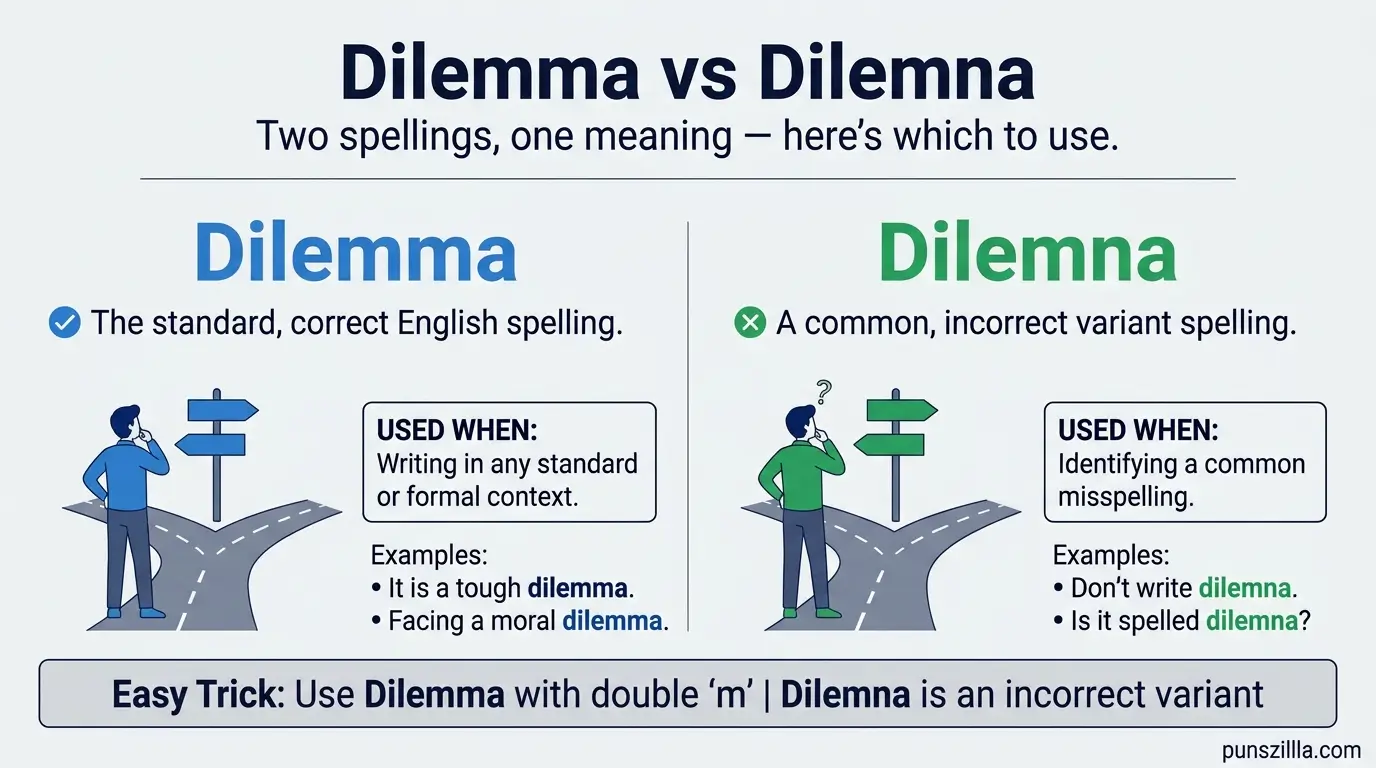
Dilemma is the correct spelling, while dilemna is a common misspelling. Use dilemma when describing a difficult choice or situation. Remember the rule: double m, no n.
Have you ever written dilemna and wondered if it was correct? You are not alone. This spelling confuses many English learners because the word’s pronunciation can make its spelling less obvious.
The correct spelling is dilemma. The spelling dilemna is a common misspelling, not a standard alternative.
Both forms may appear in online searches, social media posts, and informal writing. However, only dilemma belongs in standard English writing.
A dilemma is a difficult situation that requires a choice. Often, both options have drawbacks.
You might face a dilemma when choosing between two job offers, making a tough decision, or trying to please two people with different needs.
Learning this spelling helps you write clearer emails, school assignments, and professional documents. It also helps you avoid spelling errors in exams and online content.
The good news is that you only need one simple rule to remember the correct form.
Write dilemma, with mm in the middle, not mn. This guide explains the spelling, its history, common mistakes, and everyday uses.
Dilemna or Dilemma Quick Answer
Quick Answer: Dilemma is the correct spelling. Dilemna is a common misspelling and is not the standard form in modern English.
A dilemma is a difficult situation that forces you to make a choice. Remember the double m in dilemma to spell it correctly every time.
Examples with dilemma:
- I faced a dilemma when choosing between the two jobs.
- She is in a dilemma about what to study.
- The team must solve a difficult business dilemma.
Examples of the incorrect spelling:
- Incorrect: I have a serious dilemna to solve.
- Correct: I have a serious dilemma to solve.
- Incorrect: He faced a moral dilemna.
- Correct: He faced a moral dilemma.
The Origin of Dilemna or Dilemma
The word dilemma has roots in ancient Greek. It entered English through Latin and became a term used in logic and rhetoric.
The Greek word combines di-, meaning “two,” with lemma, meaning a premise or proposition. The original idea involved an argument with two alternatives.
Over time, the word gained its familiar meaning. Today, it describes a difficult choice or a problem that requires careful thought.
The standard spelling is dilemma, with two m’s. The spelling dilemna may seem reasonable because English has other words with silent letters. However, those patterns do not change the spelling of this word.
Words such as condemn, solemn, and hymn may help explain the confusion. Their silent letters can lead writers to expect a similar pattern in dilemma. However, this is a spelling mistake, not a recognized regional variant.
For a reliable definition and pronunciation, consult the Cambridge Dictionary or the Oxford Learner’s Dictionaries.
Correct Spelling vs Common Misspelling
The difference between dilemma and dilemna is simple. One is correct, and the other is a spelling error in standard English.
The correct word: Dilemma
Use dilemma when describing a difficult choice, a challenging problem, or a situation with competing options.
Examples:
- Choosing between family time and work can create a dilemma.
- The manager faced an ethical dilemma.
- I have a dilemma about which course to take.
The incorrect spelling: Dilemna
Avoid dilemna in essays, emails, reports, and other formal writing. Readers may understand what you mean, but the spelling is still incorrect.
Examples:
- Incorrect: This dilemna is hard to solve.
- Correct: This dilemma is hard to solve.
- Incorrect: She discussed her personal dilemna.
- Correct: She discussed her personal dilemma.
Comparison Table
| Word | Use when | Example sentence |
|---|---|---|
| Dilemma | Writing about a difficult choice or problem | I faced a dilemma about accepting the offer. |
| Dilemna | Not appropriate as the standard spelling | Incorrect: I faced a dilemna about accepting the offer. |
Simple rule: If you mean a difficult choice, write dilemma. Always use mm, never mn.
Which Spelling Is Correct?
There is no standard US or UK spelling difference here. American, British, Canadian, Australian, and other English-language readers should use dilemma.
For US readers
Use dilemma in schoolwork, workplace documents, articles, and everyday messages. Do not use dilemna as an alternative spelling.
Example: The company faces a dilemma over its new policy.
For UK and Commonwealth readers
The same spelling rule applies in the UK and across Commonwealth English. Dilemma is the standard form in formal and informal writing.
Example: She faced a dilemma over whether to accept the position.
For global English learners
If English is not your first language, learn dilemma as a single vocabulary item. Do not rely on spelling patterns from similar-looking words.
For IELTS and TOEFL, always use dilemma. A spelling error may affect the accuracy of your written response. In business emails, reports, and applications, the correct spelling also helps your writing look professional.
Remember: One spelling works across English varieties: dilemma.
Common Mistakes with Dilemna or Dilemma
Many writers make spelling errors when a word sounds different from how they expect it to look. Here are common mistakes to avoid.
| Wrong | Right | Why |
|---|---|---|
| Dilemna | Dilemma | The standard spelling uses mm. |
| Dilemna situation | Dilemma situation | Correct the spelling of the noun. |
| Moral dilemna | Moral dilemma | The correct spelling stays the same in common phrases. |
| Ethical dilemna | Ethical dilemma | Ethical does not change the spelling of dilemma. |
| Dilemnas | Dilemmas | The plural of dilemma is usually dilemmas. |
| Dilemna’s | Dilemma’s | Use the correct spelling before adding an apostrophe. |
Mistake 1: Replacing the Double M
The most common mistake is writing dilemna instead of dilemma.
Incorrect: I cannot decide because this is a difficult dilemna.
Correct: I cannot decide because this is a difficult dilemma.
Mistake 2: Assuming It Is a Regional Variant
Some spelling differences are accepted in different English varieties. For example, colour and color are both correct in their respective settings.
However, dilemna is not a standard British or American alternative. Use dilemma in both varieties.
Mistake 3: Misspelling Common Phrases
The word often appears in phrases such as moral dilemma, ethical dilemma, and personal dilemma. The spelling remains the same in every phrase.
Incorrect: The committee discussed an ethical dilemna.
Correct: The committee discussed an ethical dilemma.
Mistake 4: Using the Wrong Plural
The usual plural form is dilemmas. Do not write dilemnas.
Example: Students discussed several moral dilemmas during class.
Mistake 5: Trusting Spellings Seen Online
A misspelling may appear in comments, posts, or older texts. Seeing it online does not make it standard.
When unsure, check a trusted dictionary before using the word in important writing.
Dilemna or Dilemma in Everyday Examples
Seeing the correct spelling in real situations makes it easier to remember. The following examples show how to use dilemma in different types of writing.
| Context | Example |
|---|---|
| I’m facing a dilemma about which project to prioritize. | |
| Could you help me resolve this dilemma before Friday? | |
| News headline | Local Council Faces a Budget Dilemma |
| News headline | New Rules Create a Dilemma for Small Businesses |
| Social media | My dilemma today: coffee now or an early bedtime? |
| Social media | Choosing between two great options is still a dilemma! |
| Formal writing | The study examines the ethical dilemma faced by medical professionals. |
| Formal writing | The organization must address the dilemma between cost and quality. |
Using Dilemma in Emails
In professional emails, dilemma can describe a decision that needs input from another person.
For example:
- I am facing a dilemma regarding the project schedule.
- I would appreciate your advice on this dilemma.
Use the word when the choice is genuinely difficult. For a simple question, decision or choice may be clearer.
Using Dilemma in News
Journalists often use dilemma to describe competing priorities or difficult public decisions.
For example:
- The city faces a dilemma over housing costs.
- Officials must resolve a dilemma involving growth and conservation.
The word can make a headline sound more serious because it suggests that the available options create problems.
Using Dilemma on Social Media
In casual posts, dilemma can describe serious choices or lighthearted situations.
For example:
- My weekend dilemma is deciding which movie to watch.
- The biggest dilemma: pizza or burgers tonight?
The spelling does not change in casual writing. Always use dilemma, even when the tone is playful.
Using Dilemma in Formal Writing
In academic writing, the word often appears in discussions about ethics, policy, medicine, and business.
For example:
- The case presents a moral dilemma for the research team.
- The report explores the dilemma between economic growth and environmental protection.
Choose the word carefully. It works best when the situation involves a difficult problem or competing choices.
Dilemna or Dilemma Google Trends & Usage Data
The standard spelling is dilemma. The form dilemna is a misspelling, so the two should not be treated as equal alternatives.
Without verified live search data, it would be misleading to give exact popularity figures or claim specific search peaks. The general spelling rule remains the same across regions.
Which Form Is More Common?
Dilemma is the form used in standard dictionaries, formal writing, news reports, books, and educational materials.
Dilemna may appear in spelling searches, social media posts, informal discussions, or texts containing errors. Its appearance in those settings does not make it correct.
| Word | More common in | Where you see it |
|---|---|---|
| Dilemma | Standard English worldwide | Dictionaries, books, news, schoolwork, and professional writing |
| Dilemna | Searches for spelling help and misspelled text | Online questions, informal posts, and typing errors |
There is no accepted regional spelling difference between these forms. Writers in the US, UK, and other English-speaking regions should use dilemma.
Check It Yourself
You can compare the terms using these tools:
- Google Trends: Visit Google Trends and compare searches for “dilemma” and “dilemna.” Select your preferred country and time range.
- Google Books Ngram Viewer: Open Google Books Ngram Viewer and enter both forms. Compare their appearance in the available book collection.
- Check the context: Remember that search interest in a misspelling can reflect people asking which form is correct. It does not prove that the misspelling is accepted.
Check It Yourself: Treat these tools as ways to explore search and publication patterns, not as replacements for dictionary spelling guidance.
Comparison Table
Use this table for a quick final check before publishing or submitting your writing.
| Word | Type/Meaning | Region or Status | Example | Formality | Memory trick |
|---|---|---|---|---|---|
| Dilemma | A difficult choice or problem | Correct worldwide | I faced a dilemma at work. | Formal and informal | Double m is correct. |
| Dilemna | Intended to mean a difficult choice | Common misspelling | Incorrect: I faced a dilemna. | Avoid in standard writing | No n in the middle. |
FAQs
Is dilemna or dilemma correct?
Dilemma is correct. The word has two m’s in the middle. Dilemna is a common spelling mistake. Use dilemma in school assignments, emails, articles, and professional documents.
What does dilemma mean?
A dilemma is a difficult situation that requires a choice. Often, the available options have disadvantages. For example, choosing between two job offers can create a dilemma when each offer has benefits you value.
Why do people spell dilemma as dilemna?
People may confuse the spelling because English contains words with silent letters, such as condemn and solemn.
This pattern can encourage an incorrect spelling. However, the standard form is dilemma, with double m.
Is dilemna ever correct in British English?
No. Dilemna is not a standard British English spelling.
British writers should use dilemma, just like American, Canadian, and Australian writers. It is not an accepted regional alternative.
What is the plural of dilemma?
The usual plural is dilemmas. For example, “The students discussed several dilemmas in class.”
The spelling of the singular word remains the same, and the plural ending is added normally.
How do you use dilemma in a sentence?
You can write, “I faced a dilemma about whether to accept the job.” The word describes a difficult choice. It can also appear in phrases such as moral dilemma, ethical dilemma, and business dilemma.
How can I remember the spelling of dilemma?
Remember the phrase “double m, no n.” The correct spelling is dilemma, not dilemna. You can also write the word several times and use it in a sentence to reinforce the correct spelling.
Conclusion
Key Takeaways:
- Dilemma is the correct spelling in standard English.
- Dilemna is a common misspelling, not a regional variant.
- Use dilemma for difficult choices, ethical problems, and challenging situations.
- Remember the simple rule: double m, no n.
Choosing between dilemna or dilemma becomes easy once you learn the correct spelling. Always write dilemma in schoolwork, business emails, articles, and everyday messages.
The word is useful when you describe a situation where making a decision feels difficult. You might face a personal dilemma, an ethical dilemma, or a business dilemma. In each case, the spelling stays the same.
If you are unsure, check a trusted dictionary before submitting your work. Reading the word in books and reliable articles can also help you remember it.
For students preparing for IELTS or TOEFL, correct spelling matters. For professionals, it helps maintain clear and polished writing. English learners can build confidence by learning the word as a complete unit rather than guessing its spelling.
The final rule is simple: write dilemma, never dilemna in standard English. Remember the double m, and you will avoid this common spelling mistake.