Hayday or Heyday: Which Is Correct?
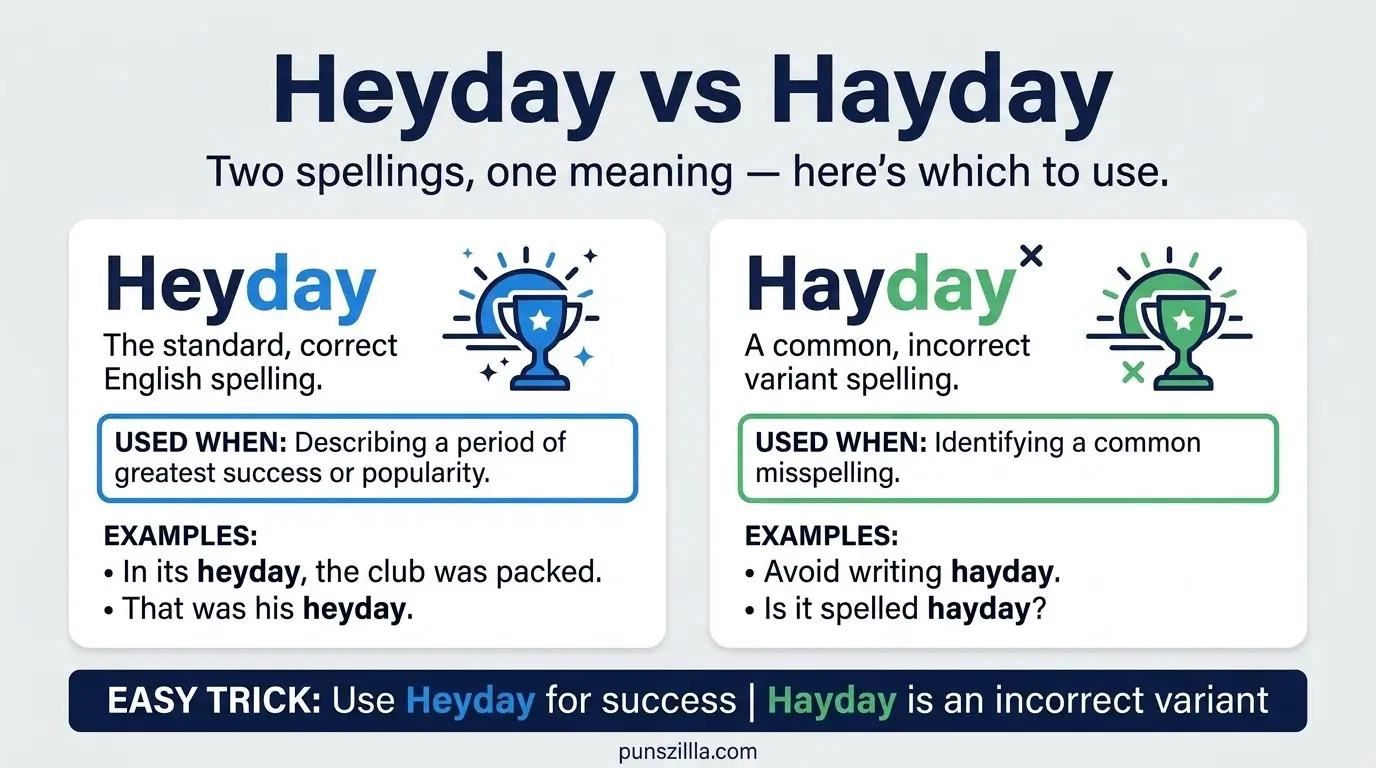
Heyday is the correct spelling when referring to a period of great success or popularity.
Hayday is usually a misspelling, while Hay Day is the name of a farming mobile game.
Have you ever wondered whether to write hayday or heyday? These words look almost identical, so it is easy to mix them up.
However, only one is the standard spelling of the word meaning a period of great success or popularity.
Heyday is the correct spelling when you mean someone’s best or most successful period.
For example, a singer might reach their heyday when their songs become popular worldwide.
Hayday is generally a misspelling of heyday when used with this meaning. You might see it in online searches, social media posts, or casual messages.
It can also appear as a name or in a brand name, such as the mobile game Hay Day. That separate use does not make hayday the standard spelling of the English word.
This guide explains the difference between hayday and heyday. You will learn their meanings, origins, correct usage, and common mistakes.
You will also find simple examples to help you choose the right spelling in schoolwork, business emails, and everyday writing.
The easiest rule is simple: Use “heyday” when talking about a time of success, fame, or popularity.
Hayday or Heyday Quick Answer
Quick Answer: Heyday is the correct spelling for a period when someone or something is most successful, popular, or powerful.
Hayday is usually a misspelling when you intend this meaning. However, “Hay Day” is also the name of a farming mobile game, so check the context before correcting it.
Examples with heyday:
- The band enjoyed its heyday in the 1990s.
- This cinema was popular during the heyday of silent films.
- She often talks about the heyday of her acting career.
Examples with hayday:
- Incorrect: The actor reached his hayday in Hollywood.
- Correct: The actor reached his heyday in Hollywood.
- Special name: I downloaded Hay Day on my phone.
Remember that the game title is written as two words: Hay Day. The ordinary English word is written as one word: heyday.
The Origin of Hayday or Heyday
The word heyday has a long history in English. Its spelling and meaning developed over time.
According to the Oxford Advanced Learner’s Dictionary, heyday dates to the late sixteenth century.
It originally expressed joy, surprise, or excitement. Later, it developed its modern meaning of a period of great success or popularity.
The word’s early form was connected to an exclamation like “heyday!” The modern spelling also reflects the word day, which helps explain its present form.
Today, heyday is a noun. It often describes the best period in someone’s career, a business’s history, or an industry’s development.
For example:
- The actor’s heyday came before the rise of streaming services.
- Vinyl records had a heyday before digital music became widespread.
- The town remembers the heyday of its textile industry.
The spelling hayday likely comes from confusion between the similar sounds of hay and hey.
However, dictionaries recognize heyday as the standard spelling for this meaning.
One important distinction is the game title Hay Day. It combines the ordinary word hay, meaning dried grass used as animal feed, with day. The title is a name, not an alternative spelling of heyday.
Correct Spelling vs Common Misspelling
The correct spelling depends on what you want to say. When describing a period of success, use heyday. When referring to the farming game, use its official name, Hay Day.
The rule for using heyday
Use heyday when someone or something reaches a period of great success, strength, influence, or popularity.
You can use it for:
- A person’s career or life.
- A famous singer, actor, or sports team.
- A successful business or industry.
- A popular trend, technology, or cultural movement.
Examples:
- The restaurant was busiest during its heyday.
- She remembers the heyday of pop music on the radio.
- The company expanded quickly during its heyday.
Comparison table
| Word | Use when | Example sentence |
|---|---|---|
| Heyday | Describing a period of success or popularity | The team reached its heyday in the 1980s. |
| Hayday | Generally a misspelling of heyday | Write “the band’s heyday,” not “the band’s hayday.” |
| Hay Day | Referring to the farming mobile game | My sister enjoys playing Hay Day. |
Easy rule: If you mean someone’s best or most successful time, write heyday. If you mean the game, write Hay Day.
Which Spelling Is Correct?
Heyday is correct when you mean a period of great success or popularity. Hayday is not the standard spelling for that meaning.
This rule applies to American English, British English, and other major varieties of English. There is no standard US-versus-UK spelling difference here.
For American English users
Use heyday in essays, reports, emails, and everyday writing.
Example: “The movie studio enjoyed its heyday during the golden age of cinema.”
For British English and Commonwealth users
Use heyday as well. The spelling remains the same in British English and other major English varieties.
Example: “The railway reached its heyday before widespread car ownership.”
For global English learners
If you are learning English for school, work, or everyday communication, remember heyday.
For IELTS and TOEFL, use the standard spelling in essays and written answers. For business emails, use heyday when discussing a company’s strongest period.
You generally do not need to avoid this word in formal writing. It is a recognized English noun and works well in historical, business, and cultural contexts.
Common Mistakes with Hayday or Heyday
Writers often confuse these spellings because they sound alike. Others use heyday incorrectly because they misunderstand its meaning.
| Wrong | Right | Why |
|---|---|---|
| The singer’s hayday was in the 1990s. | The singer’s heyday was in the 1990s. | Heyday means a period of success. |
| The company is in its hayday. | The company is in its heyday. | Use the standard spelling. |
| He remembers the hayday of rock music. | He remembers the heyday of rock music. | The word refers to a popular period. |
| The team had many heydays. | The team had several successful periods. | Heyday is usually singular; rephrase when clarity helps. |
| I downloaded Heyday to play the farming game. | I downloaded Hay Day to play the farming game. | The game’s name is Hay Day. |
| This is the hey day of her career. | This is the heyday of her career. | The modern noun is normally written as one word. |
Note that heydays can be used as a plural in some contexts. However, heyday is usually singular when describing one person’s or organization’s best period.
How to avoid these mistakes
Read the whole sentence before choosing the spelling. Ask yourself what the word means.
If the sentence describes fame, success, or a golden period, use heyday. If it refers to the farming game, use Hay Day. This simple check can prevent most spelling errors.
Hayday or Heyday in Everyday Examples
The word heyday appears in many types of writing. It is especially useful when discussing history, entertainment, business, and culture.
| Context | Example |
|---|---|
| Our company grew rapidly during its heyday. | |
| I would love to hear about the heyday of your career. | |
| News headline | Local Theatre Recalls Its Heyday |
| News headline | The Heyday of Vinyl Records Returns to Public Attention |
| Social media post | Listening to old songs from the heyday of pop music! |
| Social media post | Remembering the heyday of classic video games. |
| Formal writing | The industry experienced its heyday before digital technology transformed the market. |
| Formal writing | The author’s heyday coincided with a period of major literary change. |
These examples show that heyday works in both casual and formal settings. It is not limited to describing people. You can also use it for businesses, technologies, sports, and cultural movements.
A useful phrase is “in its heyday.” This means during the time when something was most successful or popular.
For example, “In its heyday, the theatre attracted audiences from across the region.”
Another common phrase is “past its heyday.” This suggests that something was once successful but is no longer at its peak.
For example, “The magazine seems to be past its heyday.”
Hayday or Heyday Google Trends & Usage Data
The standard English word is heyday. The spelling hayday often appears when people search for the correct spelling or type the word by mistake.
Without a verified comparison of live search data, it would be misleading to claim exact search volumes, rankings, or regional percentages. The following overview describes the words’ standard uses, not measured search statistics.
General usage patterns
| Word | More common in | Where you see it |
|---|---|---|
| Heyday | Standard English writing worldwide | Books, news, essays, business writing, and conversation |
| Hayday | Searches involving spelling confusion | Search queries, typos, and informal online text |
| Hay Day | People discussing the mobile game | Gaming websites, app listings, and social media |
The spelling heyday is used in American and British English. Its meaning does not change between these varieties.
You may encounter hayday in online content, but its appearance does not establish it as a standard spelling. Search interest can reflect spelling questions rather than correct usage.
Check It Yourself
Check It Yourself:
- Open Google Trends. Compare “heyday” and “hayday” for your country and preferred time range.
- Check the search type and category. Consider whether results include the game Hay Day.
- Open Google Books Ngram Viewer. Compare the words in published books, remembering that book data does not represent every type of online writing.
For the definition and standard spelling, consult the Cambridge Dictionary entry for heyday.
Comparison Table
| Word | Type/Meaning | Region or Status | Example | Formality | Memory trick |
|---|---|---|---|---|---|
| Heyday | A period of success or popularity | Standard worldwide | The singer enjoyed her heyday. | Formal and informal | Your best days are your heyday. |
| Hayday | Usually an incorrect spelling of heyday | Nonstandard for this meaning | Avoid writing “his hayday.” | Incorrect in standard writing | Remember the “ey” in heyday. |
| Hay Day | Name of a farming mobile game | Official game title | He plays Hay Day after school. | Proper name | Two words: Hay Day. |
The key difference is spelling and context. Heyday describes a successful period. Hay Day names a game. Hayday is usually a spelling mistake when used to describe success.
FAQs
Is hayday or heyday correct?
Heyday is correct when describing a period of great success, popularity, or power. Hayday is generally a misspelling in this context. Remember that Hay Day is a separate proper name used for the farming mobile game.
What does heyday mean?
Heyday means the period when someone or something was most successful, popular, or powerful. For example, a musician’s heyday might be the time when their albums sold widely and their concerts attracted large crowds.
Is hayday ever a correct word?
Hayday is not the standard spelling for a period of success. However, similar forms may appear in names, usernames, or informal text. The farming game is correctly called Hay Day, with two separate words.
How do you use heyday in a sentence?
Use heyday as a noun to describe someone’s best period. For example, “The actor was famous during his heyday.” You can also write, “The company expanded rapidly in its heyday.”
Is heyday one word or two?
Heyday is normally written as one word. For example, “The band’s heyday lasted several years.” The farming game, Hay Day, is written as two words because that is its official title.
Is heyday the same in American and British English?
Yes, heyday has the same spelling and basic meaning in American and British English. Both varieties use it to describe a period of greatest success or popularity. You do not need to change its spelling for either audience.
What is another word for heyday?
Common alternatives include prime, peak, golden age, and glory days. The best choice depends on your sentence. For example, “the company’s heyday” could become “the company’s most successful period.”
Conclusion: Hayday or Heyday?
Key Takeaways:
- Heyday is the correct spelling for a period of success, fame, or popularity.
- Hayday is generally a misspelling when used with that meaning.
- Hay Day is the name of a farming mobile game.
- American and British English use the same spelling: heyday.
Choosing between hayday and heyday is easy once you understand the meaning. If you are writing about a singer’s most successful years, a company’s strongest period, or a popular cultural trend, choose heyday.
For example, “The actor enjoyed his heyday in the early years of his career” is correct. Writing “the actor enjoyed his hayday” is not standard English.
If you are writing for school, an exam, a website, or a professional email, always use the recognized spelling. You can check a trusted dictionary whenever you feel unsure.
Remember the simple rule: Heyday means the best time; Hay Day is the game. This distinction will help you avoid common spelling mistakes and write with greater confidence.