Personel or Personnel: Which Is Correct?
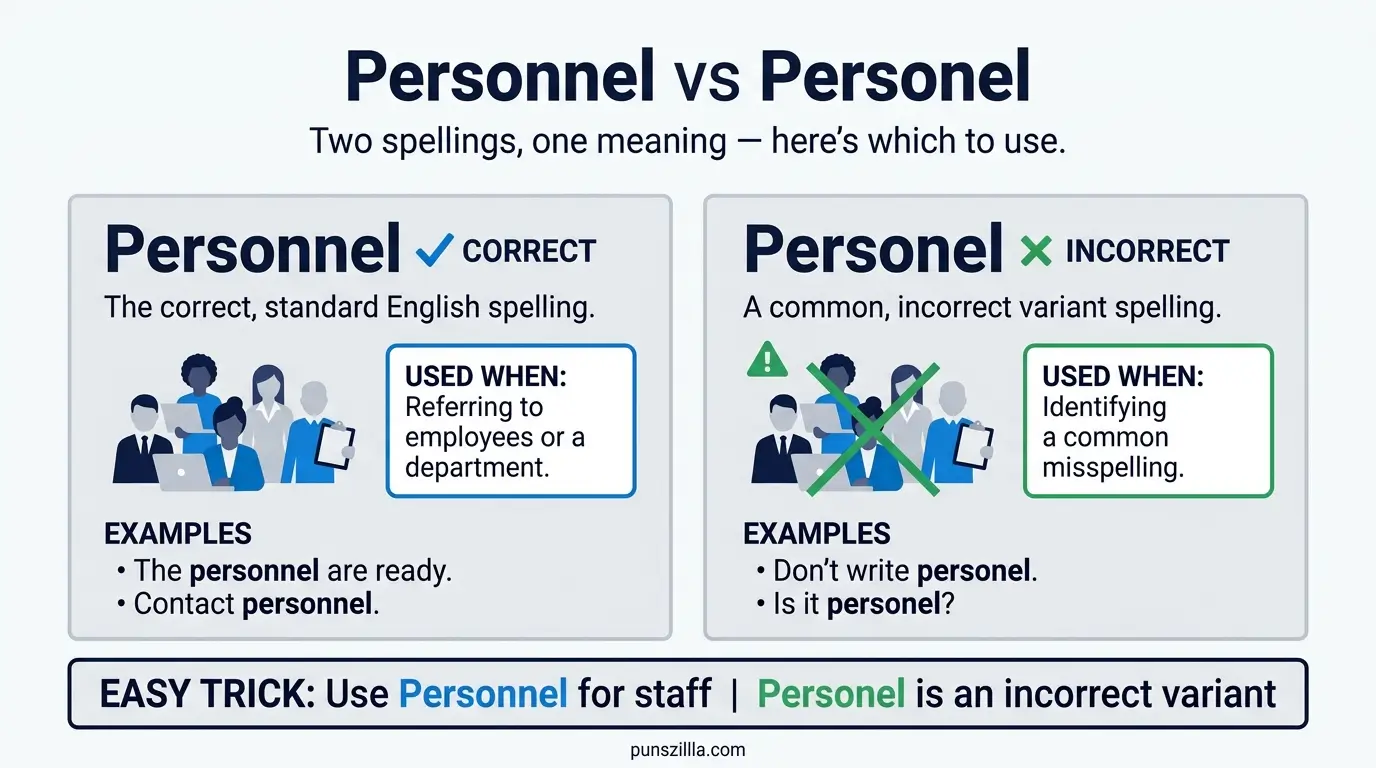
Personnel is correct; personel is a misspelling. Personnel means employees or staff.
Have you ever wondered whether to write personel or personnel? These words look almost identical, so it is easy to mix them up.
However, only one is the correct standard spelling of the word you probably mean.
The correct spelling is personnel. It refers to the people who work for an organization, company, school, or military unit. Personel is a common misspelling of personnel in standard English.
This mistake often happens in business emails, job applications, reports, and online searches.
The extra letters can be easy to overlook when typing quickly. The word also looks similar to personal, which has a different meaning.
The good news is that remembering the correct spelling is simple. Once you understand what personnel means, you can use it confidently in professional and everyday writing.
In this guide, you will learn the correct spelling, its meaning, and its origin. You will also see common mistakes, useful examples, and answers to frequently asked questions.
Simple rule to remember: Write personnel when you mean the people working for an organization. Avoid personel in standard English writing.
Personel or Personnel Quick Answer
Quick Answer: Personnel is the correct standard English spelling when referring to employees or members of an organization.
Personel is a misspelling of this word. Remember the double “n” and double “l” in personnel. Do not confuse it with personal, which means something related to an individual.
Examples of Personnel
- The company hired additional personnel for its new office.
- All hospital personnel must follow safety procedures.
- The manager thanked the personnel for their hard work.
Examples of Personel
Personel is not the standard spelling of the intended word in these sentences. Use personnel instead.
- Incorrect: The company needs more personel.
- Incorrect: Hospital personel received new training.
- Incorrect: All personel must attend the meeting.
Personnel vs. Personal
These two words are both correct, but they have different meanings.
- Personnel: The employees or people working for an organization.
- Personal: Something belonging to, affecting, or relating to an individual.
For example, “The personnel manager called me about my personal documents” uses both words correctly.
The Origin of Personel or Personnel
The word personnel entered English through French. It developed from French personnel, which relates to people or persons.
Its modern English meaning refers to the people employed by an organization or serving in a group.
The word became useful as businesses, governments, and military organizations developed formal systems for managing workers.
Today, it appears in human resources, administration, healthcare, education, and military contexts.
The spelling personnel can look unusual to English learners. Its ending does not follow the spelling pattern many people expect. This can lead writers to drop a letter and produce personel.
However, personel is not the accepted standard spelling for employees. It is generally a spelling error, not a British or American English variant.
The word personal has a different history and meaning. It refers to an individual or something connected with that person. Although personal and personnel look similar, they serve different purposes.
Remember: Personnel means a group of people working for an organization. Personal relates to an individual. The spelling personel should be corrected when you mean personnel.
For a dictionary check, consult Merriam-Webster’s entry for personnel and Cambridge Dictionary’s entry for personnel.
Correct Spelling vs. Common Misspelling
The difference between personel and personnel is spelling, not regional preference. In standard English, personnel is the correct word when you mean employees or members of an organization.
1. Personnel: The Correct Spelling
Use personnel when talking about a company’s workforce, military members, or staff in an institution.
Examples:
- The school hired new administrative personnel.
- Emergency personnel arrived at the scene.
- The company provides training for its personnel.
The word is often used in formal and professional settings. You may also see it in job descriptions, workplace policies, and organizational reports.
2. Personel: The Misspelling
Personel is a common spelling error. It usually occurs when writers leave out one of the letters in personnel.
Examples:
- Incorrect: The personel department approved my request.
- Correct: The personnel department approved my request.
- Incorrect: We need more personel for this project.
- Correct: We need more personnel for this project.
Do not use personel in formal documents, school assignments, or business communication when you mean employees.
Comparison Table
| Word | Use when | Example sentence |
|---|---|---|
| Personnel | Referring to employees or organizational staff | The personnel attended the safety meeting. |
| Personel | Not the standard spelling of the intended word | Correct it to personnel. |
| Personal | Referring to an individual or private matter | Please keep your personal information secure. |
A Simple Spelling Rule
Remember the two pairs of letters in personnel: nn and ll.
You can also break the word into smaller parts while learning its spelling: per-son-nel. Say it slowly and practise writing it correctly.
The word personal has a different spelling and meaning. If you mean someone’s private life, belongings, or individual experience, use personal. If you mean employees, use personnel.
Which Spelling Is Correct?
Use personnel in standard English when referring to employees or members of an organization. Use personal for individual or private matters. Avoid personel when you intend to write personnel.
For American English Readers
American English uses personnel in business documents, workplace policies, and news reports. The misspelling personel is not an accepted American spelling variant.
For example: “The company trained its personnel in workplace safety.”
For British English and Commonwealth Readers
British English also uses personnel. The spelling does not change to personel in the United Kingdom or other Commonwealth contexts.
For example: “Hospital personnel received updated safety guidance.”
For Global English Learners
If you write English as a second language, learn personnel as the standard spelling. This is especially useful for resumes, job applications, reports, and formal emails.
You may encounter personel online, but seeing a spelling mistake does not make it correct.
For IELTS and TOEFL
Use personnel when discussing workers, companies, or organizations in academic writing or speaking examples. These exams assess accurate vocabulary and spelling in written responses.
Remember that personal is a separate word. For example, “personal goals” is correct, while “personnel goals” would usually express a different idea.
For Business Emails
Use personnel in messages about employees, staffing, recruitment, or workplace procedures.
Correct: “Please contact the personnel department for further information.”
Incorrect: “Please contact the personel department for further information.”
Best advice: Use personnel for employees, personal for individual matters, and correct personel before publishing or sending professional writing.
Common Mistakes with Personel or Personnel
Even confident writers can misspell personnel. These mistakes are easy to avoid once you know the correct form.
| Wrong | Right | Why |
|---|---|---|
| personel department | personnel department | The correct spelling contains two n’s. |
| personel manager | personnel manager | Use the standard spelling in job titles. |
| military personel | military personnel | The same spelling applies to military staff. |
| personal department | personnel department | Personnel concerns employees; personal concerns individuals. |
| personnels | personnel | Personnel usually refers to employees collectively without adding s. |
One important distinction is personal versus personnel. A personal matter affects an individual. A personnel matter concerns employees or staffing.
For example, a personnel file contains employment information. A personal file may contain private information about an individual. The exact meaning depends on the context.
Personel or Personnel in Everyday Examples
The correct spelling matters in emails, news reports, social media, and formal documents. These examples show how to use personnel naturally.
| Context | Example |
|---|---|
| Please contact the personnel department for help with your employment records. | |
| All personnel should complete the training before Friday. | |
| News headline | Emergency Personnel Respond to Building Fire |
| News headline | Hospital Personnel Prepare for Increased Patient Demand |
| Social media post | Thank you to all the personnel who helped make this event successful! |
| Social media post | Our support personnel work hard to help customers every day. |
| Formal writing | The organization provides regular training for its personnel. |
| Formal writing | Only authorized personnel may enter the restricted area. |
Notice that personnel fits best when the sentence refers to workers as a group. In casual conversation, staff or employees may sound simpler.
For example, “Our staff will contact you soon” is often more natural than “Our personnel will contact you soon.”
Personel or Personnel Google Trends and Usage Data
Without a live Google Trends comparison, exact search popularity cannot be confirmed.
However, standard dictionary usage supports a clear spelling recommendation: personnel is the correct form, while personel is a common misspelling.
Searches for personel or personnel often reflect spelling checks. Writers may want to confirm the spelling before sending an email, submitting an assignment, or preparing a workplace document.
The correct form appears in business writing, military reports, news articles, and formal documents. The incorrect form may appear in search queries, online comments, or typing errors.
There is no established American-versus-British spelling difference. Both varieties use personnel.
| Word | More common in | Where you see it |
|---|---|---|
| Personnel | Standard English writing worldwide | Business, news, military, and formal documents |
| Personel | Spelling-error searches and mistakes | Incorrect drafts, search queries, and informal online writing |
These descriptions reflect standard spelling and usage, not measured search volumes. No numerical popularity claims are made here.
Check It Yourself:
- Open Google Trends and compare “personnel” with “personel.” Select a country and time range.
- Compare the terms in Google Books Ngram Viewer. Check how they appear in published books.
- Remember that search interest and book frequency do not determine correctness. Use a trusted dictionary to confirm standard spelling.
Comparison Table: Personel vs. Personnel
| Word | Type/Meaning | Region or Status | Example | Formality | Memory Trick |
|---|---|---|---|---|---|
| Personnel | Employees or staff | Correct in US, UK, and global English | All personnel must attend. | Formal and professional | Remember the double n. |
| Personel | Misspelling of personnel | Incorrect in standard English | Correct: The company needs personnel. | Avoid in all standard writing | Add the missing n. |
| Personal | Private or related to an individual | Correct in US, UK, and global English | This is a personal matter. | Formal or informal | Personal means individual. |
FAQs About Personel or Personnel
Is it personel or personnel?
Personnel is the correct spelling. Personel is a common misspelling when referring to employees or staff. Write personnel in business emails, academic assignments, reports, and other standard English documents.
What does personnel mean in simple words?
Personnel means the people who work for an organization. For example, school personnel may include teachers, administrators, and other employees. The word often refers to workers collectively rather than to one specific person.
Why is personnel spelled with two n’s?
The English word personnel comes through French, which uses the same spelling. English retained that spelling. The double n is part of the standard form, so it should not be removed when writing the word.
Is personnel the same in American and British English?
Yes. American and British English both use personnel when referring to employees or staff. Personel is not a standard regional alternative. You can use personnel for readers in either country.
What is the difference between personnel and personal?
Personnel means employees or staff members. Personal means private, individual, or related to a particular person. For example, a personnel department manages employee matters, while personal information relates to an individual.
Can I use personnel for one person?
Usually, use employee, worker, or staff member when referring to one person. Personnel normally refers to a group of workers. For example, write “One employee attended the meeting,” rather than “One personnel attended the meeting.”
What is an easy way to remember personnel?
Remember the double n in personnel and connect the word with people at work. You can also practise writing “personnel department” and “company personnel.” Repeating these common phrases helps you remember the correct spelling.
Conclusion: Personel or Personnel?
Key Takeaways:
- Personnel is the correct spelling for employees or staff.
- Personel is a misspelling in standard English.
- Personal means private or related to an individual.
- American and British English both use personnel.
The difference between personel and personnel is simple once you remember the extra n. If you are writing about employees, staffing, or an organization’s workforce, choose personnel.
Use the word in business emails, reports, news writing, and academic assignments whenever it fits your meaning. If you are writing for an American, British, or international audience, the spelling stays the same.
Also, watch out for personal. The two correct words look similar, but their meanings differ. A personnel department handles employee matters, while personal information belongs to or concerns an individual.
When in doubt, check a trusted dictionary before submitting your work. A quick spelling check can prevent avoidable mistakes and make your writing clearer.