
Piece or Peice: Which Is Correct?
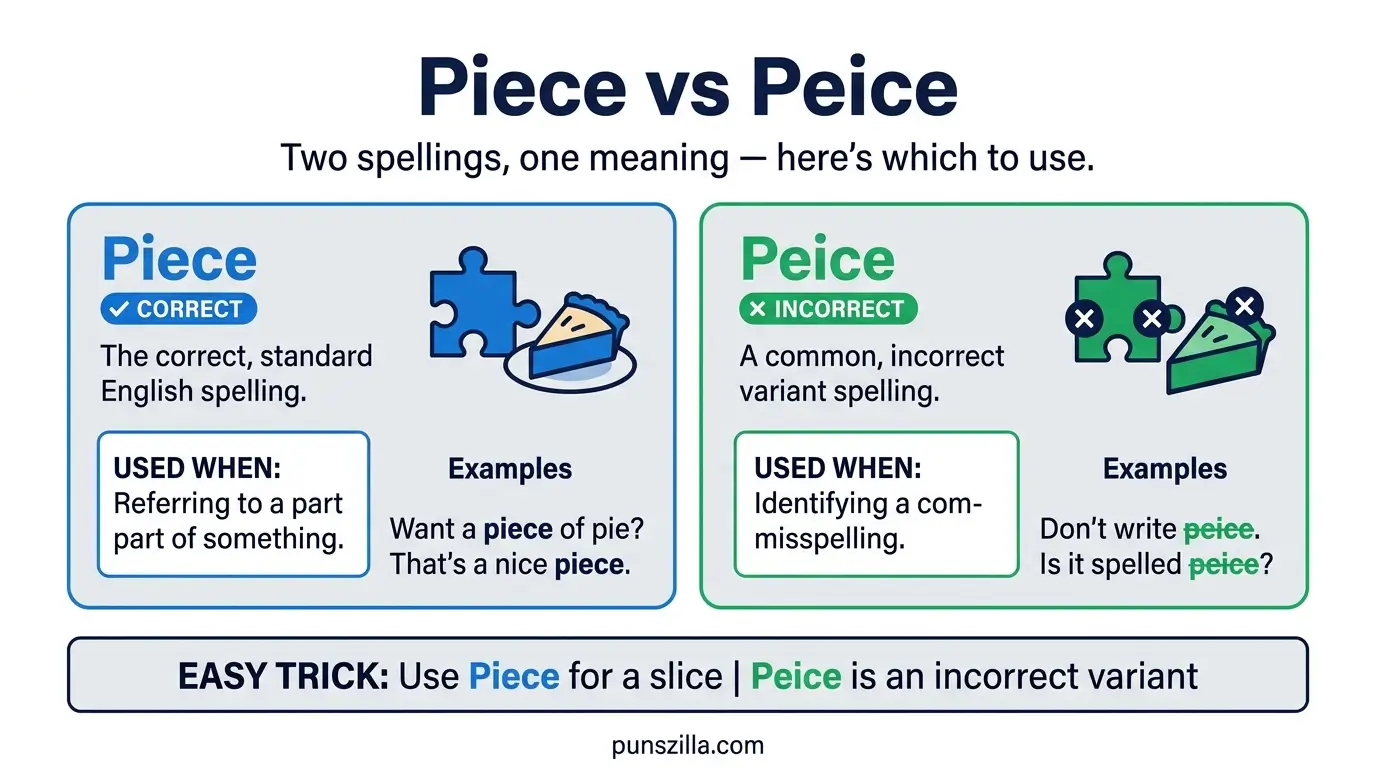
Piece is the correct spelling; peice is incorrect. Remember, “piece” uses ie, as in “a piece of cake.”
Have you ever paused while writing and wondered whether to spell it “piece” or “peice”? You are not alone. These words look similar, and their letters are easy to mix up.
The correct spelling is piece. The spelling “peice” is a common mistake, not a standard English word.
You use “piece” when talking about part of something, an item, or a work of art. For example, you might eat a piece of cake, read a piece of writing, or move a piece on a chessboard.
But why do people often write “peice” by mistake? The answer lies in the way we remember letter patterns. Many English words contain “ie” or “ei,” and these combinations can be confusing.
This guide explains the difference between piece and peice in simple English. You will learn the correct spelling, see everyday examples, and discover an easy trick to remember it.
Whether you are writing a school assignment, a business email, or a social media post, this rule will help you write with confidence.
Piece or Peice Quick Answer
Quick Answer: “Piece” is the correct spelling. “Peice” is a misspelling and should not be used in standard English.
A piece can mean part of something, a single item, or a work created by an artist or writer. Remember to put “i” before “e” in “piece.”
Examples of the correct spelling:
- Please give me a piece of cake.
- She found a missing piece of the puzzle.
- He wrote a beautiful piece of music.
Examples showing the incorrect spelling:
- Incorrect: Please give me a peice of cake.
- Incorrect: She found a missing peice of the puzzle.
- Incorrect: He wrote a beautiful peice of music.
In each sentence, replace “peice” with “piece.”
The meaning does not change because of the mistake. However, the incorrect spelling can make your writing look less polished.
The Origin of Piece or Peice
The word “piece” has a long history in English. It entered the language through Old French, where piece meant a part, portion, or item.
Its history goes back further to a Latin form, often linked to the word’s earlier development. The exact deeper origin is uncertain, so it is best not to treat one proposed explanation as proven.
Over time, English speakers began using “piece” for many things. It can describe part of an object, a separate item, or a creative work.
For example, a piece of bread is part of a larger amount. A chess piece is one item in a game. A piece of music is a complete creative work.
You can explore the word’s meaning in the Cambridge Dictionary.
Why Do People Write Peice?
People often misspell “piece” because they mix up the letters “i” and “e.”
English has many words with these letters in different orders. This can make spelling difficult, especially when a word sounds the same regardless of how someone spells it.
When people type quickly, they may also place the letters in the wrong order. Spellcheck tools can help, but learning the correct pattern is more useful in the long run.
The important point is simple: “peice” is not an accepted alternative spelling of “piece.”
Correct Spelling vs Common Misspelling
The difference between “piece” and “peice” is spelling, not meaning. Only “piece” is correct in standard English.
| Word | Use when | Example sentence |
|---|---|---|
| Piece | Referring to part of something | I ate a piece of pizza. |
| Piece | Referring to one item | Each piece of furniture is handmade. |
| Piece | Referring to creative work | She performed a piano piece. |
| Peice | No standard English use | Incorrect: I need a peice of paper. |
The Simple Spelling Rule
Remember this pattern: piece = p + ie + ce.
The letters “i” and “e” appear in that order. Do not reverse them.
The familiar phrase “a piece of cake” can help you remember the spelling. Picture a slice of cake and repeat the word “piece” as you write it.
You can also compare “piece” with other words that contain “ie,” such as:
- Field
- Believe
- Relief
- Chief
These words share the same letter order. Learning them together can make spelling easier.
However, English has exceptions to common spelling patterns. Do not assume that every word follows the same rule.
Which Spelling Is Correct?
Always use “piece” in standard English. There is no US or UK spelling difference for this word.
For US Readers
American English uses “piece” in schoolwork, business writing, books, and everyday messages.
Correct: I need a piece of paper for my notes.
For UK and Commonwealth Readers
British English and other Commonwealth varieties also use “piece.”
Correct: She bought a piece of cheese from the shop.
The spelling stays the same, even when other words differ between regional varieties of English.
For IELTS and TOEFL
Use “piece” in essays, written answers, and other exam responses. Writing “peice” is a spelling error that may affect the quality of your work.
For example:
Correct: The author presents a compelling piece of evidence.
Incorrect: The author presents a compelling peice of evidence.
For Business Emails
Professional writing should use the correct spelling. This applies to reports, proposals, presentations, and customer messages.
Correct: Please review the attached piece of documentation.
Remember that “piece” can also appear in common expressions such as “piece of advice,” “piece of information,” and “piece of work.”
Common Mistakes with Piece or Peice
Many spelling errors happen when people type without checking their work. Use this table to spot and correct common mistakes.
| Wrong | Right | Why |
|---|---|---|
| A peice of cake | A piece of cake | The letters are reversed in the incorrect spelling. |
| One peice of paper | One piece of paper | “Piece” is the standard spelling. |
| A peice of advice | A piece of advice | The correct letter order is “ie.” |
| A peice of music | A piece of music | Creative works can be called pieces. |
| Missing peices | Missing pieces | The plural of “piece” is “pieces.” |
| Peice by peice | Piece by piece | The expression uses the correct spelling throughout. |
Mistake 1: Reversing the Letters
The most common error is writing “ei” instead of “ie.”
Remember: Write “piece,” not “peice.”
Mistake 2: Misspelling the Plural
The plural form is “pieces,” not “peices.”
Example: The box contains several small pieces of wood.
Mistake 3: Trusting Pronunciation Alone
“Piece” is pronounced like “peace.” Hearing the word does not tell you which letters to write.
Remember the spelling pattern instead of relying only on sound.
Mistake 4: Typing Too Quickly
Fast typing can lead to transposed letters. Slow down when writing words you often misspell.
Mistake 5: Ignoring Spellcheck
A spellchecker may catch “peice,” but you should still learn the correct spelling. Automatic tools can miss errors in some contexts.
Piece or Peice in Everyday Examples
The word “piece” works in casual messages and formal writing. Here are examples from common situations.
| Context | Example |
|---|---|
| Could you send me the missing piece of information? | |
| I have attached the final piece of the report. | |
| News headline | Local Artist Unveils New Piece of Public Art |
| News headline | Missing Piece Helps Investigators Solve the Puzzle |
| Social media | This cake is amazing! I want another piece. |
| Social media | Finally finished my latest piece of artwork. |
| Formal writing | Each piece of evidence was examined carefully. |
| Formal writing | The researcher published a detailed piece of analysis. |
Common Expressions with Piece
Learning familiar phrases can help you remember the correct spelling.
- A piece of cake: Something very easy. Example: The test was a piece of cake.
- Piece by piece: One part at a time. Example: We assembled the model piece by piece.
- A piece of advice: One helpful suggestion. Example: Let me give you a piece of advice.
- A piece of information: One fact or detail. Example: I learned an important piece of information.
- Give someone a piece of your mind: Tell someone firmly that you are angry or unhappy. Example: She gave him a piece of her mind.
Each expression uses “piece,” never “peice.”
Piece or Peice Google Trends & Usage Data
People search for “piece or peice” because the two spellings look similar. Many want a quick answer before finishing a message, assignment, or article.
Important: No live search-interest figures were supplied for this article. The notes below describe spelling guidance, not measured Google Trends results.
Which Spelling Is More Common?
“Piece” is the accepted spelling in standard English. “Peice” is a common misspelling, so it should not be treated as an equal alternative.
The correct form appears in dictionaries, published books, news articles, school materials, and professional writing. The misspelling may appear in informal posts, search queries, or unedited text.
| Word | More common in | Where you see it |
|---|---|---|
| Piece | Standard English worldwide | Books, news, emails, schoolwork, and everyday writing |
| Peice | Incorrect spelling in standard English | Typing errors, spelling questions, and unedited online posts |
Actual search popularity can vary by country and context. Search interest alone does not establish whether a spelling is correct.
Check It Yourself:
Follow these steps to compare the words:
- Open Google Trends. Compare “piece” and “peice,” selecting your target country and time range.
- Open Google Books Ngram Viewer. Compare the words to explore their appearances in the selected book collection.
- Check the Cambridge Dictionary to confirm the accepted spelling and meaning.
Remember that search results can include misspellings. A word appearing online does not make it correct.
Comparison Table
Use this table for a quick review of the correct spelling.
| Word | Type/Meaning | Region or Status | Example | Formality | Memory trick |
|---|---|---|---|---|---|
| Piece | A part, item, or creative work | Correct worldwide | I ate a piece of bread. | Formal and informal | Remember “ie.” |
| Peice | No standard meaning as an English spelling | Misspelling | Incorrect: I ate a peice of bread. | Avoid in all standard writing | Switch the letters to “ie.” |
FAQs
Is it piece or peice?
“Piece” is correct, while “peice” is a misspelling. Use “piece” when describing part of something, an individual item, or a creative work. The correct spelling is the same in American and British English.
Why is piece spelled with ie?
The word follows the established spelling of “piece,” inherited through its history in English. The letters “ie” appear in that order. Although English spelling patterns have exceptions, learning the word’s exact spelling helps prevent mistakes.
Is peice ever correct?
No. “Peice” is not a standard alternative spelling of “piece.” You might see it in informal posts or typing errors, but you should correct it in essays, emails, articles, and other standard English writing.
What is the plural of piece?
The plural of “piece” is “pieces.” For example, you can say, “The puzzle has several missing pieces.” Do not write “peices.” Remember the original “ie” spelling when adding the plural ending.
How can I remember the spelling of piece?
Remember the phrase “a piece of cake.” Picture a slice of cake and focus on the letters “ie.” You can also connect “piece” with “field” and “believe” to practise the same letter order.
Is piece spelled differently in British and American English?
No. Both British and American English use “piece.” Unlike words such as “colour” and “color,” this word does not have a regional spelling variation. Use “piece” in schoolwork, professional writing, and everyday communication.
What does the word piece mean?
“Piece” can mean part of a whole, a single item, or a work created by an artist, musician, or writer. Examples include a piece of bread, a piece of furniture, and a piece of music.
Conclusion
Key Takeaways:
- Piece is the correct spelling.
- Peice is a common misspelling.
- Remember the letter order “ie,” not “ei.”
- Use “piece” in every standard English context.
Choosing between piece and peice is simple once you learn the correct letter order.
The word “piece” works across American, British, and other varieties of English. You do not need a different spelling for different countries.
Use it when describing a part of something, an individual item, or a creative work. You can write “a piece of cake,” “a piece of advice,” or “a piece of music.”
If you often confuse the two spellings, practise writing a few short sentences. Read them aloud and check the spelling before submitting your work. Spellcheck tools can also help catch mistakes.
Most importantly, do not assume that a spelling is correct just because you see it online.
Remember the simple rule: piece has “ie” in the middle. With a little practice, you can avoid this common spelling mistake and write more confidently.