
Tennant or Tenant: Which Spelling Is Correct?
Have you ever typed “tennant or tenant” and stopped to wonder which spelling is right? You are not alone.
This is a common spelling question because the word sounds simple, but many people add an extra n by mistake.
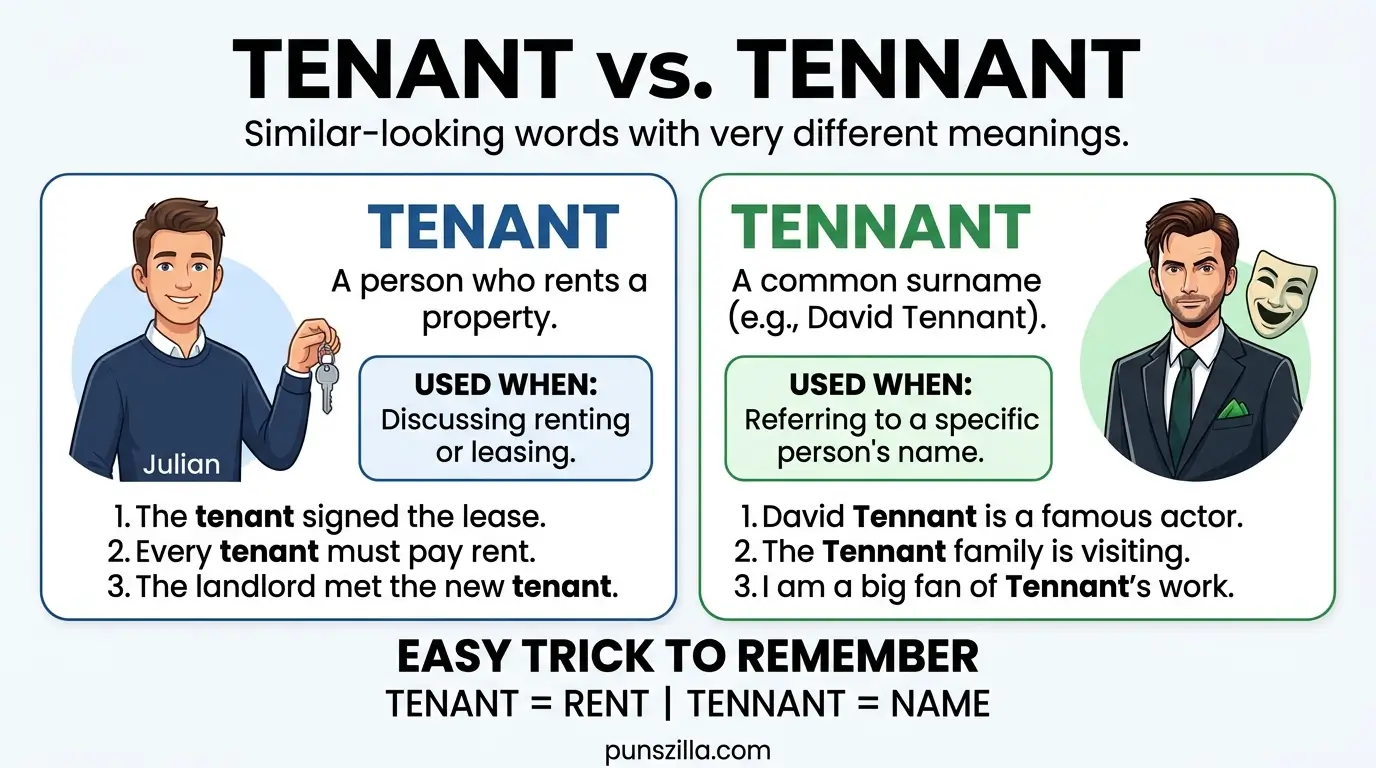
The correct spelling is tenant. It means a person who rents or occupies a house, apartment, office, or other property.
Tennant is usually a spelling error when you mean a renter. However, Tennant can be a proper surname, as in the name of actor David Tennant.
People search for “tennant or tenant” because both spellings look possible. English has many words with double consonants, so it is easy to assume that “tennant” follows the same pattern.
This guide gives you the quick answer first, then explains the word’s origin, spelling rules, regional usage, common mistakes, and real-world examples.
By the end, you will know exactly when to use tenant, when “Tennant” may be correct, and how to avoid this common spelling mistake.
Tennant or Tenant Quick Answer
Tenant is the correct spelling when you mean a person who rents or occupies property.
- Correct: The tenant paid the rent on time.
- Correct: Our new tenant moved in yesterday.
- Incorrect: The tennant paid the rent on time.
Tennant is not the standard spelling of the common noun. It is mainly used as a surname, such as David Tennant.
| Variation | Correct? | Meaning |
| tenant | Yes | A person who rents or occupies property |
| tennant | No | Common spelling mistake |
| Tennant | Yes, in some contexts | A surname or proper name |
So, if you are writing about someone who rents a home, use tenant.
The Origin of Tennant or Tenant
The word tenant has a long history in English. It comes from Old French and ultimately from Latin.
The word is linked to the Latin verb tenere, meaning “to hold.” This idea led to the sense of someone who holds or occupies land or property.
English adopted tenant through Old French. Over time, it became a common legal and everyday term for someone who has the right to occupy property under an agreement.
The spelling tenant has remained fairly stable. The extra n in tennant is usually caused by pronunciation and spelling patterns in English.
Many English words use double consonants, so writers may add an extra “n” without realizing that tenant has only one.
There is another important point: Tennant is a real surname. This is why you may see the spelling in names, including David Tennant.
A proper name does not follow the same rules as the common noun.
British English vs American English Spelling
There is no major British-American spelling difference for this word.
Both British English and American English use tenant when referring to a person who rents or occupies property.
| Usage | British English | American English |
| Person renting property | tenant | tenant |
| Incorrect extra “n” | tennant | tennant |
| Surname | Tennant | Tennant |
| Plural | tenants | tenants |
| Property agreement | tenancy | tenancy |
For example:
- British English: The tenant signed a new tenancy agreement.
- American English: The tenant signed a new rental agreement.
The key difference is often the surrounding vocabulary, not the spelling of tenant.
British English commonly uses tenancy agreement, while American English often uses rental agreement or lease. But the word tenant stays the same.
Which Spelling Should You Use?
Use tenant almost every time you are talking about a person who rents property.
For a US audience
Use tenant in:
- Rental agreements
- Property listings
- Emails
- Legal documents
- News articles
- Real estate websites
For a UK or Commonwealth audience
Use tenant as well. The spelling does not change.
You may see related words such as tenancy, landlord, and letting, depending on the country.
For a global audience
Choose tenant. It is the standard spelling and is understood across major English-speaking regions.
If you are writing a person’s name, however, preserve the person’s actual spelling. Tennant may be a surname and should not be changed to Tenant.
Common Mistakes with Tennant or Tenant
Here are some frequent errors.
Mistake 1: Adding a second “n”
Wrong: The tennant complained about the heating.
Correct: The tenant complained about the heating.
Mistake 2: Confusing the word with a surname
Wrong: The new Tennant must pay rent.
Correct: The new tenant must pay rent.
Use Tennant only when it is part of someone’s name or another proper name.
Mistake 3: Misspelling the plural
The plural of tenant is tenants, not “tennants.”
Correct: The building has 20 tenants.
Mistake 4: Misspelling “tenancy”
The related noun is tenancy, not “tennancy.”
Correct: The tenant began a one-year tenancy.
Easy memory tip
Think:
tenant = one “n”
You can remember the spelling by linking it to rent:
tenant → rents
Tennant or Tenant Comparison Table
| Word | Spelling | Meaning | Example |
| Tenant | tenant | Person renting or occupying property | The tenant paid rent. |
| Tennant | Tennant | Usually a surname | David Tennant is an actor. |
| Tennant | tennant | Usually a misspelling | Avoid this spelling for a renter. |
| Tenants | tenants | More than one tenant | The tenants received a notice. |
| Tenancy | tenancy | The state or period of being a tenant | The tenancy lasts one year. |
| Landlord | landlord | Person who rents out property | The landlord repaired the door. |
Tennant or Tenant in Everyday Examples
Knowing the correct spelling is useful in many types of writing.
In an email
Dear Tenant,
Please remember that rent is due on the first day of each month.
In a property listing
The property is ideal for a tenant looking for a quiet apartment near the city center.
In the news
The tenant contacted the landlord after the heating system stopped working.
On social media
Our new tenant has moved into the apartment. Welcome!
In formal writing
The tenant must provide written notice before ending the agreement.
In legal or property documents
The tenant agrees to maintain the property in good condition.
In each example, tenant has only one n after the “te.”
Tennant or Tenant Google Trends & Usage Data
Search interest for “tennant or tenant” comes from a simple spelling problem: people often know the word when they hear it but are unsure how to write it.
Search behavior can vary by country and context. People are more likely to search the phrase when writing:
- Rental agreements
- Property advertisements
- Real estate content
- School or college assignments
- Business emails
- Legal or housing documents
The correct word, tenant, is much more widely used in normal English than tennant. Searches for Tennant can also reflect interest in surnames, especially when people search for David Tennant.
Google Trends data should therefore be read carefully. A search for “Tennant” does not always mean someone is making a spelling mistake. It may refer to a person or family name.
For current search-volume figures, country-by-country interest, and related searches, Google Trends is the best source because search data changes over time.
FAQs About Tennant or Tenant
Is it tenant or tennant?
The correct spelling is tenant when you mean someone who rents or occupies property.
Is “tennant” a word?
Tennant can be a surname, but tennant is normally an incorrect spelling of the common word tenant.
Why do people spell tenant as tennant?
The mistake probably comes from English spelling patterns. People often expect a double consonant and add a second n.
Is tenant spelled differently in British English?
No. British English uses tenant, just like American English.
What is the plural of tenant?
The plural is tenants.
Example: The building has five tenants.
What is the difference between a tenant and a landlord?
A tenant rents or occupies a property. A landlord owns or manages property that is rented to someone else.
Is David Tennant spelled with two n’s?
Yes. Tennant is David Tennant’s surname. It is a proper name and is different from the common noun tenant.
Conclusion
When choosing between tennant or tenant, the answer is simple: tenant is the correct spelling for a person who rents or occupies property.
It is used in British English, American English, and other major forms of English.
The spelling tennant is normally a mistake when used for a renter. However, Tennant can be correct when it is a surname, such as in David Tennant.
This difference is important because proper names keep their original spelling.
Remember the simple rule: tenant has one “n.” Use it in rental agreements, property listings, emails, news reports, social media posts, and formal documents.
If you are writing for a global audience, tenant is the safe and standard choice. Check the context before changing Tennant, though. If it is someone’s name, keep the spelling exactly as it is.