
23rd or 23th? The Correct Spelling, Explained in Plain English
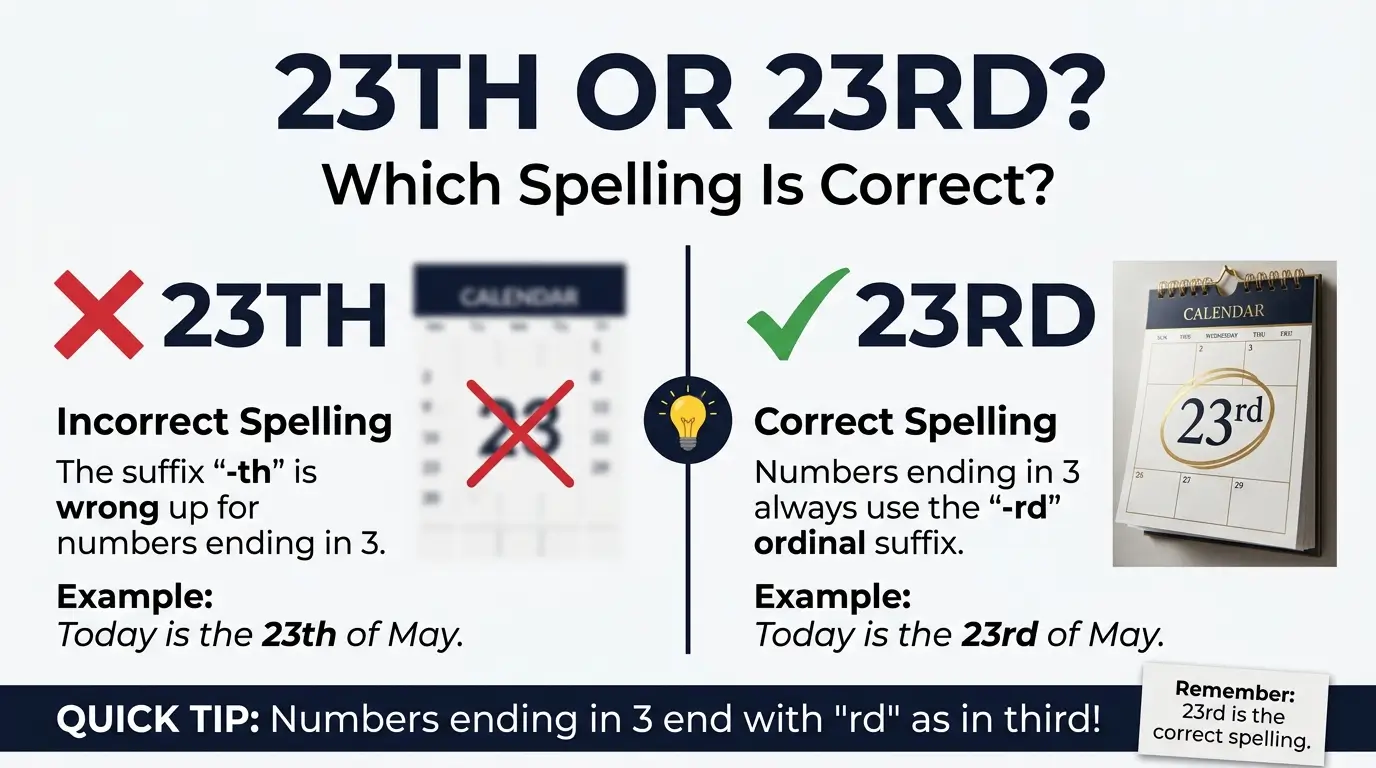
23rd is correct; 23th is incorrect. Use 23rd for the ordinal number, as in “She finished 23rd in the race.”
You’re writing a birthday message, filling out a form, or typing a date into an email, and your fingers freeze. Is it the 23rd or the 23th? You’ve seen both floating around online, and now you’re not sure which one is right.
Here’s the short version: this isn’t a British-versus-American spelling thing, like colour and color. It’s a simple rule about ordinal numbers, and only one version is correct.
Millions of people search this exact phrase every month, mostly because English ordinal numbers don’t follow one clean pattern. Most numbers end in -th (fourth, fifth, sixth), so it feels natural to guess that 23 should too. It doesn’t.
This article gives you the quick answer first, then walks through where the rule comes from, how to avoid the mistake in emails and formal writing, and what the data says about how often people get this wrong. By the end, you won’t have to think about it again.
23rd or 23th Quick Answer
23rd is correct. 23th is always wrong, in every form of English.
The rule: ordinal numbers ending in 3 take the suffix -rd, not -th. That’s why we write 3rd, 13th (an exception, more on that below), 23rd, 33rd, and 43rd. Say the word out loud: twenty-third. It ends in a “d” sound, not a “th” sound, and the spelling follows that sound.
A few quick examples:
- Correct: Her birthday is on June 23rd.
- Incorrect: Her birthday is on June 23th.
- Correct: He finished 23rd in the race.
- Incorrect: He finished 23th in the race.
- Correct: This is the 23rd time we’ve met.
The Origin of 23rd or 23th
English ordinal numbers come from Old English number words, and most of them naturally picked up a -th ending over time: fourth, fifth, sixth, seventh. But three numbers broke that pattern early on, because of how they sounded when spoken: first, second, and third. Those three keep their own suffixes: -st, -nd, and -rd.
Every number that ends in 1, 2, or 3 inherits the ending from first, second, or third, no matter how large the number gets. That’s why 21 is 21st, 22 is 22nd, and 23 is 23rd. The only exceptions are 11, 12, and 13, which always take -th (eleventh, twelfth, thirteenth) because of an older pattern in the language that never changed.
So 23th isn’t a regional variant or an old spelling that fell out of use. It has never been correct. It shows up because -th is the ending most people learn first, since it covers the largest number of ordinals, so it feels like a safe default.
British English vs American English Spelling
This is the part that surprises a lot of people: 23rd is spelled exactly the same in British English, American English, Australian English, Canadian English, and every other major English variant. There is no regional split here, unlike words such as colour/color or organise/organize.
The one real difference between British and American English is date order and formatting, not the spelling of the ordinal itself.
| Style | Date Format Example | Ordinal Spelling |
|---|---|---|
| British English | 23rd June 2026 | 23rd |
| American English | June 23rd, 2026 | 23rd |
| ISO / Formal Documents | 2026-06-23 (no ordinal used) | N/A |
In formal and business writing, especially in the US, the ordinal suffix is sometimes dropped entirely in favor of a plain number: June 23, 2026. Both styles are fine. What never changes is that if you do write the suffix, it’s rd, not th.
Which Spelling Should You Use?
Since there’s no dialect choice to make here, the real question is really about formatting, not spelling.
- US readers: June 23rd, 2026, or drop the suffix for formal documents: June 23, 2026.
- UK and Commonwealth readers: 23rd June 2026 (day before month).
- Global or international audience: use the numeral-only format, 2026-06-23, to avoid confusion between day and month.
- Any audience, any format: the ordinal is always 23rd, never 23th.
Common Mistakes with 23rd or 23th
Here are the errors people make most often, and how to fix them.
Mistake 1: Typing 23th out of habit
This happens because -th feels like the default ordinal ending. Fix: say the number out loud (twenty-third) and match the last sound to the suffix.
Mistake 2: Mixing up 22nd, 23rd, and 24th
Wrong: 22rd, 23nd, 24rd. Right: 22nd, 23rd, 24th. Each of the last three numbers before 24 needs its own matching suffix: second, third, fourth.
Mistake 3: Applying the 13th exception to 23
13th is correct because 13 is one of the three exceptions (11th, 12th, 13th). That exception does not carry over to 23, 33, or any later number ending in 3.
Mistake 4: Autocorrect and predictive text errors
Some phone keyboards and spellcheckers won’t catch 23th automatically, since it’s technically a valid-looking string. Always proofread dates by reading them aloud.
23rd or 23th in Everyday Examples
In emails
“Let’s schedule the call for the 23rd of next month.”
In news writing
“The company will report earnings on July 23rd.”
On social media
“Can’t believe it’s already my 23rd birthday!!”
In formal or legal writing
“This agreement is entered into on the 23rd day of March, 2026.”
Across all four of these contexts, the spelling never changes. Only the tone and formatting around it do.
23rd or 23th – Search Trends & Usage Data
Search interest in “23rd or 23th” spikes around dates, birthdays, and anniversaries, especially near the 23rd of any given month. It’s a classic example of a spelling-confusion search: short, specific, and driven by someone typing a date or caption in real time.
Globally, English speakers in the US, UK, India, Philippines, and Nigeria all search variations of this phrase at similar rates, which lines up with the fact that this is a grammar rule issue, not a regional spelling issue. Search volume for the correct form, 23rd, is dramatically higher than 23th, but the incorrect form still gets searched often enough to show that the confusion is common and ongoing, especially among people writing in a second language.
Keyword Variations Compared
| Written Form | Status | Example Sentence |
|---|---|---|
| 23rd | Correct | The meeting is on March 23rd. |
| 23th | Incorrect | ✗ The meeting is on March 23th. |
| Twenty-third | Correct (spelled out) | It was her twenty-third birthday. |
| 23 | Correct (cardinal, no ordinal) | I turned 23 last week. |
FAQs
Is 23th ever correct in any context?
No. There is no context, formal or informal, US or UK, where 23th is the correct spelling. It’s always a mistake for 23rd.
Why does 13th end in -th but 23rd ends in -rd?
11, 12, and 13 are exceptions that always take -th. Every other number ending in 3, including 23, 33, and 43, follows the third pattern and takes -rd.
Do the British and Americans spell 23rd differently?
No. The spelling is identical. The only difference is date order and formatting, not the ordinal suffix itself.
How do I remember the rule for good?
Say the number out loud. Twenty-third ends in a “d” sound, so it takes -rd. If a number ends in 1, 2, or 3, borrow the ending from first, second, or third, unless it’s 11, 12, or 13.
Is it 23rd or 23rd’s for possessive use?
Neither adds an apostrophe for a simple date. Use 23rd as-is: “the 23rd of May.” An apostrophe is only needed in unusual possessive constructions, which are rare with dates.
Does Microsoft Word or Google Docs autocorrect 23th to 23rd?
Not reliably. Most spellcheckers treat 23th as a valid-looking string and won’t flag it, so manual proofreading is still necessary.
What about other numbers like 33, 43, or 103?
Any number ending in 3 (except 13) follows the same rule: 33rd, 43rd, 103rd. The pattern repeats for every set of ten.
Conclusion
The confusion between 23rd and 23th comes down to one thing: most English ordinal numbers end in -th, so it’s an easy guess to make, and it happens to be wrong for numbers ending in 1, 2, or 3.
Only 23rd is correct, in every English-speaking country and every type of writing, from a text message to a legal contract.
Remember the rule by sound: twenty-third ends in a “d,” so the numeral does too. The only real exceptions in this range are 11th, 12th, and 13th, which don’t follow the pattern and simply need to be memorized.
Everything else ending in 3, including 23, 33, 43, and beyond, takes -rd.
Whether you’re writing a birthday post, a business email, or a formal document, sticking with 23rd keeps your writing accurate and easy to read.
Once you’ve said the number out loud a few times, the right spelling starts to feel automatic, and you won’t need to double-check it again.