
Conscience or Conscious: Which Spelling Is Correct?
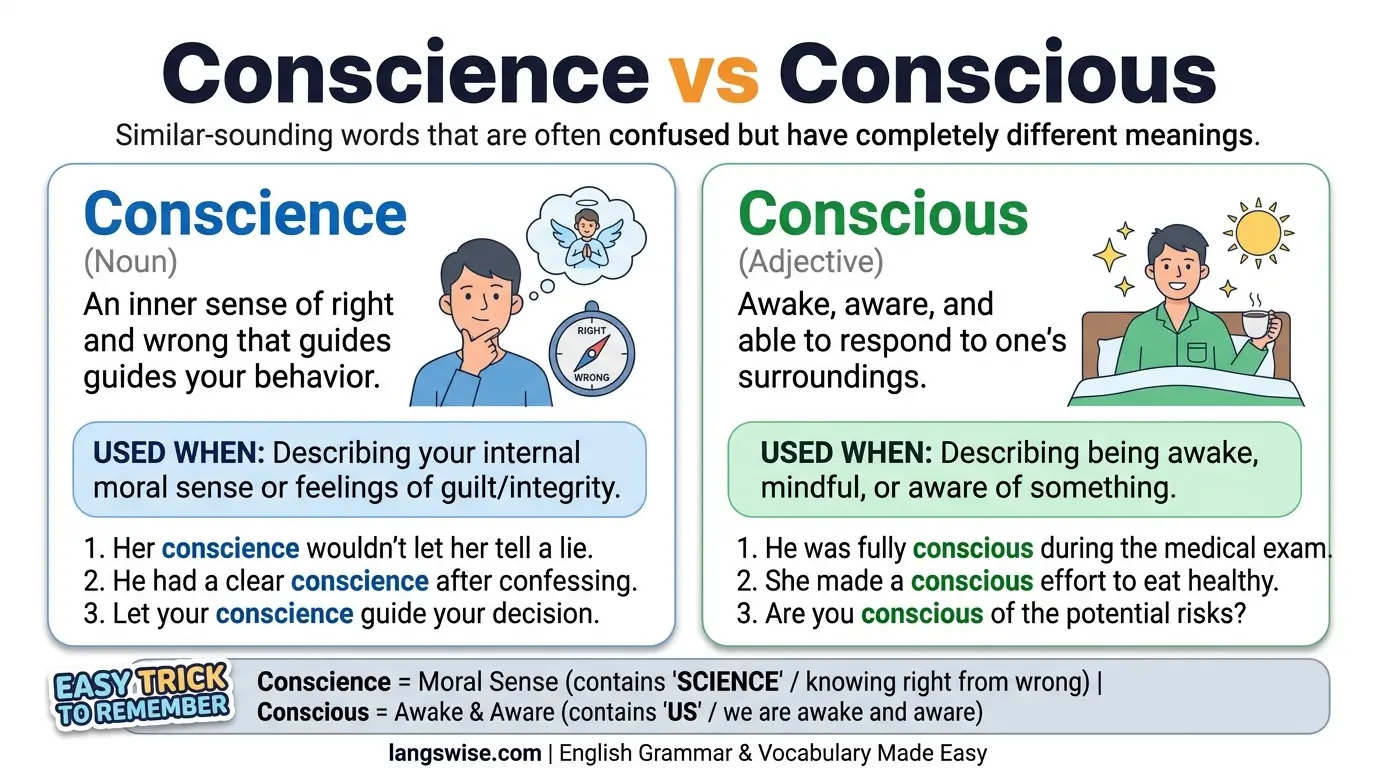
Conscience means your inner sense of right and wrong, while conscious means being awake or aware of something.
Conscience or conscious? Both words are correct, but they have different meanings.
Conscience means your inner sense of right and wrong. Conscious means being awake or aware of something.
Many people mix up these words because they sound almost the same. However, their spelling, meaning, and use are different.
Choosing the wrong word can change the meaning of your sentence.
This guide explains the difference between conscience and conscious in simple English.
You will learn their origins, spelling rules, common mistakes, and everyday uses. You will also see examples from emails, news, social media, and formal writing.
Whether you speak American English, British English, or English as a second language, this guide will help you choose the right word.
By the end, you will know when to use each spelling and how to avoid common grammar errors.
Conscience or Conscious Quick Answer
Both conscience and conscious are correct English words. The right choice depends on what you want to say.
- Conscience: Your inner voice that helps you know right from wrong.
- Conscious: Being awake, alert, or aware of something.
Examples:
- My conscience told me to tell the truth.
- She was conscious after the accident.
- He has a clear conscience.
- I am conscious of my mistakes.
Remember this easy trick: conscience is about morality, while conscious is about awareness.
The Origin of Conscience or Conscious
The words conscience and conscious come from Latin. Both are linked to the Latin word conscientia, which means knowledge or awareness shared with oneself.
Over time, the words developed different meanings in English. Conscience became linked to a person’s sense of right and wrong.
Conscious developed to describe being awake, aware, or able to notice things around you.
The spelling difference exists because English uses different word forms for different meanings.
Although the words look and sound similar, they are not interchangeable.
British English vs American English Spelling
There is no spelling difference between British and American English for these two words. Both countries use conscience and conscious in the same way.
The difference is not regional. It is based on meaning and grammar. Writers in the UK, USA, Canada, and Australia should follow the same spelling rules.
| Word | American English | British English | Meaning |
|---|---|---|---|
| Conscience | Conscience | Conscience | Sense of right and wrong |
| Conscious | Conscious | Conscious | Awake or aware |
| Conscientious | Conscientious | Conscientious | Careful and responsible |
| Consciously | Consciously | Consciously | In an aware or deliberate way |
| Unconscious | Unconscious | Unconscious | Not awake or aware |
Examples:
- US: He acted according to his conscience.
- UK: He acted according to his conscience.
- US: She was conscious of the noise.
- UK: She was conscious of the noise.
Both versions are correct. You do not need to change either spelling for a British or American audience.
Which Spelling Should You Use?
Your choice depends on the meaning of your sentence, not your location. Both spellings are accepted in all major forms of English.
For American English readers: Use conscience when talking about moral values. Use conscious when talking about being awake or aware.
For British and Commonwealth readers: Follow the same rule. Neither word has a different regional spelling.
For global English writing: Choose the word that matches your meaning. This is especially important in emails, blogs, schoolwork, and professional documents.
If you are unsure, ask yourself one simple question: Am I talking about right and wrong, or awareness?
- Right and wrong = Conscience.
- Awareness or being awake = Conscious.
This simple rule can help you avoid most spelling mistakes.
Common Mistakes with Conscience or Conscious
Many English learners confuse these words because their pronunciation is similar. However, using one instead of the other can make a sentence incorrect or change its meaning.
Here are some common mistakes and their corrections:
| Incorrect sentence | Correct sentence | Reason |
|---|---|---|
| My conscious hurts me. | My conscience hurts me. | It refers to moral feelings. |
| She lost her conscience after the accident. | She lost consciousness after the accident. | It refers to awareness. |
| I have a clear conscious. | I have a clear conscience. | The phrase is about guilt. |
| He is conscience of the danger. | He is conscious of the danger. | It means aware. |
| She was conscience during surgery. | She was conscious during surgery. | It means awake. |
Important tip: Conscience is a noun, while conscious is an adjective. Learning their grammar roles makes them easier to use correctly.
Conscience or Conscious in Everyday Examples
Both words appear in daily conversations and professional writing. Knowing their meanings helps you write clearly and avoid confusion.
1. In Emails
Use conscience when discussing honesty or responsibility. Use conscious when talking about awareness.
- Conscience: I cannot ignore my conscience when making this decision.
- Conscious: I am conscious of the time and will finish the work soon.
2. In News
News reports often use conscious when describing a person’s condition. They use conscience when discussing moral choices.
- The driver was conscious when help arrived.
- The leader followed his conscience and spoke the truth.
3. On Social Media
People often use these words when sharing thoughts about life, choices, and personal feelings.
- A clear conscience brings peace.
- Stay conscious of your words and actions.
- My conscience tells me to do what is right.
4. In Formal Writing
Both words are useful in essays, reports, and business documents. Choose the word that fits the meaning.
- Conscience: Every person should act according to their conscience.
- Conscious: The company is conscious of its social duties.
Conscience or Conscious Google Trends & Usage Data
People search for conscience or conscious because the words have similar sounds but different meanings. Students, writers, and English learners often look for the correct spelling.
Google Trends can help compare interest in these search terms. It shows relative search interest by country and over time, rather than exact monthly search numbers. Trends Help+1
Search Interest by Country
The following countries are useful markets to check when researching this spelling question:
- United States: English learners and students may search for the difference between the words.
- United Kingdom: Students and writers may look for spelling and grammar guidance.
- Canada: Searchers may compare meanings and correct sentence usage.
- Australia: English learners may look for simple spelling explanations.
- India and Pakistan: Students and ESL learners may search for help with commonly confused English words.
These are suggested research markets, not a verified ranking of search popularity.
Why Do People Search for These Words?
The main reason is pronunciation. Both words sound similar, so people may remember the wrong spelling.
Another reason is grammar. Conscience is a noun, while conscious is an adjective. This difference can confuse new English learners.
For accurate SEO research, compare the exact search terms in Google Trends using the same country and time range. Remember that a score of 100 means peak relative interest, not 100 searches. Trends Help+1
Conscience vs Conscious Comparison Table
This table makes the difference easy to remember. Check the meaning and example before choosing a word.
| Feature | Conscience | Conscious |
|---|---|---|
| Part of speech | Noun | Adjective |
| Main meaning | Sense of right and wrong | Awake or aware |
| Used for | Moral choices | Awareness |
| Example | My conscience is clear. | I am conscious of my actions. |
| Related word | Conscientious | Consciousness |
| Opposite | No exact direct opposite | Unconscious |
| Memory trick | Think of honesty | Think of awareness |
Easy reminder: If your sentence is about guilt, honesty, or moral choices, use conscience. If it is about being awake or aware, use conscious.
Frequently Asked Questions (FAQs)
1. What is the difference between conscience and conscious?
Conscience is your inner sense of right and wrong. It helps you decide whether an action is good or bad.
Conscious means being awake or aware of something. For example, you can be conscious of your mistakes.
2. Is it a clear conscience or a clear conscious?
The correct phrase is a clear conscience. It means you feel free from guilt because you have done nothing wrong.
Example: She has a clear conscience because she always tells the truth.
3. Is conscious a noun or an adjective?
Conscious is an adjective. It describes someone who is awake or aware of something.
Example: He was conscious after the operation. The noun form is consciousness.
4. Is conscience a noun or an adjective?
Conscience is a noun. It refers to the inner feeling that helps you understand right and wrong.
Example: My conscience tells me to help others. The related adjective is conscientious.
5. How do you remember conscience vs conscious?
Remember that conscience is connected to moral choices. It helps you know whether something is right or wrong.
Conscious is connected to awareness. If someone is awake or knows what is happening, they are conscious.
6. Is there a spelling difference between British and American English?
No, both British and American English use conscience and conscious. Their spellings and meanings are the same in both varieties.
You can use either word in the United States, United Kingdom, Canada, and Australia without changing its spelling.
7. What is the opposite of conscious?
The opposite of conscious is unconscious. It describes someone who is not awake or aware.
Example: The patient was unconscious after the accident. Conscience does not have one exact opposite word.
Conclusion
Understanding conscience or conscious is easy when you know what each word means. Both words are correct, but they are used in different situations.
Conscience refers to your inner sense of right and wrong. Conscious means being awake, alert, or aware of something.
Remember that conscience is a noun, while conscious is an adjective. This small grammar rule can help you avoid many common spelling mistakes.
For example, you should write “I have a clear conscience,” not “I have a clear conscious.”
There is no spelling difference between British and American English. Both versions use the same words with the same meanings.
You can follow these rules in emails, essays, social media posts, and professional documents.
If you are ever confused, think about the meaning of your sentence before choosing a spelling. Use conscience for moral feelings and conscious for awareness.
With regular practice, you will remember the difference and use both words correctly in everyday English.