
Bail or Bale: What Is the Difference and Which Spelling Is Correct?
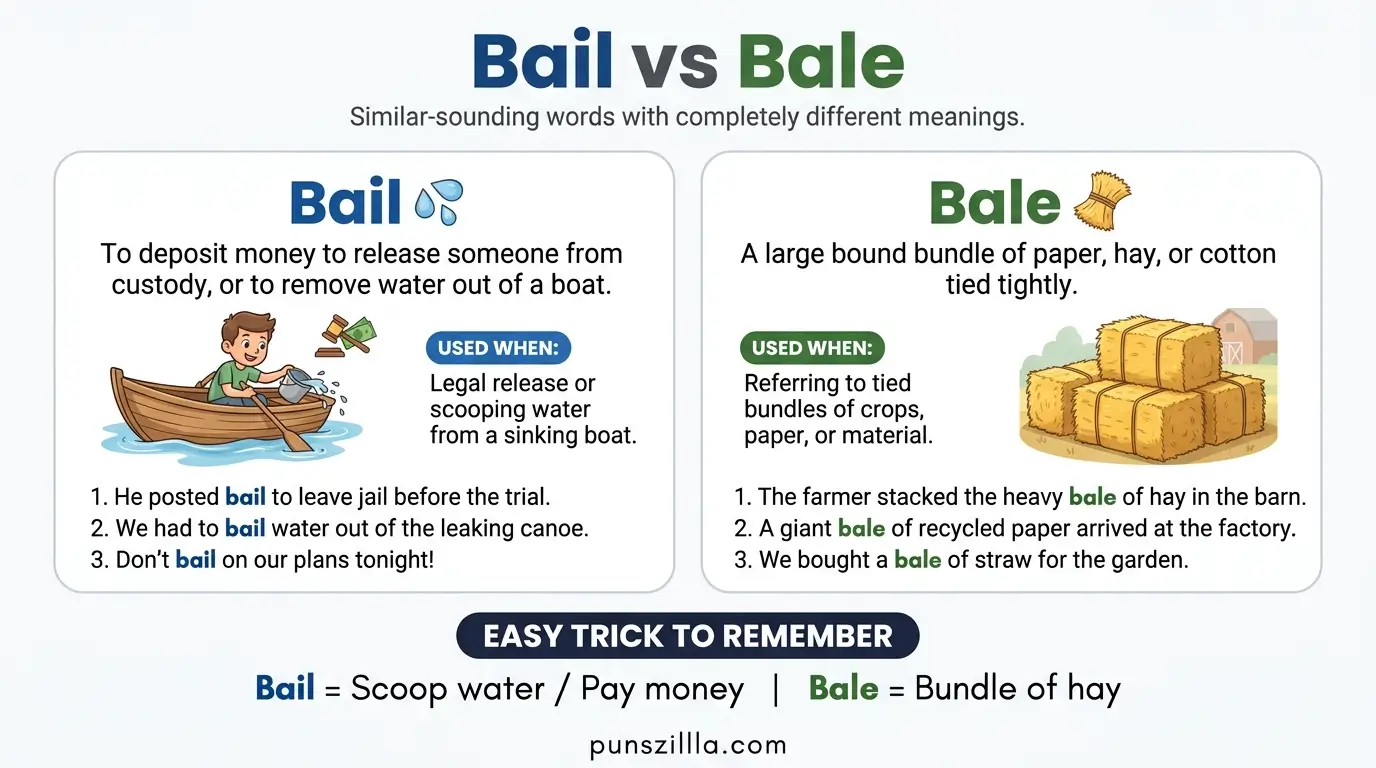
Bail means legal release or leaving a situation, while bale means a bundle of hay, cotton, or straw.
Have you ever wondered whether to write bail or bale? These two words sound exactly the same, but they have very different meanings.
Choosing the wrong spelling can change the meaning of your sentence and make your writing confusing.
The word bail is often used when talking about money paid to release someone from jail. It can also mean leaving a difficult situation or removing water from a boat.
In contrast, bale refers to a large bundle of material, such as hay, cotton, paper, or straw, that is tied together for storage or transport.
People often search for “bail or bale” because both words have the same pronunciation.
This makes them easy to mix up in emails, schoolwork, news articles, and everyday conversations.
The good news is that the difference is simple once you understand their meanings.
In this guide, you will learn how to use each word, where they came from, and which spelling is correct in different situations.
Bail or Bale – Quick Answer
Bail and bale are both correct spellings, but they have different meanings.
- Bail: Money paid to secure someone’s release from jail or the act of leaving a situation.
- Bale: A large bundle of goods or materials tied together.
Examples:
- His family paid his bail.
- The farmer stored a bale of hay.
Quick tip: Use bail when talking about jail or leaving a situation. Use bale when talking about a bundle of material.
The Origin of Bail or Bale
The words bail and bale have different histories, even though they sound alike today.
Origin of Bail
The word bail comes from Old French baillier, meaning to deliver or hand over. It entered English through legal language and became associated with releasing a person from custody under certain conditions.
Over time, bail developed other uses. For example, the verb to bail can mean removing water from a boat or leaving a difficult situation.
Origin of Bale
The word bale comes from Old French bale, which referred to a bundle or package. It is also linked to older Germanic words for a rounded or wrapped bundle.
Today, it commonly describes tightly packed materials such as hay, cotton, wool, and paper.
Why Are the Spellings Different?
English has many words that sound alike but have different meanings and origins. These words are called homophones.
Bail and bale are examples of homophones. Their different spellings help readers understand their meanings from context.
British English vs American English Spelling
There is no spelling difference between British and American English for these two words.
Both countries use bail for legal release and bale for a bundle of material.
| Meaning | American English | British English |
|---|---|---|
| Money for release from jail | Bail | Bail |
| Leaving a situation | Bail | Bail |
| Bundle of hay | Bale | Bale |
| Bundle of cotton | Bale | Bale |
| Removing water from a boat | Bail | Bail |
Examples in American English
- The judge set his bail at $5,000.
- The farmer loaded a bale of hay onto the truck.
Examples in British English
- He was released on bail.
- The workers moved a bale of cotton.
Important: Neither spelling is exclusive to British or American English. The correct choice depends on the meaning, not the country.
Which Spelling Should You Use?
Your choice depends on what you want to say.
For American Readers
Use bail when discussing legal release, leaving a situation, or removing water. Use bale for a bundle of material.
For British and Commonwealth Readers
Follow the same rule. British, Australian, Canadian, and other Commonwealth writers use both spellings with the same meanings.
For Global Readers
If you write for an international audience, focus on the meaning of each word.
Remember these simple rules:
- Legal release = Bail
- Leaving a situation = Bail
- Removing water = Bail
- A bundle of material = Bale
These rules will help you avoid spelling mistakes in professional and everyday writing.
Common Mistakes with Bail or Bale
Writers sometimes confuse these words because they have the same sound. Here are some common mistakes and their corrections.
| Incorrect Sentence | Correct Sentence |
|---|---|
| He paid his bale. | He paid his bail. |
| The farmer sold a bail of hay. | The farmer sold a bale of hay. |
| She was released on bale. | She was released on bail. |
| We loaded a bail of cotton. | We loaded a bale of cotton. |
| I had to bale out of the meeting. | I had to bail out of the meeting. |
Mistake 1: Using Bale for Legal Release
Incorrect: The court set his bale.
Correct: The court set his bail.
Use bail when discussing money or conditions related to release from custody.
Mistake 2: Using Bail for a Bundle
Incorrect: The farmer carried a bail of straw.
Correct: The farmer carried a bale of straw.
Use bale when describing a large bundle of material.
Mistake 3: Mixing Up Their Verb Forms
Bail is a verb that can mean leaving or removing water. Bale can also be used as a verb meaning to pack material into bundles.
Always check the meaning before choosing the spelling.
Bail or Bale in Everyday Examples
Understanding these words becomes easier when you see them in different situations.
1. In Emails
- Bail: Please confirm whether the bail payment has been received.
- Bale: The delivery includes one bale of recycled paper.
2. In News Articles
- Bail: The court granted bail to the accused person.
- Bale: Farmers reported an increase in the price of each bale of cotton.
3. On Social Media
- Bail: I had to bail on the plans because I was busy.
- Bale: The video shows a farmer moving a large bale of hay.
4. In Formal Writing
- Bail: The defendant was released on bail while awaiting trial.
- Bale: The company exports compressed bales of cotton to other countries.
5. In Everyday Conversation
- Bail: Let’s bail before the traffic gets worse.
- Bale: We need another bale of straw for the animals.
These examples show that the meaning of the sentence determines which spelling you should use.
Bail or Bale – Google Trends & Usage Data
The words bail and bale appear in different search contexts because they have separate meanings.
Bail is commonly associated with legal matters, court cases, police reports, and casual expressions about leaving a place or situation.
Bale is more closely related to farming, agriculture, cotton production, recycling, and material transportation.
Search Interest by Country
Both words are used in countries where English is spoken, including:
- United States: Bail often appears in legal and everyday contexts, while bale is used in farming and industry.
- United Kingdom: Both words are common in legal, agricultural, and general writing.
- Canada: Bail is widely used in legal contexts, while bale appears in agricultural and industrial discussions.
- Australia: Both spellings are used in everyday and professional English.
- India: Bail is common in legal discussions, while bale is used in agriculture and textile-related contexts.
Which Word Is More Popular?
The word bail has broader everyday uses because it appears in legal language and informal expressions. The word bale is more limited to specific subjects, such as farming and packaging.
However, exact search popularity changes over time and depends on the country and search term. These are general usage observations, not verified Google Trends rankings or search-volume figures.
Bail vs Bale – Comparison Table
Here is a quick comparison to help you remember the difference.
| Feature | Bail | Bale |
|---|---|---|
| Pronunciation | /beɪl/ | /beɪl/ |
| Part of speech | Noun and verb | Noun and verb |
| Main meaning | Legal release or leaving | A tied bundle |
| Common context | Law and daily speech | Farming and industry |
| Example | He paid bail. | She lifted a bale of hay. |
| Related word | Bailout | Baling |
| Spelling | Bail | Bale |
Easy memory trick:
- Bail has an “i” like in prison? Not quite, but remember it for legal release.
- Bale has an “e” like in bundle.
Frequently Asked Questions
1. Is it bail or bale?
Both spellings are correct, but their meanings are different. Bail refers to legal release or leaving a situation, while bale means a bundle of material.
2. What does bail mean?
Bail is money or a legal arrangement that allows someone accused of a crime to be released from custody. It can also mean leaving a place or situation.
3. What does bale mean?
A bale is a large bundle of material tied together for storage or transport. Common examples include bales of hay, cotton, straw, and paper.
4. Are bail and bale pronounced the same?
Yes, both words are pronounced /beɪl/. They are homophones because they sound alike but have different meanings and spellings.
5. Is bail an American or British spelling?
Bail is used in both American and British English. There is no regional spelling difference between the two varieties.
6. Is it a bale of hay or a bail of hay?
The correct phrase is a bale of hay. Bale refers to a bundle of hay that has been compressed and tied together.
7. Is it released on bail or released on bale?
The correct expression is released on bail. It refers to someone being allowed to leave custody under specific legal conditions.
Conclusion
The difference between bail and bale is simple once you understand their meanings. Both words sound the same, but they are used in different situations.
Use bail when talking about money or conditions for release from jail, leaving a difficult situation, or removing water from a boat. For example, you can say, “The court granted him bail” or “We decided to bail on the trip.”
Use bale when referring to a large bundle of material, such as hay, cotton, straw, or paper. For example, “The farmer loaded a bale of hay onto the truck.”
Remember that both spellings are correct in American and British English. The difference is not about regional spelling rules; it is about meaning and context.
If you are unsure which word to choose, ask yourself whether you mean legal release or a bundle of material. This simple check will help you select the right spelling in emails, articles, schoolwork, and professional documents.