Objective or Subjective: What’s the Real Difference (And Which One Are You Using)?
Objective vs Subjective: Objective means based on facts and evidence, while subjective means based on personal opinions, feelings, or beliefs. Learn the simple difference with clear examples so you never confuse them again.
You hear these two words all the time. A teacher says “give an objective summary.” A friend says “that’s just your subjective opinion.” But what do they actually mean, and why do people mix them up so often?
Most people search “objective or subjective” because they’re stuck between the two. Maybe you’re writing an essay and your teacher marked it “too subjective.”
Maybe you’re arguing with someone online about whether a movie is “objectively bad” or just not to their taste.
Maybe you’re studying for an English test and the words look almost the same but mean opposite things.
Here’s the confusion in one line: objective means based on facts, subjective means based on feelings.
That sounds simple, but the line gets blurry fast. Is a movie review objective or subjective? Is a court ruling objective or subjective? Is your own pain objective or subjective?
This article gives you the quick answer first, then breaks down the history, the spelling, the common mistakes, and real examples so you never mix them up again.
Objective or Subjective Quick Answer
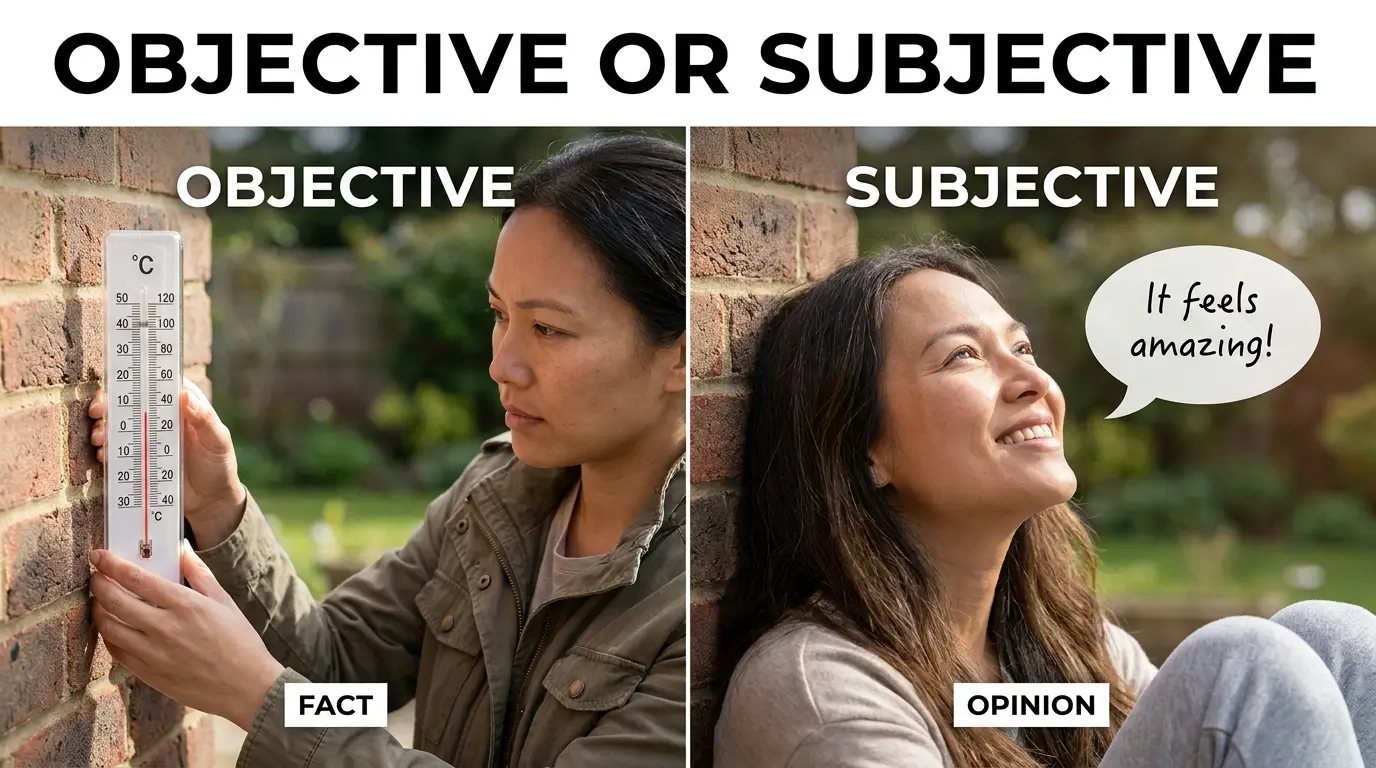
Objective means based on facts. It does not change from person to person. Example: “The car is red.” Anyone looking at the car will agree.
Subjective means based on personal opinion or feeling. It can change from person to person. Example: “The car is beautiful.” Not everyone will agree.
Quick test: ask yourself, “Would every person agree with this, no matter their taste?” If yes, it’s objective. If no, it’s subjective.
A few more pairs to lock this in:
- Objective: “The test score was 85 out of 100.”
- Subjective: “That was a hard test.”
- Objective: “The meeting starts at 3 PM.”
- Subjective: “That meeting was a waste of time.”
Both words are correct English. There is no British vs American spelling difference here, but people still search that question, so we’ll clear it up in the next section too.
The Origin of Objective or Subjective
Both words come from Latin.
Objective comes from the Latin word objectum, meaning “a thing thrown before” or “a thing placed in front of the mind.” The idea is something you can point to outside yourself, something real and separate from your own thoughts.
Subjective comes from the Latin word subjectus, meaning “placed under” or “brought under control.” Over time this came to mean something shaped by the person experiencing it, something that lives inside your mind rather than outside it.
Both words entered English through Old French and Medieval Latin around the 1300s to 1600s, mostly used first in philosophy and logic.
Philosophers needed a way to separate “what is true about the world” from “what a person believes or feels about the world.” That split is still exactly how we use the words today.
Why do spelling questions even come up? Because English has many word pairs that look almost the same in British and American English (like colour/color or organise/organize).
People searching “objective or subjective spelling” often expect a UK vs US difference. There isn’t one for these two words, but the next section explains why that mix-up happens.
British English vs American English Spelling
Here’s the short version: objective and subjective are spelled the same way in both British and American English. No difference. No debate.
So why do so many people search for a spelling difference? A few reasons:
- Many other English word pairs really do change between US and UK spelling, so people assume every word might.
- Some writers confuse objective/subjective with similar-looking pairs like analyse/analyze or realise/realize, which do change.
- Non-native English learners often double-check spelling out of habit, especially with longer words.
To be fully clear, here is a comparison table showing these two words next to word pairs that actually do change spelling:
| Word | British English | American English | Spelling Differs? |
|---|---|---|---|
| Objective | objective | objective | No |
| Subjective | subjective | subjective | No |
| Analyse/Analyze | analyse | analyze | Yes |
| Colour/Color | colour | color | Yes |
| Organise/Organize | organise | organize | Yes |
| Realise/Realize | realise | realize | Yes |
So if you were worried about spelling “objective” or “subjective” wrong depending on where you live, you can stop worrying. The real issue people run into is not spelling. It’s knowing which word fits the sentence.
See also: Ridden or Rode: Which One Is Correct?
Which Spelling Should You Use?
Since spelling is the same everywhere, this section is really about which word to use, and that depends on your audience and your purpose.
For US readers: Use “objective” for facts and data-based writing (reports, research, news). Use “subjective” for opinion-based writing (reviews, blogs, personal essays). Same rule as everywhere else in English, no regional twist.
For UK and Commonwealth readers (Canada, Australia, India, etc.): Same words, same spelling, same meaning. No adjustment needed.
For global or ESL audiences: Stick to short, clear sentences when using these words, since they’re abstract concepts. Instead of “the subjective nature of aesthetic judgment,” try “beauty is a matter of opinion.” Same meaning, easier to read.
For academic or formal writing: Use “objective” to describe methods, data, and evidence. Use “subjective” to describe interpretation, opinion, or personal experience. Mixing them up in an essay is one of the fastest ways to lose marks or credibility.
For business writing: Use “objective” when presenting numbers, results, and facts to clients. Use “subjective” carefully, and usually only when you’re clearly labeling something as your team’s opinion or recommendation.
Common Mistakes with Objective or Subjective
Mistake 1: Using “objective” when you mean opinion. Wrong: “It’s objective that this is the best restaurant in town.” Right: “In my opinion, this is the best restaurant in town.” (This is subjective, not objective.)
Mistake 2: Calling facts “subjective” to avoid disagreement. Wrong: “Well, that’s just subjective” (said about a measurable fact like a test score). Right: Facts stay objective even if someone doesn’t like them.
Mistake 3: Confusing “objective” (noun) with “objective” (adjective). “Objective” can also mean a goal, as in “our objective this quarter is to grow sales.” That’s a different use of the same word, not related to fact vs opinion.
Mistake 4: Thinking one word is more polite than the other. Neither word is rude or soft. They just describe different types of statements.
Mistake 5: Overusing “subjective” to dodge criticism. People sometimes say “that’s subjective” to shut down a fair, fact-based critique. If something can be measured or proven, it’s not actually subjective just because someone disagrees.
Mistake 6: Spelling errors from autocorrect. Some people accidentally type “objectiv” or “subjectiv” on mobile keyboards. Always double check the full “-ive” ending.
Objective or Subjective in Everyday Examples
In emails: “Please provide an objective summary of the project results, not your personal take.” (Here the writer wants facts only, no opinion.)
In news writing: “The report offers an objective look at unemployment numbers this quarter.” (News aims to be objective, even though full objectivity is hard to reach.)
In social media: “Objectively, this show has the best writing this year.” (Often used loosely online to mean “strongly,” even when the claim is really an opinion.)
In formal writing (essays, reports): “This paper presents an objective analysis of the data, followed by a subjective discussion of its implications.” (This is the correct academic use, both words doing separate jobs in the same sentence.)
In everyday conversation: “I know it’s subjective, but I think the first movie was better.” (The speaker is admitting this is opinion, not fact.)
Objective or Subjective Google Trends & Usage Data
Search interest in “objective vs subjective” stays fairly steady year-round, with small spikes during school terms (September to May in the US and UK), when students are writing essays or studying for English and philosophy classes.
By country, search volume is highest in the United States, India, the United Kingdom, Canada, and Australia, which lines up with the largest English-speaking and English-learning populations.
By context, most searches fall into three groups:
- Academic – students comparing objective vs subjective writing, especially in essay and research contexts.
- Everyday debate – people settling arguments about movies, food, music, or opinions online.
- Professional – workplace writing, performance reviews, and reports that need to separate fact from opinion.
There is very little search volume for “British vs American spelling” of these two words specifically, which confirms what we found earlier: the spelling is not the confusion, the meaning is.
Comparison Table: Objective vs Subjective at a Glance
| Feature | Objective | Subjective |
|---|---|---|
| Based on | Facts, evidence | Opinions, feelings |
| Changes person to person? | No | Yes |
| Common in | Reports, news, data | Reviews, essays, personal opinion |
| Example word type | Noun and adjective | Adjective |
| UK vs US spelling | Same | Same |
| Sample sentence | “The room is 20 feet wide.” | “The room feels cramped.” |
FAQs
What is the difference between objective and subjective?
Objective means based on facts that don’t change from person to person. Subjective means based on personal opinion or feeling, which can be different for everyone.
Is “objective or subjective” spelled differently in British and American English?
No. Both words are spelled exactly the same in British English and American English.
Can something be both objective and subjective?
Yes. A movie review can include objective facts (runtime, release date, cast) and subjective opinions (whether the acting was good) in the same piece of writing.
How do I know if a statement is objective or subjective?
Ask if everyone would agree with it regardless of taste. If yes, it’s objective. If it depends on personal feeling or belief, it’s subjective.
Is science always objective?
Science aims to be objective through testing and evidence, but the questions scientists choose to study, and how they interpret results, can involve some subjective judgment.
Why do people confuse objective with opinion?
Because “objective” sounds formal and serious, so people sometimes use it to make an opinion sound like a proven fact. That usage is incorrect.
Is “objective” also used to mean a goal?
Yes. In business and planning, “objective” often means a goal or target, such as “our main objective this year is to increase revenue.” This is a separate meaning from the fact vs opinion sense.
Conclusion
Objective and subjective are two words that trip people up not because of spelling, but because of meaning.
Objective describes facts that stay true no matter who is looking at them. Subjective describes opinions and feelings that shift from person to person.
There is no British vs American spelling difference for either word, so you can stop worrying about that and focus on using the right word for the right sentence.
Use objective when you’re presenting facts, data, or evidence. Use subjective when you’re sharing opinion, taste, or personal experience.
In writing, whether it’s a school essay, a work report, or a social media post, mixing these two up can confuse your reader or weaken your argument.
Say “in my opinion” when you mean subjective. Save “objectively” for claims you can actually prove.
Get this right, and your writing will sound clearer, more honest, and more convincing, whether you’re stating a fact or sharing your point of view.