Tons or Tonnes: Which Spelling Is Correct?
Have you ever wondered whether to write tons or tonnes when describing a heavy load, a shipment, or a large amount of material? Both spellings are correct, but they do not always refer to the same measurement.
Choosing the right one matters in technical reports, business documents, news articles, and everyday communication.
The word tons is the plural of ton, while tonnes is the plural of tonne. A metric tonne equals 1,000 kilograms. A ton, however, can refer to different units of weight depending on the measurement system.
The easiest rule is to use tonnes when you specifically mean metric tonnes. Use tons when referring to US short tons, British long tons, or an informal large quantity, depending on the context.
For example, you might write, “The truck carried 12 tonnes of sand,” or “We have tons of work to finish today.”
Understanding this distinction will help you choose the correct word and communicate clearly in both casual and professional writing.
Tons or Tonnes Quick Answer
Both tons and tonnes are correct English spellings. Use tonnes for metric measurements of 1,000 kilograms each, and use tons when referring to short tons, long tons, or a large amount informally.
Examples:
- The truck carried 12 tonnes of sand.
- We have tons of work to finish today.
The Origin of Tons and Tonnes
The word ton has a long history as a unit of weight. Over time, different measurement systems developed their own definitions of a ton.
The spelling tonne is used for the metric unit, which equals 1,000 kilograms. The spelling helps distinguish this measurement from other types of tons.
Today, ton is associated with different measurement systems, including the US short ton and the British long ton. The metric tonne provides a standardized measurement used in international trade, science, and industry.
The key difference is practical: tonnes clearly identifies metric weight, while tons may require additional context to show which measurement system is intended.
Spelling Comparison
| Spelling | Where It’s Used | Tone | Example |
|---|---|---|---|
| Tons | US customary measurements and informal expressions | Neutral or casual | The truck weighs two tons. |
| Tonnes | Metric measurements and international reporting | Neutral or technical | The shipment weighs two tonnes. |
The distinction is not simply that one spelling is British and the other American. Although tonnes is common in British and international metric writing, both forms are recognized in English. The intended measurement matters more than the spelling alone.
How Much Does a Ton or Tonne Weigh?
| Measurement | Weight in Kilograms | Weight in Pounds |
|---|---|---|
| Metric tonne | 1,000 kg | Approximately 2,204.6 lb |
| US short ton | Approximately 907.18 kg | 2,000 lb |
| British long ton | Approximately 1,016.05 kg | 2,240 lb |
These differences matter when calculating freight costs, comparing product weights, or reading industrial reports. A shipment described as 10 tons may weigh more or less than 10 tonnes, depending on the measurement system.
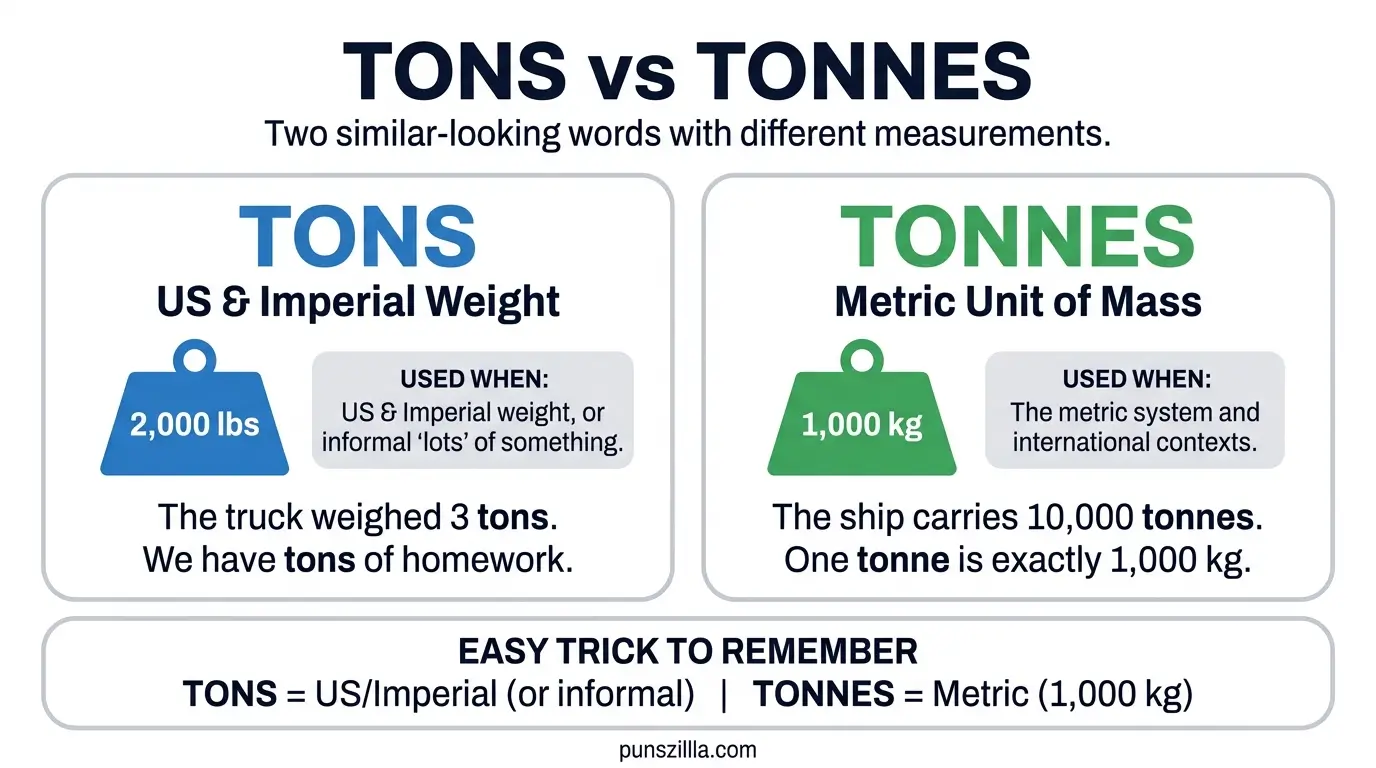
Tons vs Tonnes: Visual Comparison
Tons vs Tonnes: Visual Comparison
TONS
2,000 lb
Approximately 907.18 kg
Commonly used for US customary weight measurements.
Example: The truck carries 5 tons of cargo.
TONNES
1,000 kg
Approximately 2,204.62 lb
Used for metric weight measurements worldwide.
Example: The shipment weighs 5 tonnes.
Remember: A US short ton and a metric tonne are different measurements, even though their names sound similar.
Quick Spelling Guide
| Spelling | Meaning | Example |
|---|---|---|
| Tons | Plural of ton; also means a large amount informally. | We have tons of work. |
| Tonnes | Plural of tonne; each metric tonne equals 1,000 kg. | The load weighs 10 tonnes. |
Weight Conversion Table
| Measurement | Kilograms | Pounds |
|---|---|---|
| US Short Ton | 907.18 kg | 2,000 lb |
| Metric Tonne | 1,000 kg | 2,204.62 lb |
| British Long Ton | 1,016.05 kg | 2,240 lb |
Which Spelling Should You Use?
The best choice depends on your audience and what you are measuring.
1. General and Modern Writing
Use tons for everyday American English when referring to customary weight or a large amount of something.
Example: “There are tons of books in the library.”
Use tonnes when the weight is measured in metric units.
Example: “The farm produced 40 tonnes of wheat.”
2. Formal and Academic Writing
Be precise in research papers, scientific reports, and academic assignments. If the measurement is metric, write tonnes or follow the unit format required by your institution.
Example: “The experiment used three tonnes of raw material.”
Always identify the unit clearly when different measurement systems could cause confusion.
3. Business and Technical Writing
Use the measurement specified in the contract, technical specification, or reporting standard. International shipping and engineering documents often need to distinguish metric tonnes from short or long tons.
Example: “The vessel transported 2,500 metric tonnes of cargo.”
4. Writing for a Global Audience
If your readers come from different countries, tonnes is a useful choice when you mean exactly 1,000 kilograms. It reduces confusion about the intended weight.
For informal expressions such as “tons of fun,” use the spelling that fits your audience and the conventions of your publication.
Common Mistakes with Tons or Tonnes
Here are six mistakes to avoid.
- Using tons when you specifically mean metric tonnes.Incorrect for an explicitly metric measurement: “The shipment weighs 15 US tons” when the intended weight is 15,000 kilograms.Correct: “The shipment weighs 15 tonnes.”
- Assuming a ton always equals 1,000 kilograms.A US short ton is 2,000 pounds, while a metric tonne is 1,000 kilograms. They are not equal.
- Writing tonne’s instead of tonnes.Incorrect: “The factory produced 50 tonne’s.”Correct: “The factory produced 50 tonnes.”An apostrophe is not needed to form this plural.
- Using ton’s as a plural.Incorrect: “We ordered ten ton’s of gravel.”Correct: “We ordered ten tons of gravel.”
- Mixing measurement systems in calculations.Incorrect: Adding 10 short tons to 10 metric tonnes without converting the units.Correct: Convert both quantities to the same unit before calculating the total.
- Changing spelling within one document without a reason.Choose the appropriate unit and follow it consistently. If your report uses metric measurements, use tonnes consistently unless a quoted source or specified standard requires otherwise.
Tons or Tonnes in Everyday Examples
Both spellings can appear in different contexts. Here are examples showing how to use them naturally.
In Emails
- “The supplier confirmed that the order contains 20 tonnes of steel.”
- “We have tons of tasks to complete before Friday.”
In News Headlines
- “Factory Produces Thousands of Tonnes of Cement”
- “US Company Reports Record Sales of 500,000 Tons of Coal”
These are illustrative headlines, not reports of actual events.
In Social Media Posts
- “We collected two tonnes of recyclable waste today!”
- “I have tons of photos from our trip.”
In Formal Writing
- “The facility can process 100 tonnes of waste per day.”
- “The cargo vessel has a capacity of 20,000 metric tonnes.”
The important point is to match the spelling and measurement to the meaning, rather than choosing a form simply because it looks more familiar.
Usage and Popularity of Tons vs Tonnes
Both spellings are established in modern English, but their usage depends on context.
- Tons is common in American writing, especially when referring to US customary weight. It is also used informally to mean “a lot.”
- Tonnes is common in metric measurements, including international trade, scientific reporting, agriculture, and environmental discussions.
It is not necessary to claim that one spelling is universally more popular. Their suitability depends on the country, measurement system, and context.
For clear writing, focus on the intended meaning rather than trying to choose the supposedly more popular spelling. In technical documents, accuracy is more important than regional preference.
Tons vs Tonnes: Comparison Table
| Word | Part of Speech | Meaning | Example Sentence |
|---|---|---|---|
| Ton | Noun | A unit of weight whose exact value depends on the system | The load weighs one ton. |
| Tons | Plural noun | More than one ton; also an informal large amount | We have tons of supplies. |
| Tonne | Noun | A metric unit equal to 1,000 kilograms | The machine weighs one tonne. |
| Tonnes | Plural noun | More than one metric tonne | The farm produced 25 tonnes of grain. |
Frequently Asked Questions
Which is correct, tons or tonnes?
Both are correct. Tons is the plural of ton, while tonnes is the plural of tonne. Use the form that matches your intended measurement.
Is tonnes British English and tons American English?
Not exactly. Tonnes is widely used in British and international metric writing, while tons is common in American English. However, the main distinction is the measurement system, not nationality alone.
Is one tonne equal to one ton?
Not always. A metric tonne equals 1,000 kilograms. A US short ton equals 2,000 pounds, or about 907 kilograms. A British long ton equals 2,240 pounds, or about 1,016 kilograms.
What is the plural of tonne?
The plural is tonnes.
Example: “The company transported 12 tonnes of grain.”
Can I write “tons of work”?
Yes. “Tons of work” is an informal expression meaning a large amount of work. It does not normally describe a literal measurement of weight.
Which spelling should I use in academic writing?
Use tonnes for metric measurements. If your assignment or publication specifies another unit or style, follow those requirements and identify the measurement clearly.
Are tons and tonnes pronounced the same way?
Yes. Both are generally pronounced the same way in the plural, although accents can vary. Their meanings and spellings differ even though their pronunciation is the same.
Should I use tons or tonnes in a news article?
Choose according to the measurement being reported. Use tonnes for metric weight and tons when the source uses short or long tons or when the context calls for the informal expression.
Conclusion: Tons or Tonnes?
The choice between tons and tonnes is more than a spelling preference. Both are correct English words, but they can refer to different units of weight.
Understanding the distinction helps you write clearly and avoid errors in measurements, reports, business documents, and everyday conversations.
Use tons when referring to US short tons, British long tons where appropriate, or informal expressions such as “tons of fun.” Use tonnes when you mean metric units of 1,000 kilograms each.
If you are writing for an international audience, specifying the measurement system can prevent confusion.
Consistency is also important. Once you choose the appropriate unit for your document, use it throughout and convert measurements before comparing quantities from different systems.
For academic, scientific, and professional writing, accuracy matters more than regional spelling preferences.
The rule to remember: Use tonnes for metric weight and tons when the intended unit or informal meaning calls for it.