
Afternoon or Evening? How to Know the Difference (With Clear Time Ranges)
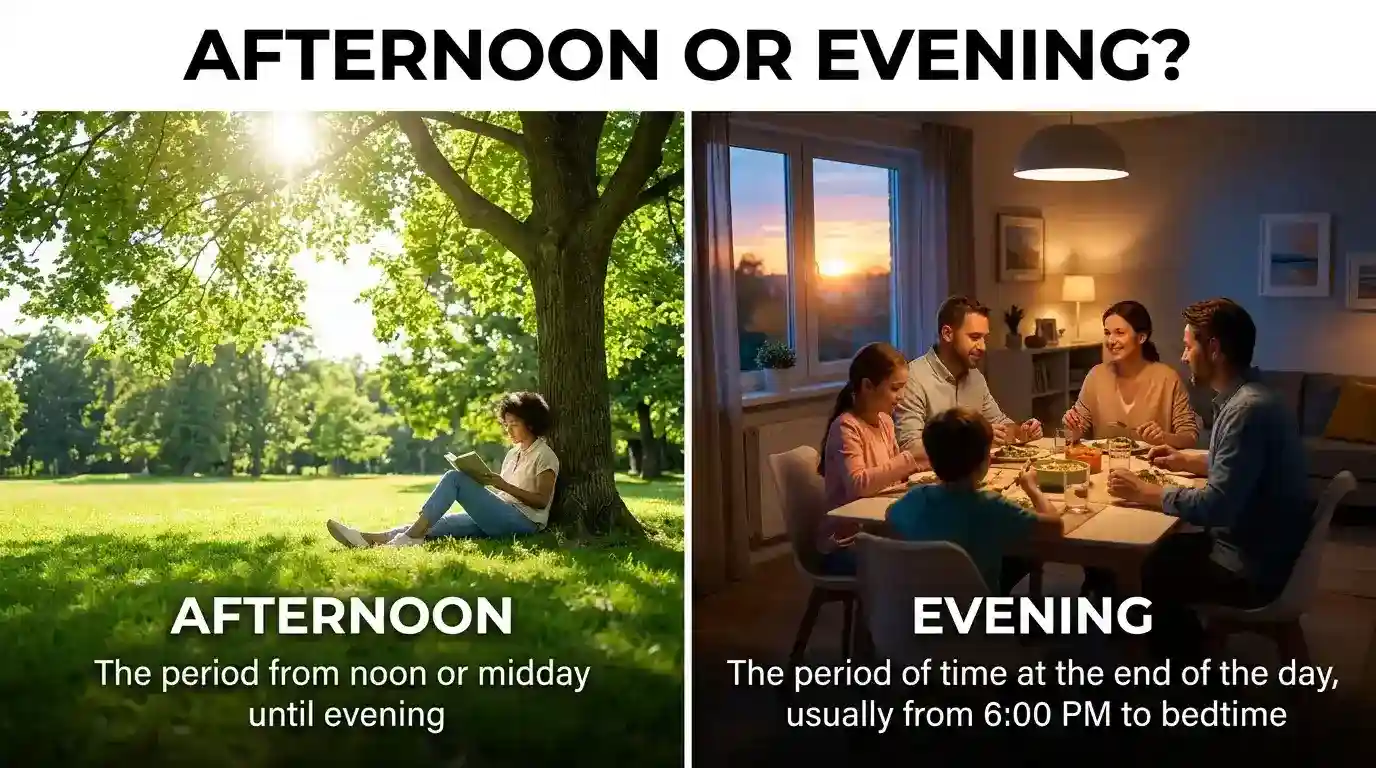
Afternoon or Evening: Afternoon is after noon, while evening is the later part of the day before night.
Quick is 5 p.m. the afternoon or the evening? Most people freeze for a second before answering. That tiny pause is the whole reason “afternoon or evening” is one of the most searched time-of-day questions online.
It sounds like something you should already know, yet the line between the two is blurry, and it moves depending on who you ask, where you live, and even the season.
People search this phrase for a few practical reasons. They want to send the right greeting in an email. They need to know when to switch from “good afternoon” to “good evening” on a call.
Businesses need clear hours for staff shifts and customer service. Writers want to use the correct word in a story or article. And plenty of people are just plain curious, because school never really taught this.
This guide gives you a fast, direct answer first, then walks through where these words come from, how usage shifts by country, common mistakes, and real examples so you can use “afternoon” and “evening” correctly every time, in any setting.
Afternoon or Evening Quick Answer
Afternoon runs from 12:00 noon to roughly 5:00–6:00 p.m.
Evening runs from around 5:00–6:00 p.m. until night falls, usually 8:00–9:00 p.m.
There’s no official clock cutoff. The switch depends on the sun going down, local habits, and context. A 4 p.m. meeting is safely “afternoon.” A 7 p.m. dinner is safely “evening.” The messy middle is 5 to 6 p.m., where either word works depending on where you are.
A few quick examples:
- “Let’s meet in the afternoon, around 2 p.m.” clearly daytime, sun still high.
- “I’ll call you this evening after dinner.” clearly after dark or close to it.
- “See you this afternoon or evening, whichever works.” used when the exact time isn’t fixed yet.
The Origin of Afternoon and Evening
Afternoon is a simple combination: “after” plus “noon.” It has been used in English for centuries, going back to Middle English, where you’d also find the older word “aftermete” meaning the same thing.
Noon itself used to mean 3 p.m., not 12 p.m. Church prayer times shifted the meaning of noon backward to midday over a few hundred years, and afternoon shifted along with it.
Evening comes from an old English root meaning “the close of day” or the approach of night. It’s tied to the idea of the sun going down, not a fixed hour.
That’s exactly why the boundary between afternoon and evening was never nailed down with an exact time. Before clocks were common, people split the day by sunlight and daily routines like meals and prayer, not by numbers on a dial. That habit is baked into the language, and it’s why the boundary still feels fuzzy today.
Formal vs Everyday Usage
Unlike words such as “colour” and “color,” afternoon and evening don’t have separate British and American spellings. The spelling is the same everywhere English is spoken.
What actually changes across regions is when people switch from one word to the other, and how the words get used in formal versus casual settings.
| Setting | Typical Range | Example Phrase |
|---|---|---|
| Formal / business | Afternoon: 12–5 p.m.Evening: 5–9 p.m. | “Good afternoon, thank you for calling.” |
| Everyday / casual (US) | Afternoon: 12–6 p.m.Evening: 6 p.m. onward | “Catch you this evening.” |
| Everyday / casual (UK) | Afternoon: 12–5/6 p.m.Evening: 6 p.m. onward | “See you this evening, then.” |
| Retail / hospitality shifts | Afternoon shift: noon–8 p.m.Evening shift: 8 p.m.–close | “She’s on the evening shift tonight.” |
Some American English speakers stretch “evening” to cover almost anything after lunch, which can confuse readers used to a stricter noon-to-6 p.m. afternoon window. When in doubt, match the tone and region of the person you’re writing to.
Which One Should You Use?
The right word depends less on strict rules and more on daylight, context, and audience.
- Before 3 p.m.: always “afternoon.” No debate here.
- 3 p.m. to 5 p.m.: still “afternoon” in almost every context, especially formal ones.
- 5 p.m. to 6 p.m.: the grey zone. Either word is acceptable. Follow local custom if you know it.
- After 6 p.m., or once it’s dark: use “evening.”
- Writing for a US audience: afternoon can stretch closer to 6 p.m.
- Writing for a UK or Commonwealth audience: the switch to evening tends to happen a little earlier, closer to 5 p.m.
- Writing for a global or unknown audience: say the actual time instead of relying on the word. “Let’s talk at 5 p.m. your time” beats “let’s talk this evening.”
Common Mistakes with Afternoon or Evening
Mistake: Saying “good evening” at 3 p.m. This sounds off in almost every English-speaking region. Stick with “good afternoon” until at least 5 p.m.
Mistake: Using “afternoon” for anything after dinner. Once the meal is done and it’s dark outside, it’s evening, not late afternoon.
Mistake: Assuming there’s a British/American spelling split. There isn’t. The confusion here is about timing, not spelling, so don’t go looking for a “correct” spelling that doesn’t exist.
Mistake: Writing vague event times like “drop by in the afternoon or evening” for formal invitations. Give an actual time or time range instead.
Mistake: Ignoring context. A business email at 5:30 p.m. reads differently from a text to a friend at 5:30 p.m. Formal writing should lean earlier toward “afternoon”; casual writing has more room to say “evening.”
Afternoon or Evening in Everyday Examples
In emails
“Good afternoon, I hope this message finds you well.” (sent before 5 p.m.)
“Good evening, thank you for your patience today.” (sent after 6 p.m.)
In news writing
“The press conference is scheduled for early afternoon.” (around 1–2 p.m.)
“Storms are expected to roll in by evening.” (after sunset, roughly 7 p.m. or later)
On social media
“Afternoon walk with the dog ☀️” (posted mid-day)
“Evening wind-down, tea and a book 🌙” (posted after dark)
In formal writing and contracts
“Staff members whose shifts begin between noon and 8 p.m. receive an afternoon shift premium.” This is a common style in HR policy documents, where the cutoff is stated as an exact hour instead of a general feeling, precisely because “afternoon” and “evening” are too loose for legal or payroll use.
Related Post: Assure or Ensure? The Simple Way to Never Mix Them Up Again
Afternoon or Evening Search and Usage Patterns
This phrase gets searched heavily around a few recurring situations: people writing greetings, people scheduling meetings across time zones, employees checking shift definitions, and writers double-checking word choice for a story or article.
Search interest tends to spike around late afternoon hours, which makes sense: people are searching right at the moment they’re unsure which word to use.
Country matters more than most people expect. In the US, casual speech pushes “evening” earlier, sometimes starting around 5 p.m. In the UK and much of the Commonwealth, “afternoon” tends to hold on a bit longer in daily speech, with “evening” reserved for after 6 p.m.
Businesses everywhere tend to define both words with exact hours in their internal policies, because vague time-of-day words don’t work well for pay, scheduling, or legal contracts.
| Phrase Variation | Meaning / Use | Typical Time |
|---|---|---|
| Afternoon | Daytime, after noon, sun still up | 12 p.m. – 5/6 p.m. |
| Evening | Later part of day, sun setting or down | 5/6 p.m. – 9 p.m. |
| Late afternoon | The tail end of afternoon, close to the switch point | 3 p.m. – 6 p.m. |
| Early evening | Right after the switch, before it’s fully dark | 5 p.m. – 7 p.m. |
| Good afternoon / Good evening | Formal greetings tied to time of day | Matches the ranges above |
Frequently Asked Questions
What time does afternoon end and evening begin?
Most people place the switch somewhere between 5 p.m. and 6 p.m. There’s no official rule, so treat this as a soft guideline, not a fixed clock time.
Is 4 p.m. afternoon or evening?
4 p.m. is afternoon almost everywhere. The sun is still up and the workday isn’t done, so “evening” would sound early here.
Is 6 p.m. afternoon or evening?
6 p.m. sits right at the edge. In the US, many people already call it evening. In the UK, some still treat it as late afternoon, especially in summer when it’s still light out. Either word is defensible at 6 p.m.
Do British and American English spell these words differently?
No. “Afternoon” and “evening” are spelled the same in British and American English. The confusion around this phrase is about timing and usage, not spelling.
What’s the correct greeting to use after 5 p.m.?
“Good evening” is the safer formal choice after 5 p.m., especially in business settings. Before 5 p.m., stick with “good afternoon.”
Does the afternoon-evening switch change with the seasons?
Yes, informally. In summer, when it stays light later, people often keep saying “afternoon” longer. In winter, once it gets dark by 5 p.m., people switch to “evening” earlier, even at the same clock time.
Should I use the exact time instead of “afternoon” or “evening” in scheduling?
For anything formal, business-related, or across time zones, yes. Say “3 p.m.” or “5:30 p.m.” instead of “this afternoon” or “this evening” to avoid any mix-up.
Conclusion
The line between afternoon and evening was never meant to be exact, and that’s exactly why so many people search for a clear answer.
As a general rule, afternoon covers noon to roughly 5–6 p.m., and evening picks up from there until night sets in. The switch point moves a little depending on your country, the season, and whether you’re writing something formal or casual.
There’s no spelling difference to worry about here, only a timing judgment call. When you’re speaking casually with friends, either word works fine in that 5–6 p.m. window.
When you’re writing something formal, a business email, a contract, an official invitation, it’s safer to use an exact time instead of relying on either word.
Keep this simple rule in mind: before 5 p.m., say afternoon; after 6 p.m., say evening; and anywhere in between, go with what sounds natural for your audience or just state the clock time. That one habit will keep your writing and speech accurate no matter where your reader is.