
Tryed or Tried: Which Spelling Is Correct?
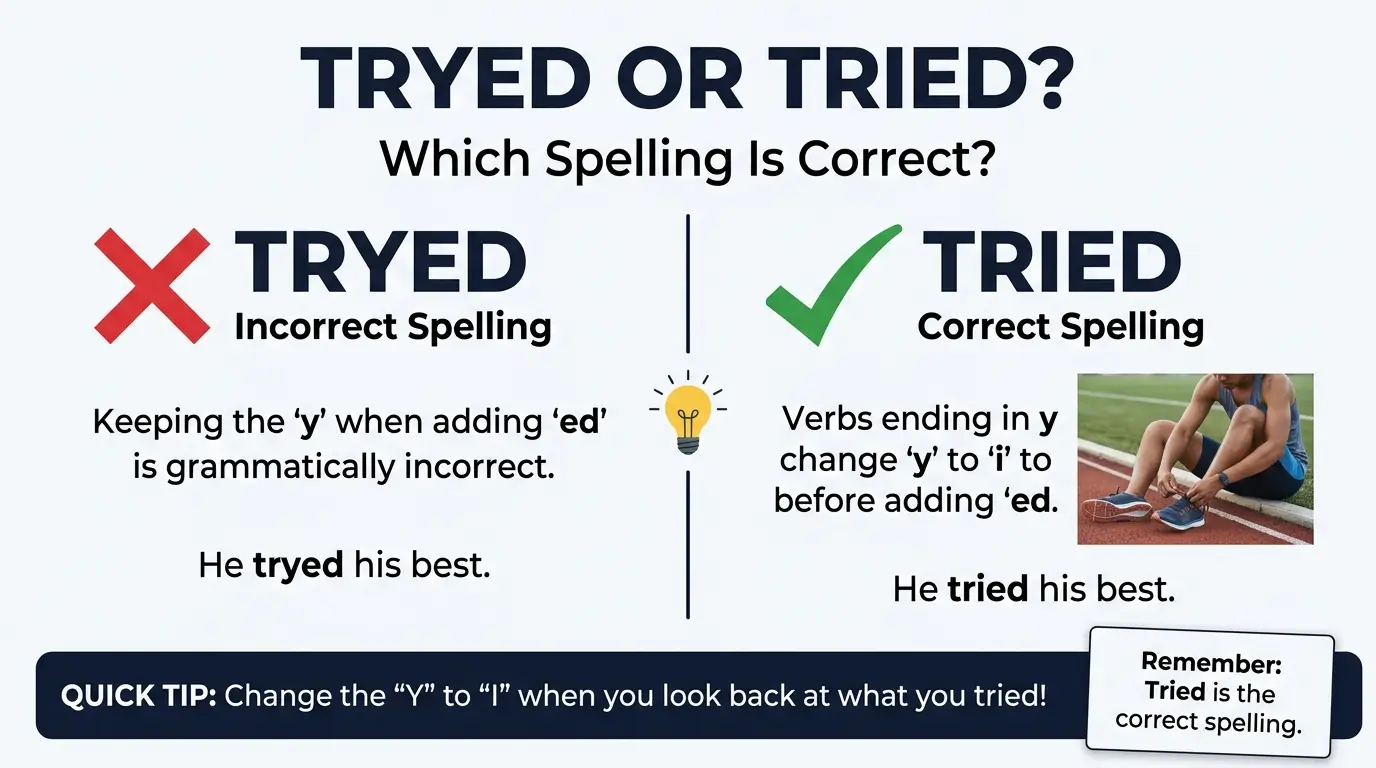
Have you ever typed “tryed” and wondered if it looks right? You are not alone. Tryed or tried is a common spelling question because the word try changes its ending when we make it past tense. The correct spelling is tried, while tryed is incorrect in standard English.
This small spelling change can cause confusion in schoolwork, emails, essays, social media posts, and professional writing.
The rule is simple once you know it: when a verb ends in a consonant + y, the y usually changes to i before adding -ed. So, try becomes tried, not tryed.
In this guide, you will learn why tried is correct, where the spelling comes from, how British and American English handle it, and how to use it in everyday sentences.
You will also see common mistakes, examples, usage patterns, and answers to frequently asked questions.
Tryed or Tried Quick Answer
Tried is the correct spelling. Tryed is incorrect.
The verb try becomes tried in the past tense and past participle.
Examples:
- I tried to call you yesterday.
- She tried the new recipe.
- We have tried everything.
- He tried his best.
Quick Comparison
| Spelling | Correct? | Example |
| tried | ✅ Yes | I tried to help. |
| tryed | ❌ No | I tryed to help. |
The same spelling rule appears in other verbs:
- cry → cried
- study → studied
- carry → carried
- hurry → hurried
The Origin of Tryed or Tried
The word try comes from Old French trier, meaning to sort, sift, or test. Over time, its meaning developed into testing or making an attempt.
The past form tried follows a long-established English spelling rule. When a verb ends in a consonant followed by y, English normally changes y to i before adding -ed.
So:
try + ed → tried
The spelling tryed may look logical because speakers can hear the same basic sound. However, standard English spelling uses tried.
There is an important exception. If the letter before y is a vowel, the y usually stays:
- play → played
- enjoy → enjoyed
- stay → stayed
This explains why we write tried but played.
British English vs American English Spelling
There is no difference between British and American English for this word.
Both varieties use:
tried
The spelling rule is the same in standard British and American English.
| Verb | British English | American English |
| try | tried | tried |
| cry | cried | cried |
| study | studied | studied |
| carry | carried | carried |
| play | played | played |
Some English words have different British and American spellings, such as colour/color and centre/center. Tried is not one of them.
Which Spelling Should You Use?
Use tried in all standard English writing.
For US English
Use tried in:
- School assignments
- Business emails
- Websites
- Reports
- Text messages
- Social media
For UK and Commonwealth English
Use tried as well. The spelling does not change.
For Global English
If you write for an international audience, tried is the correct choice. It is understood and accepted across major English varieties.
Simple rule:
Always use tried, never tryed, when writing standard English.
Common Mistakes with Tryed or Tried
1. Writing “tryed”
❌ I tryed to finish the work.
✅ I tried to finish the work.
2. Forgetting the spelling change
❌ She tryed a new method.
✅ She tried a new method.
3. Confusing “tried” with “try”
Try is the base form:
I will try again.
Tried is the past form:
I tried yesterday.
4. Using “tried” with the wrong time
The word tried refers to a completed attempt.
✅ I tried it yesterday.
For a present or future action, use try:
✅ I try every day.
✅ I will try tomorrow.
Tryed or Tried in Everyday Examples
In Emails
I tried to reach you earlier but could not get through.
In News Writing
The team tried several methods before finding a solution.
On Social Media
I tried this new app today, and it works well!
In Formal Writing
The researchers tried several approaches during the study.
In Conversation
I tried, but it did not work.
In School Writing
She tried to complete her assignment before the deadline.
Tryed or Tried Google Trends & Usage Data
Searches for “tryed or tried” usually come from people checking whether tryed is a valid past-tense spelling.
The correct form, tried, is overwhelmingly more common because it is the standard past tense and past participle of try.
Tryed appears mainly as a spelling error, informal mistake, or search query from someone checking the correct form.
Usage is broadly consistent across countries, including the United States, United Kingdom, Canada, Australia, and other English-speaking regions. Unlike words such as color/colour, there is no major regional spelling difference here.
Search interest can vary by context. People may search for this spelling while writing school assignments, emails, articles, social posts, or English-learning exercises.
Note: Search trends change over time, so Google Trends should be treated as a relative indicator of search interest rather than a fixed measure of word frequency.
Tryed vs Tried: Comparison Table
| Variation | Correct? | Meaning | Example |
| tried | ✅ Correct | Past form of try | I tried again. |
| tryed | ❌ Incorrect | Intended as past form of try | I tryed again. |
| try | ✅ Correct | Base verb | I will try again. |
| trying | ✅ Correct | Present participle | I am trying again. |
| tries | ✅ Correct | Third-person present | She tries every day. |
The Complete Word Family
Try → tries → trying → tried
Examples:
- I try to help.
- She tries to help.
- They are trying to help.
- We tried to help.
FAQs About Tryed or Tried
Is “tryed” a correct word?
No. Tryed is not the standard English spelling. The correct past tense of try is tried.
Why is it “tried” instead of “tryed”?
Because verbs ending in a consonant + y usually change y to i before adding -ed.
Is “tried” correct in American English?
Yes. Tried is the standard spelling in American English.
Is “tried” correct in British English?
Yes. British English also uses tried.
What is the past tense of “try”?
The past tense of try is tried.
What is the past participle of “try”?
The past participle is also tried.
Example:
I have tried several times.
Is “tryed” ever acceptable?
Not in standard English. For normal writing, always use tried.
Conclusion
When choosing between tryed or tried, the answer is clear: tried is the correct spelling. Tryed is a common spelling mistake and should not be used in standard English.
The reason is the spelling rule for verbs ending in a consonant + y. The y changes to i before -ed: try → tried. The same pattern appears in words such as cry → cried, study → studied, and carry → carried.
This rule works the same way in both British and American English. There is no regional spelling difference for tried, so you can safely use it in schoolwork, professional emails, articles, news writing, and everyday messages.
The easiest way to remember it is simple: try becomes tried, never tryed. If you are writing about a past attempt, choose tried every time. Once you remember the y → i rule, this spelling question becomes easy to solve.