
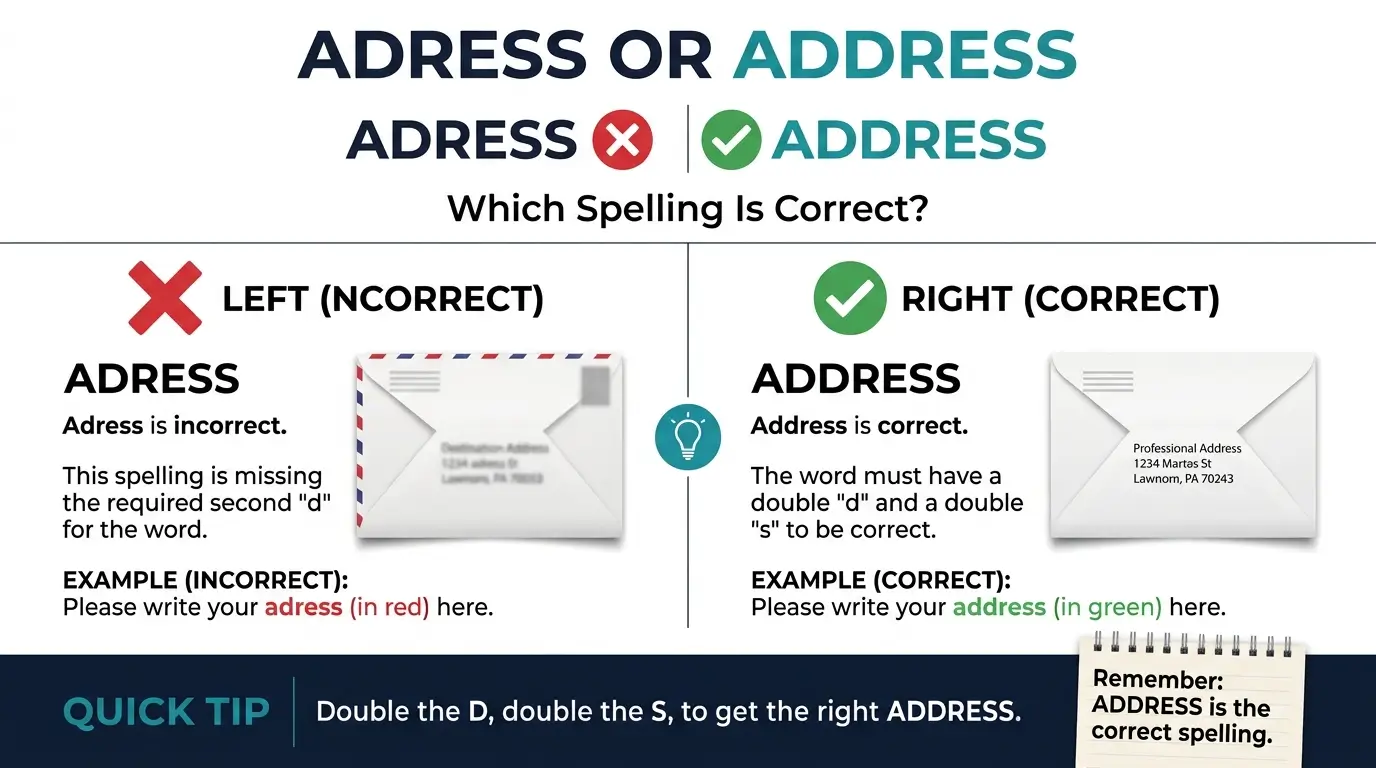
Address or Adress: Which Spelling Is Correct?
The correct spelling is “address” with two d’s. “Adress” is incorrect in standard English.
Have you ever typed “adress” and wondered if it was correct? You are not alone. Many English learners, writers, and native speakers search for address or adress because the two words look very similar. The difference is only one letter, but that letter matters.
The correct spelling in standard English is address, with two “d” letters. The spelling adress, with one “d,” is generally a misspelling. This rule is the same in British English and American English.
The confusion often happens because English spelling can be tricky. Some words use double consonants, while others do not. People may also type quickly and accidentally leave out one d. Since address can be both a noun and a verb, this can create even more confusion.
This guide gives you a quick answer first. Then, it explains the word’s origin, spelling rules, common mistakes, real-life examples, and usage advice. By the end, you will know exactly when and how to use address.
Address or Adress Quick Answer
Address is the correct spelling.
Adress is a misspelling in standard English.
Correct examples
- Please write your home address.
- What is your email address?
- The president will address the public.
- We need to address this problem.
Incorrect example
- Please send me your adress. ❌
The simple rule is easy:
Always use “address” with two d’s.
The Origin of Address or Adress
The word address has a long history. It came into English through French and has roots in Latin.
Over time, the word developed several meanings. Today, address can mean:
- The place where someone lives.
- An email or website location.
- A formal speech.
- The act of speaking to someone.
- The act of dealing with a problem.
For example:
- Home address → Where you live.
- Email address → Your email location.
- Address the audience → Speak to the audience.
- Address a problem → Deal with a problem.
The spelling address became the standard English form. The version adress did not become an accepted spelling in modern standard English.
The double d is part of the correct spelling, no matter how you use the word.
British English vs American English Spelling
Some English words have different spellings in British and American English.
For example:
- Colour in British English and color in American English.
- Organise in British English and organize in American English.
However, address is different. Both British and American English use the same spelling.
| English Type | Correct Spelling | Example |
|---|---|---|
| British English | Address | Please confirm your address. |
| American English | Address | Please confirm your address. |
| Australian English | Address | Please confirm your address. |
| Canadian English | Address | Please confirm your address. |
| Incorrect spelling | Adress ❌ | Not standard English. |
So, there is no British vs American spelling difference here.
Address is correct everywhere in standard English.
Which Spelling Should You Use?
Your audience does not change the spelling in this case.
For a US audience
Use address.
Example:
Please enter your mailing address.
For a UK audience
Use address.
Example:
Please provide your home address.
For Australia, Canada, and other Commonwealth countries
Use address.
Example:
Your address is required for delivery.
For a global audience
Use address.
This is one of the easiest spelling choices in English because the correct form stays the same around the world.
| Variation | Should You Use It? | Where? |
|---|---|---|
| Address | Yes | US, UK, Canada, Australia, and globally |
| Adress | No | Standard English |
Common Mistakes with Address or Adress
The most common mistake is leaving out one d.
Mistake 1: Using “adress”
Incorrect: What is your email adress?
Correct: What is your email address?
Mistake 2: Misspelling it in a formal document
An address is often used in:
- Job applications.
- Business forms.
- Shipping details.
- Legal documents.
- Emails.
A spelling mistake can make a professional document look less polished.
Incorrect: Please update your contact adress.
Correct: Please update your contact address.
Mistake 3: Forgetting that “address” is also a verb
Address is not only a location.
It can also mean to speak to someone or deal with something.
Example:
The manager will address the issue tomorrow.
Not:
The manager will adress the issue tomorrow. ❌
Address or Adress in Everyday Examples
Here are some simple examples of how address appears in daily life.
In emails
Please send the file to my email address.
Can you confirm your mailing address?
In the news
The Prime Minister will address the nation tonight.
Here, address means to speak to.
On social media
Please do not share your home address online.
In formal writing
The company will address the customer’s concerns.
Here, address means to deal with or discuss.
In online forms
Enter your billing address.
In a business letter
Please update your contact address before submitting the form.
The spelling remains the same in every situation.
Address or Adress Google Trends & Usage Data
Search behavior shows why people ask about address or adress. Many users type “adress” because they are unsure whether the word needs one d or two.
The correct spelling, address, is widely used in all English-speaking countries. It appears in everyday searches related to:
- Home addresses.
- Email addresses.
- IP addresses.
- Website addresses.
- Business addresses.
- Formal speeches.
- Solving problems.
The misspelling adress often appears in spelling searches, typing errors, and questions from English learners.
Usage can vary by search intent. For example, someone searching address meaning may want a definition. Someone searching address or adress usually wants a quick spelling answer.
The key point is simple: popularity does not make a spelling correct. Even if adress appears in searches, address is the standard spelling for professional and everyday English.
Address vs Adress: Comparison Table
| Feature | Address | Adress |
|---|---|---|
| Spelling | Correct | Incorrect |
| Number of “d” letters | Two | One |
| Used in US English | Yes | No |
| Used in UK English | Yes | No |
| Used in formal writing | Yes | No |
| Used for home location | Yes | No |
| Used as a verb | Yes | No |
| Standard English word | Yes | No |
FAQs About Address or Adress
Is “adress” ever correct?
No. Adress is generally a misspelling of address in standard English.
Is “address” spelled differently in British and American English?
No. Both British and American English use address.
Why does “address” have two d’s?
The double d is part of the standard spelling of the word.
Can “address” be a noun and a verb?
Yes.
As a noun:
What is your home address?
As a verb:
We need to address the problem.
What does “address” mean?
It can mean a location, an email location, a speech, speaking to someone, or dealing with an issue.
Is “email adress” correct?
No.
The correct phrase is:
Email address.
How can I remember the correct spelling?
Remember that address has two d’s:
A + DD + RESS
Think: Always Double D in address.
Conclusion
The answer to address or adress is simple: address is the correct spelling, while adress is a misspelling in standard English. This rule does not change between British English and American English. Whether you are writing for readers in the US, UK, Canada, Australia, or anywhere else, address is the form you should use.
The word can work as both a noun and a verb. It may describe where someone lives, an email location, or a formal speech. It can also mean to speak to someone or deal with a problem. In every case, the spelling stays the same: address.
The best way to avoid mistakes is to remember the double d. This is especially important in emails, job applications, business documents, online forms, and other professional writing. A small spelling error may seem minor, but using the correct form makes your writing clearer and more professional.
So, when you are unsure, remember the rule: always write address, never adress.