
Knifes or Knives: Which Spelling Is Correct?
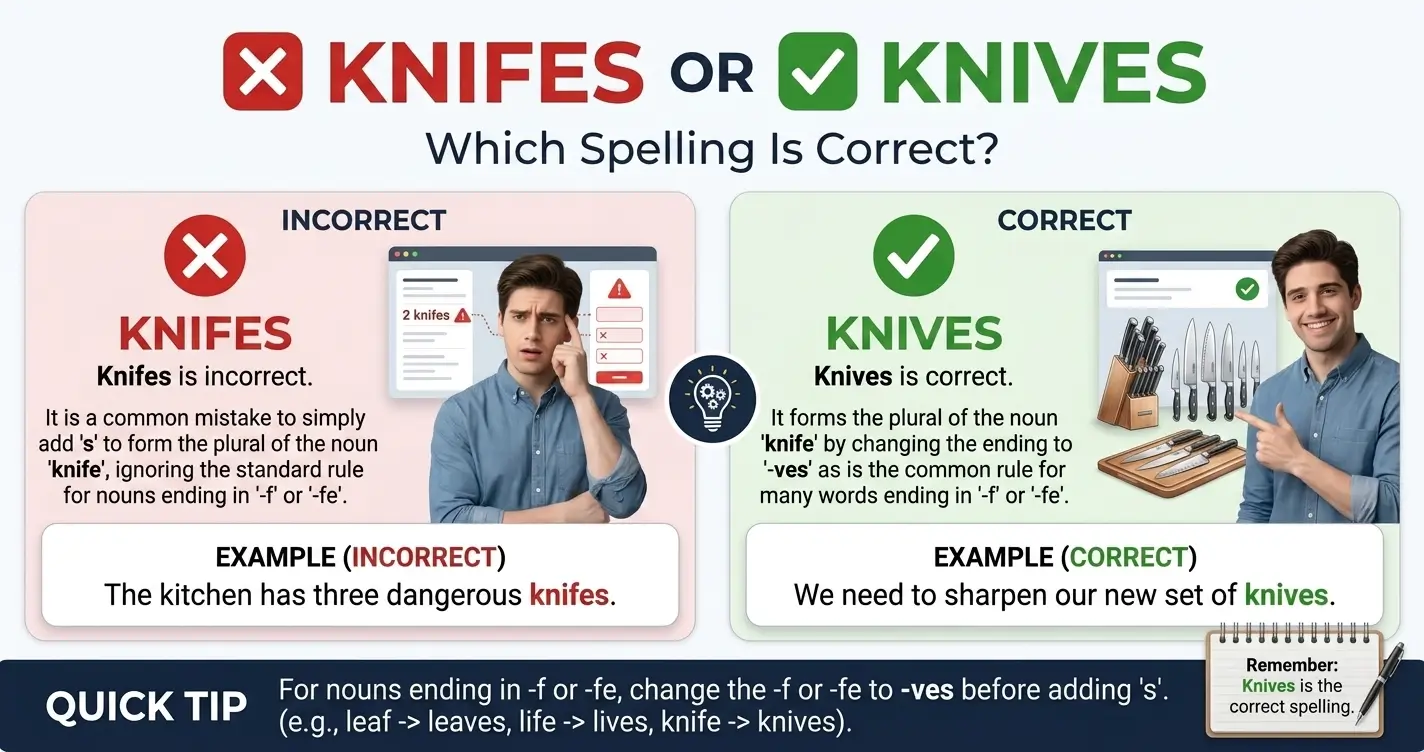
The correct plural of knife is knives. Use knife for one and knives for two or more. “Knifes” is not the standard plural spelling.
When you need to write the plural of knife, one small spelling choice can cause confusion: knifes or knives? At first glance, “knifes” may seem correct because many English nouns form their plural by adding -s. However, English has several words that change their spelling when they become plural.
The correct plural of knife is knives. For example, you say, “The chef has several knives,” not “The chef has several knifes.” The spelling knifes can exist as a verb form in some dictionaries, but it is not the standard plural noun.
People often search for “knifes or knives” when writing schoolwork, emails, recipes, product descriptions, or professional content. Knowing the difference helps you avoid a common spelling mistake and write with confidence.
This guide explains why knife becomes knives, whether British and American English use different spellings, common mistakes, everyday examples, and what search behavior tells us about this question.
Knifes or Knives Quick Answer
Knives is the correct plural spelling of knife.
- One knife → two knives
- One kitchen knife → several kitchen knives
- One sharp knife → many sharp knives
Knifes is not the standard plural form. However, knifes can be used as a third-person singular verb form of knife, meaning to cut or move through something as if cutting.
Examples
Correct:
The chef washed all the knives.
Incorrect as a plural:
The chef washed all the knifes.
Verb example:
The boat knifes through the waves.
For the plural noun, remember:
knife → knives
The Origin of Knifes or Knives
The word knife has a long history. It comes through Middle English from Old English cnīf, with a related form from Old Norse. Over time, the spelling changed into the modern word knife.
The plural knives comes from an older English pattern. Some nouns ending in -f or -fe developed a v sound in their plural forms. This helped produce forms such as:
- knife → knives
- life → lives
- wife → wives
- leaf → leaves
- wolf → wolves
- shelf → shelves
This is why the plural is not simply knife + s.
English does not apply this pattern to every word ending in -f. For example:
- roof → roofs
- chief → chiefs
- belief → beliefs
So, the best approach is to learn common plural forms rather than assume every -f word changes to -ves.
British English vs American English Spelling
There is no spelling difference between British and American English for this word.
Both use:
- knife for one
- knives for more than one
| English Variety | Singular | Plural | Correct? |
|---|---|---|---|
| British English | knife | knives | Yes |
| American English | knife | knives | Yes |
| Canadian English | knife | knives | Yes |
| Australian English | knife | knives | Yes |
| International English | knife | knives | Yes |
For example, both a British writer and an American writer would write:
The restaurant bought new kitchen knives.
The spelling knifes should not be used as the plural in standard British or American English.
The main difference is grammatical use. Knifes may appear as a verb, while knives is the standard plural noun. Dictionaries list knifes as a present-tense verb form of knife.
Which Spelling Should You Use?
If you mean more than one knife, always choose knives.
For American English
Use knives:
I bought three new knives.
For British English
Use knives:
The kitchen needs several new knives.
For Formal Writing
Use knives in essays, reports, articles, business writing, and academic work.
For Online Content
Use knives in recipes, product descriptions, blogs, and social media posts when referring to multiple knives.
A simple rule works everywhere:
One = knife
Two or more = knives
Common Mistakes with Knifes or Knives
Mistake 1: Adding -s
A common error is:
five knifes
The correct form is:
five knives
Mistake 2: Using Knifes as a Plural
Do not write:
These knifes are expensive.
Write:
These knives are expensive.
Mistake 3: Confusing the Noun and Verb
Knives is the standard plural noun.
Knifes can be a verb form:
The boat knifes through the water.
This difference explains why you may occasionally see knifes in a dictionary or word list.
Mistake 4: Misspelling Knives
Avoid forms such as:
- knivez
- knivees
- knivves
- kniwes
The correct spelling is simply:
knives
Knifes or Knives in Everyday Examples
In Emails
Please bring the kitchen knives for the cooking class.
In News Writing
Police recovered several knives from the scene.
In Recipes
Use sharp knives to cut the vegetables.
In Shopping
This set contains six stainless-steel knives.
In Social Media
I just bought a new set of kitchen knives.
In Formal Writing
Professional kitchens require high-quality knives for food preparation.
As a Verb
The boat knifes through the waves.
The last example is different because knifes is functioning as a verb, not as a plural noun.
Knifes or Knives Google Trends & Usage Data
People search for “knifes or knives” mainly because they are unsure about the plural spelling. Search behavior for spelling questions often includes both the correct and incorrect forms because users type the word they are questioning.
Common related searches include:
- knifes or knives
- plural of knife
- knife plural
- how to spell knives
- is knives correct?
- knife or knives
The word knives itself is widely used in cooking, dining, household, outdoor, and product-related content. Exact Google Trends numbers can change by country and date range, so it is better not to treat a single popularity figure as permanent data.
The important usage point is clear: knives is the standard plural form, while knifes is mainly encountered as a spelling error or as a verb form. Dictionaries and language references support this distinction.
Comparison Table: Knifes vs Knives
| Word | Meaning | Correct? | Example |
|---|---|---|---|
| knife | One cutting tool | Yes | I need a knife. |
| knives | More than one knife | Yes | The knives are clean. |
| knifes | Verb form of knife | Yes, in the right context | The boat knifes through the water. |
| knifes | Plural of knife | No | ❌ I bought three knifes. |
Easy Rule to Remember
Knife → Knives
Think of similar words:
life → lives
wife → wives
leaf → leaves
wolf → wolves
This makes knife → knives easier to remember.
FAQs About Knifes or Knives
Is it knifes or knives?
Knives is the correct plural of knife.
Is “knifes” a real word?
Yes, knifes can be a verb form of knife. However, it is not the standard plural noun.
What is the plural of knife?
The plural of knife is knives.
Why does knife become knives?
The word follows an older English plural pattern in which the f/fe ending changes to v before the plural ending.
Is “knives” correct in American English?
Yes. Knives is the standard plural in American English.
Is “knives” correct in British English?
Yes. British English also uses knives.
How do you remember the spelling?
Use this simple pattern:
knife → knives
You can also remember similar forms such as life → lives and wife → wives.
Conclusion
The answer to knifes or knives is simple: knives is the correct plural of knife. If you are talking about two or more cutting tools, write knives, not knifes.
The spelling may seem unusual because many English nouns form their plural by adding -s. However, knife follows an older plural pattern in which -fe changes to -ve before the plural ending. This gives us knife → knives.
There is no British-American spelling difference here. Writers in both varieties of English use knife for one and knives for more than one.
Remember that knifes is not always meaningless. It can function as a verb in certain sentences, such as “The boat knifes through the waves.” But when you need the plural noun, knives is the professional and standard choice.
Easy rule: One knife, two or more knives.