
Defences or Defenses: Which Is Correct?
You are writing about an army, a lawyer, or a football team. Then you stop. Is it defences or defenses? Both look right. Both appear online. So which one should you type?
Here is the good news. Both spellings are correct. They belong to different versions of English. One is common in the United States. The other is common in the United Kingdom and many other countries.
This confusion is very common. Learners meet it in school, in exams, and at work. Writers meet it in emails, reports, and blog posts. A wrong choice will not change your meaning. But it can make your writing look inconsistent.
In this guide, you get a quick answer first. Then you learn why two spellings exist. You will see clear rules, tables, and real examples.
You will also get one easy trick to remember it. By the end, you will know when to use defences and when to use defenses.
Defences or Defenses Quick Answer
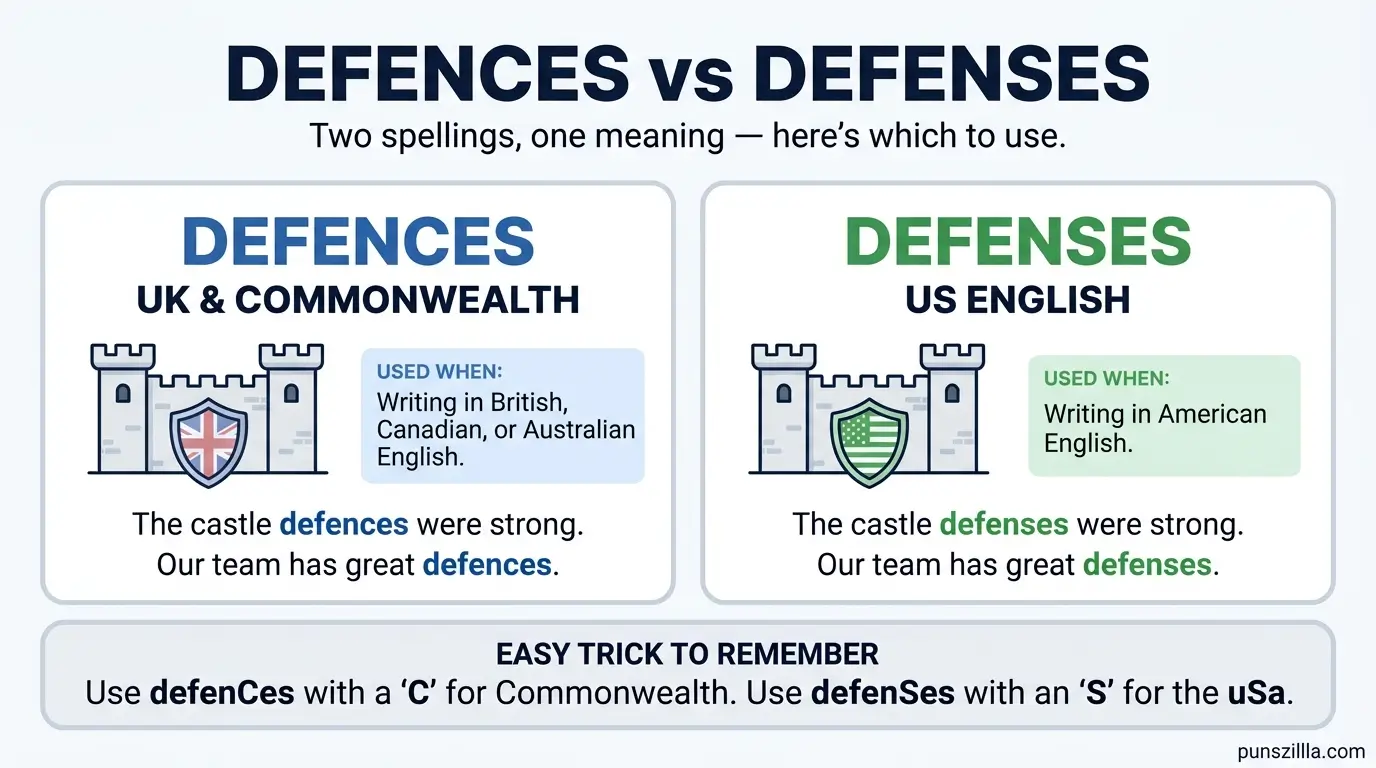
Quick Answer: Both spellings are correct. Defenses is the American English spelling. Defences is the British English spelling. Canada, Australia, and most Commonwealth countries also use defences.
Pick one spelling and use it everywhere in your text. Match the spelling to your reader. American readers expect defenses. British readers expect defences.
Defence (British English)
- The castle’s defences were weak on the north side.
- The Ministry of Defence released a new report.
- She wrote a strong defence of her idea.
Defense (American English)
- The team’s defense stopped every attack.
- Walls and moats were the castle’s main defenses.
- The lawyer built a strong defense for her client.
The Origin of Defences or Defenses
Both spellings come from the same word. English borrowed it from Old French. French took it from Latin. The Latin root means “to ward off” or “to protect.”
Early English spelling was not fixed. Writers used several forms of the word. Over time, British writers settled on defence.
American spelling took a different path. In the 1800s, Noah Webster pushed for simpler spellings. His dictionaries helped make defense the American standard. [VERIFY]
The same split appears in other words:
- offence (UK) and offense (US)
- pretence (UK) and pretense (US)
Here is a fun fact. The word fence began as a short form of defence. [VERIFY] So the word “fence” hides inside the British spelling.
British English vs American English Spelling
The rule is simple. It depends on where your reader lives.
- American English: Use defense (singular) and defenses (plural).
- British English: Use defence (singular) and defences (plural).
- Related words: Defend and defensive keep the s in both versions.
- Compound words: Self-defense and self-defence follow the same split.
- Official names: Keep the local spelling, such as Ministry of Defence in the UK.
Check the Cambridge Dictionary entry for defence. It shows the British spelling and the American variant side by side.
| Word | Use when | Example sentence |
|---|---|---|
| Defense | You write for US readers | The coach praised the team’s defense. |
| Defenses | You write the plural for US readers | The city strengthened its flood defenses. |
| Defence | You write for UK or Commonwealth readers | The ministry raised its defence budget. |
| Defences | You write the plural for UK or Commonwealth readers | The city strengthened its flood defences. |
Which Spelling Should You Use?
Writing for US readers: Use defense. American dictionaries treat it as the standard form.
Writing for UK and Commonwealth readers: Use defence. This covers the UK, Australia, New Zealand, India, and South Africa. Canada usually prefers defence too, but sports writing may use defense. [VERIFY]
Writing for a global audience: Choose one form and stay with it. If you are unsure, follow the spelling used on your website.
IELTS and TOEFL: IELTS accepts either British or American spelling if you stay consistent. [VERIFY] Many TOEFL students choose American spelling. Check the current test guidelines before your exam. [VERIFY]
Business emails: Follow your company style guide. If there is none, match your reader’s country.
Common Mistakes with Defences or Defenses
| Wrong | Right | Why |
|---|---|---|
| Our defence and our defenses | Our defense and our defenses | Do not mix spellings in one text. |
| Defance | Defense or defence | The word comes from “defend,” so it needs an e. |
| Defencive | Defensive | The adjective keeps the s in every region. |
| They defence the goal. | They defend the goal. | Defence is a noun. Defend is the verb. |
| Ministry of Defense (UK) | Ministry of Defence | Official UK names keep the British spelling. |
Defences or Defenses in Everyday Examples
| Context | Example |
|---|---|
| Email (US) | Please review the defenses in our security plan before Friday. |
| Email (UK) | Please review the defences in our security plan before Friday. |
| News headline (US) | Coach Says Team Defense Must Improve |
| News headline (UK) | Manager Says Team Defence Must Improve |
| Social media (US) | That defense was unreal tonight! #GameDay |
| Social media (UK) | That defence was unreal tonight! #MatchDay |
| Formal writing (US) | The company strengthened its cyber defenses this year. |
| Formal writing (UK) | The report reviews coastal defences along the southern shore. |
Defences or Defenses Google Trends & Usage Data
Usage depends on region and context. This section uses general descriptions only, not numbers.
Defense is more common in the United States. It appears in American news, sports, law, and school writing. Defence is more common in the UK and many Commonwealth countries. It appears in British news, government writing, and formal reports.
Overall, defense is likely the more common form online, because the US has a very large web audience. [VERIFY] Social media posts often mix both forms. Phone and computer language settings can also change the spelling people type.
In law, American writers say “defense attorney.” British writers often say “defence lawyer” or “defence barrister.” Usage can vary by publication and style guide.
| Word | More common in | Where you see it |
|---|---|---|
| Defense / defenses | United States | US news, sports, law, schools, social media |
| Defence / defences | UK, Australia, and other Commonwealth countries | UK news, government, military, formal writing |
Check It Yourself: Compare both words in three easy steps.
- Open Google Trends. Search for “defence” and add “defense” as a second term.
- Set the region to the United States, then to the United Kingdom. Compare how the two lines change.
- Open the Google Books Ngram Viewer. Type defence,defense and switch the corpus between American English and British English.
Comparison Table
| Word | Type/Meaning | Region | Example | Formality | Memory trick |
|---|---|---|---|---|---|
| Defense | Noun: protection from attack | US | The defense held strong. | Standard in all contexts | S for States |
| Defenses | Plural noun: protective measures | US | The defenses were weak. | Standard in all contexts | Keep the S |
| Defence | Noun: protection from attack | UK, Commonwealth | The defence held strong. | Standard in all contexts | C for Commonwealth |
| Defences | Plural noun: protective measures | UK, Commonwealth | The defences were weak. | Standard in all contexts | Fence hides inside |
FAQs
Is it defences or defenses?
Both are correct. Defenses is the American spelling, and defences is the British spelling. Choose the one that matches your readers, then use it everywhere in your text. Never mix the two forms in one article or essay.
Is defence or defense correct in British English?
Defence is correct in British English. British dictionaries list defence as the main spelling. You will see it in names like the Ministry of Defence. Defense is the American form, so British writers usually avoid it in formal writing.
Is it self-defence or self-defense?
Both are correct. Self-defense is the American spelling. Self-defence is the British spelling. The hyphenated word follows the same rule as defense and defence, so match the spelling to your audience. Keep the same form throughout your writing.
Is defense wrong in the UK?
No, defense is not a typo, but it looks American in the UK. British readers expect defence. In school, exams, and formal writing, use defence to match the local style. Use defense only when quoting American sources or names.
What is the plural of defense?
The plural is defenses in American English and defences in British English. Add s to the singular form. The rule stays the same: keep the s or c from the singular spelling. Both plurals are correct in their own region.
Is it offence or offense?
Both are correct, and the rule matches defence and defense. Offense is American, and offence is British. Pretence and pretense follow the same pattern. Learn one rule and you can handle all three words.
How can I remember defence vs defense?
Link S to States and C to Commonwealth. Defense has an S, so think United States. Defence has a C, so think Commonwealth. You can also spot the word fence inside defence. A fence protects a place, just like a defence.
Conclusion
Key Takeaways:
- Both defense and defence are correct.
- Defense is American English. Defence is British English.
- Plurals follow the singular: defenses or defences.
- Pick one spelling and keep it all the way through.
The choice depends on your reader, not on grammar. Writing for the United States? Use defense. Writing for the UK, Australia, or most Commonwealth countries? Use defence. Writing for a global audience? Pick one form and stay consistent.
Remember the simple trick. S is for States. C is for Commonwealth. The same pattern works for offense and offence, and for pretense and pretence. Defend and defensive keep the s in every region.
Before you publish, run a quick check. Search your text for both spellings. Make sure only one appears. Do the same before you submit an essay or send a work email. Consistent spelling looks professional, and it builds trust with your reader.
Now you can use defences or defenses with confidence.