
Immigrate or Emigrate: What Is the Difference?
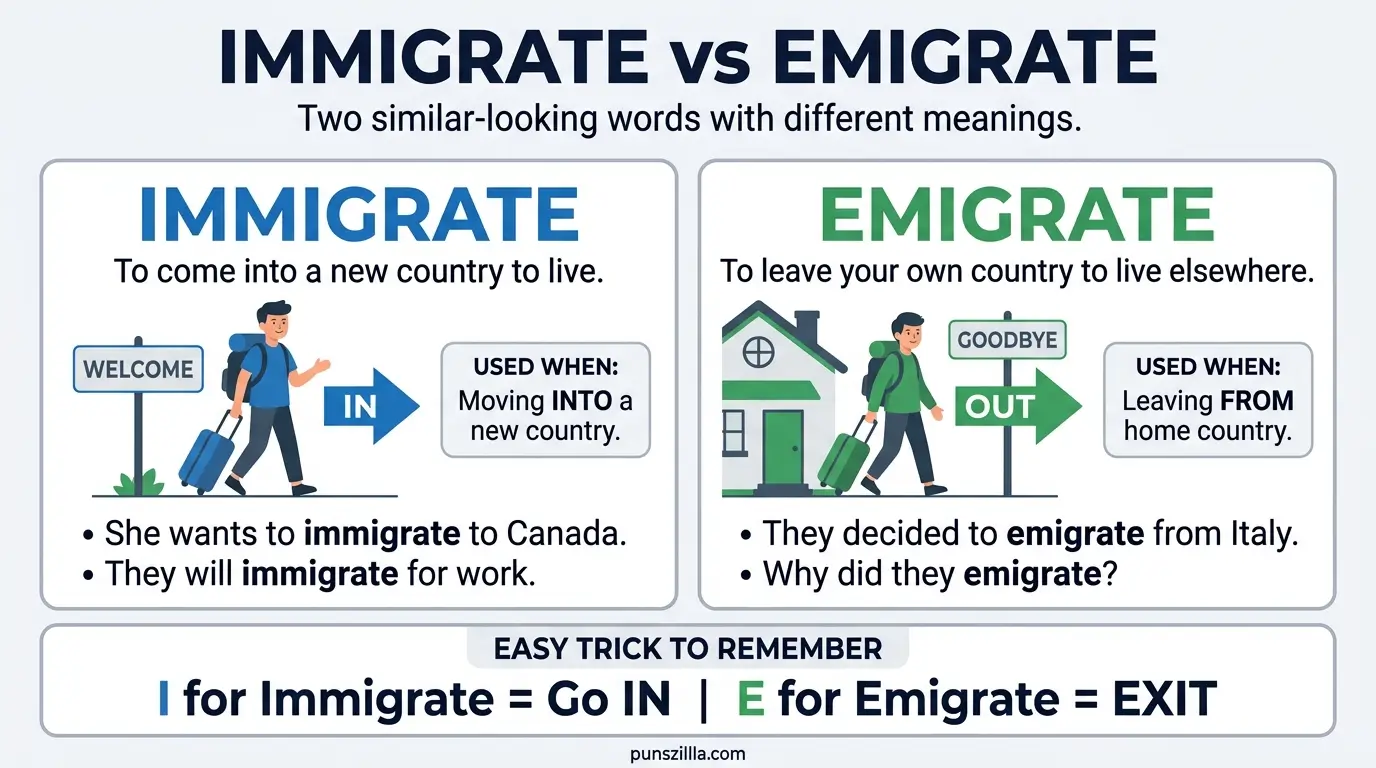
Immigrate means to move into a country to live, while emigrate means to leave a country to live elsewhere.
When should you use immigrate or emigrate? Both words relate to moving from one country to another, but they have different meanings. The key is to know which side of the move you are talking about.
Immigrate means to move into a new country to live there. Emigrate means to leave your home country to live in another country. Both words are correct, but you use them in different situations.
For example, a person who leaves Pakistan to live in Canada emigrates from Pakistan and immigrates to Canada. The person makes one move, but each word shows a different point of view.
Many people search for “immigrate or emigrate” because the words look alike and are easy to mix up. This can cause mistakes in schoolwork, job applications, emails, news reports, and formal documents.
The good news is that the difference is simple once you learn it. Think of “emigrate” as exiting and “immigrate” as moving in. This small trick can help you choose the right word every time.
In this guide, you will learn what each word means, where the words came from, how to use them in daily writing, and which common mistakes to avoid.
Immigrate or Emigrate Quick Answer
Both immigrate and emigrate are correct English words. The difference is the direction of the move.
- Immigrate: To enter another country to live there.
- Emigrate: To leave your home country to live somewhere else.
Examples:
- Sara plans to immigrate to Canada next year.
- Sara plans to emigrate from Pakistan next year.
- Many families immigrate to the United States for work.
- Some people emigrate from their home countries to find better jobs.
Remember this easy rule:
Immigrate = move in. Emigrate = move out.
The word immigrate focuses on the country a person enters. The word emigrate focuses on the country a person leaves.
The Origin of Immigrate or Emigrate
The words immigrate and emigrate both come from Latin. They share a common root, which explains why their meanings are closely related.
- Immigrate comes from the Latin immigrare, meaning to move into a place.
- Emigrate comes from the Latin emigrare, meaning to move out of a place.
- Both words are linked to migrare, which means to move or change one’s place.
The main difference comes from their prefixes. The prefix im- relates to moving in, while e- relates to moving out.
Over time, English adopted both words to describe people who move between countries to live. They became useful for explaining the same journey from two different points of view.
For example, a family that leaves Italy to settle in Australia emigrates from Italy and immigrates to Australia.
The words did not develop as British and American spelling variants. They are two separate words with different meanings. Both have been used in English for centuries.
British English vs American English Spelling
There is no spelling difference between British English and American English for immigrate and emigrate. Both forms are standard in the UK, the US, Canada, Australia, and other English-speaking countries.
The important difference is meaning, not spelling.
| Word or form | British English | American English | Meaning |
|---|---|---|---|
| Immigrate | Immigrate | Immigrate | Move into another country |
| Emigrate | Emigrate | Emigrate | Leave a country to live elsewhere |
| Immigrated | Immigrated | Immigrated | Moved into a new country |
| Emigrated | Emigrated | Emigrated | Left a country to live elsewhere |
| Immigrant | Immigrant | Immigrant | A person who moves into a country |
| Emigrant | Emigrant | Emigrant | A person who leaves a country |
Examples in British and American English
British English:
- My grandparents emigrated from India.
- They immigrated to the United Kingdom.
American English:
- My grandparents emigrated from India.
- They immigrated to the United States.
The spelling stays the same in both examples. Only the country and the context change.
For a reliable definition, you can visit the Cambridge Dictionary entry for immigrate.
Which Spelling Should You Use?
You do not need to choose between British and American spelling. Both immigrate and emigrate are correct in either variety of English.
Choose the word that matches the direction of the move.
If You Write for an American Audience
Use immigrate when someone moves into the United States to live.
Example: “Her parents immigrated to the United States in 2005.”
Use emigrate when someone leaves the United States to settle elsewhere.
Example: “They emigrated from the United States to Spain.”
If You Write for a British or Commonwealth Audience
Follow the same rule. The meanings and spellings do not change.
Examples:
- “He immigrated to the UK for work.”
- “She emigrated from Australia to New Zealand.”
If You Write for a Global Audience
Use both words when you need to explain the full journey clearly.
For example:
“Amir emigrated from Pakistan and immigrated to Canada.”
This sentence tells readers both where Amir left and where he went.
Professional writing tip: In formal documents, news reports, and academic writing, use immigrate to and emigrate from when describing the destination and the place of departure. This makes your meaning clear.
Common Mistakes with Immigrate or Emigrate
These words are easy to mix up, but a few simple rules can help you avoid errors.
1. Using Immigrate When You Mean Leave
Incorrect: “They immigrated from France to find a new home abroad.”
Better: “They emigrated from France to find a new home abroad.”
Why? The sentence focuses on leaving France, so emigrated is the better choice.
2. Using Emigrate When You Mean Enter
Incorrect: “She emigrated to Canada last year.”
Better: “She immigrated to Canada last year.”
Why? Canada is the destination, so immigrated is correct.
3. Thinking One Word Is American and the Other Is British
Incorrect: “Americans say immigrate, but British people say emigrate.”
Correct: Both words are used in British and American English. Their meanings are different.
4. Confusing Immigrant and Emigrant
An immigrant is viewed as someone arriving in a country. An emigrant is viewed as someone leaving a country.
Example: A person who moves from Japan to Germany is an emigrant from Japan and an immigrant to Germany.
5. Confusing Migrate with Immigrate and Emigrate
Migrate is a broader word for moving from one place to another. It can describe movement between countries, within a country, or even seasonal movement by animals.
Example: “Many birds migrate south in winter.”
For a person moving to another country, immigrate or emigrate may be more precise.
Immigrate or Emigrate in Everyday Examples
Knowing how these words work in daily writing helps you use them with confidence.
In Emails
When discussing a move or relocation, choose the word that matches the country you mean.
Example:
“Dear Ms. Khan, I am writing to ask about the documents needed to immigrate to Canada.”
In News Reports
News reports often describe people moving across borders.
Example:
“Thousands of people emigrated from the region during the economic crisis.”
Another example:
“The country introduced new rules for people who wish to immigrate.”
On Social Media
People often use these words when sharing plans or life updates.
Examples:
- “My family is planning to immigrate to Australia next year.”
- “We decided to emigrate from our home country for better job opportunities.”
In Formal Writing
Use the words carefully in essays, reports, and official letters.
Example:
“The study examines why families emigrate from rural areas and immigrate to large cities in other countries.”
For a more accurate sentence, note that moving from a rural area to a city within the same country is usually described as migrating, not immigrating.
In School Essays
Example:
“Many people emigrated from Ireland during the famine. After arriving in the United States, they became immigrants.”
This example shows how both words can describe the same group of people.
Immigrate or Emigrate Google Trends & Usage Data
People search for “immigrate or emigrate” because the words have similar spellings and are used in discussions about moving abroad, citizenship, jobs, and family relocation.
Google Trends can help writers explore interest in these terms across countries and over time. However, search interest is not the same as the number of people who immigrate or emigrate.
What Can Google Trends Tell Us?
- Country interest: Compare relative search interest in the United States, the United Kingdom, Canada, Australia, and other regions.
- Search context: Explore whether people search for definitions, spelling differences, immigration rules, or relocation advice.
- Interest over time: See how search interest changes during a selected period.
- Related searches: Find other questions people ask about these words.
There is no verified country-by-country ranking or exact search-volume figure provided here, so it would be misleading to claim that one country searches for these terms the most.
You can compare both terms directly using Google Trends. Choose your country and time range to explore the available data.
For SEO writers, the best approach is to answer the meaning question first. Readers searching for “immigrate or emigrate” usually need a clear distinction, simple examples, and advice on choosing the right word.
Immigrate vs Emigrate: Comparison Table
The following table gives a quick overview of the differences.
Immigrate
Meaning: To enter another country to live.
Common pattern: Immigrate to a country.
Example: They immigrated to Canada.
Emigrate
Meaning: To leave a country to live elsewhere.
Common pattern: Emigrate from a country.
Example: They emigrated from Pakistan.
| Feature | Immigrate | Emigrate |
|---|---|---|
| Main idea | Entering | Leaving |
| Focus | Destination | Place of departure |
| Common preposition | To | From |
| Related noun | Immigrant | Emigrant |
| Past tense | Immigrated | Emigrated |
| Present participle | Immigrating | Emigrating |
| British spelling | Same | Same |
| American spelling | Same | Same |
Easy way to remember: Immigrate to means coming in. Emigrate from means going out.
Frequently Asked Questions
What is the difference between immigrate and emigrate?
Immigrate means to enter a country to live there. Emigrate means to leave a country to live somewhere else. The correct word depends on whether you are talking about arrival or departure.
Is immigrate or emigrate the correct word?
Both are correct English words. Use immigrate for the destination and emigrate for the country being left.
Do Americans use immigrate and British people use emigrate?
No. Both words are used in British and American English. They have different meanings, not different regional spellings.
Is it immigrate to or immigrate from?
Both forms can be correct, depending on the sentence. Use immigrate to for the destination and immigrate from to identify where someone came from.
Example: “She immigrated to Canada from Pakistan.”
Is it emigrate to or emigrate from?
Use emigrate from to name the country someone leaves. You can also use emigrate to when describing the destination, though emigrate from is the clearest and most common pattern for the place of departure.
Example: “He emigrated from Italy to Australia.”
What is the difference between an immigrant and an emigrant?
An immigrant is someone who enters a country to live there. An emigrant is someone who leaves a country to settle elsewhere. The same person can be both.
Can I use immigrate and emigrate in the same sentence?
Yes. This is a useful way to show both sides of a move.
Example: “Lina emigrated from Egypt and immigrated to Canada.”
What is the difference between migrate, immigrate, and emigrate?
Migrate is the broad term for moving from one place to another. Immigrate focuses on entering a country, while emigrate focuses on leaving one.
Conclusion: Immigrate or Emigrate?
The difference between immigrate and emigrate is simple once you focus on the direction of the move. Immigrate means to move into a country to live, while emigrate means to leave a country to settle somewhere else.
Both words are correct, and neither is limited to British or American English.
For example, a person who moves from Pakistan to Canada emigrates from Pakistan and immigrates to Canada.
The words describe the same journey from two different points of view.
When writing emails, school essays, news reports, or formal documents, remember the common patterns: immigrate to and emigrate from.
These phrases help you explain the destination and the place of departure without confusing your reader.
If you are unsure which word to use, ask yourself one simple question: Am I talking about the country someone enters or the country they leave? Choose immigrate for entering and emigrate for leaving.
You do not need to learn two sets of regional spellings. The words remain the same in British and American English.
Learn their meanings, practise them in sentences, and you will use them correctly with confidence.