
Coarse or Course: What Is the Difference and Which Word Should You Use?
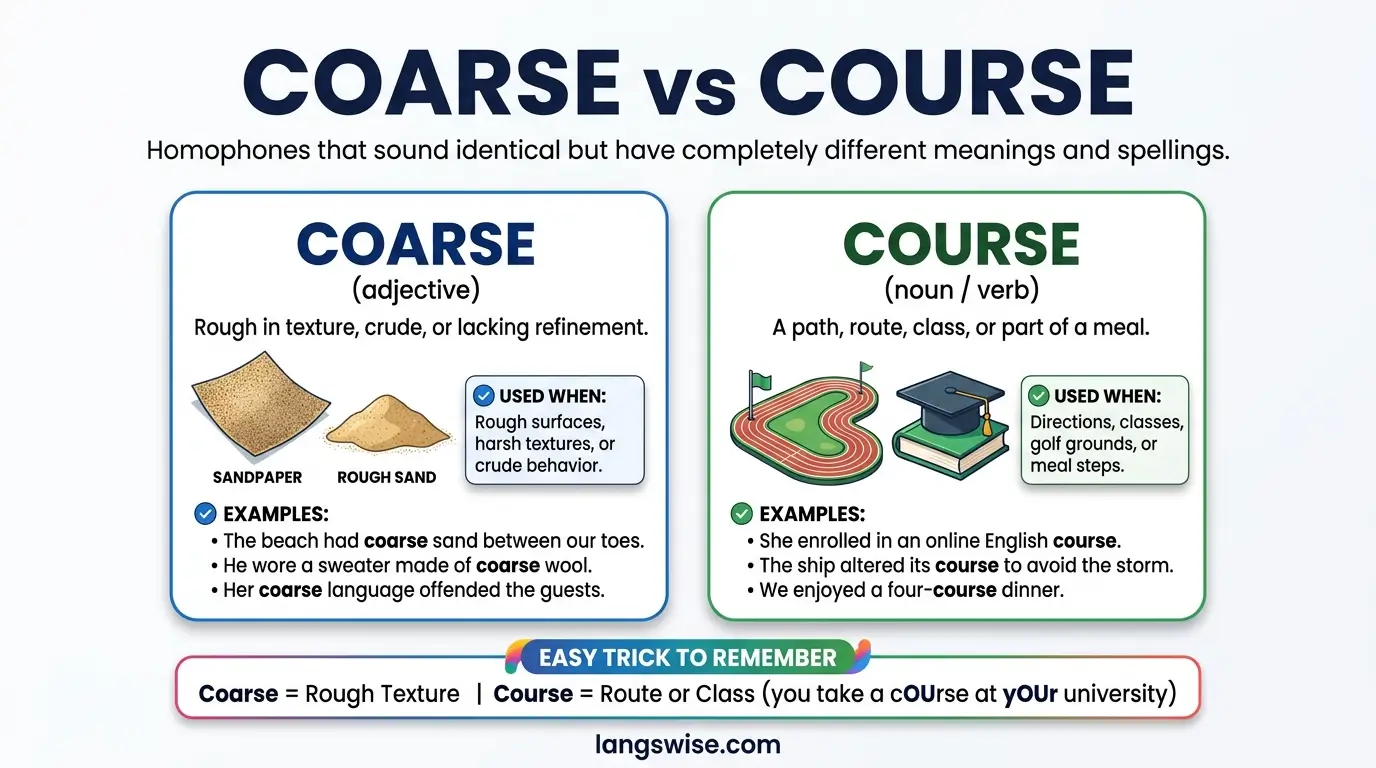
Coarse means rough or harsh, while course refers to a class, route, or sequence of events.
Have you ever wondered whether to write coarse or course? These two words sound exactly the same, but they have very different meanings.
This makes them easy to mix up in emails, schoolwork, social media posts, and everyday writing.
The confusion is simple: coarse usually describes something rough, while course refers to a class, path, direction, or part of a meal.
For example, you might say, “The sand feels coarse” or “I am taking an English course.”
Both words are correct English spellings. However, using one in place of the other can change the meaning of your sentence.
A spelling mistake may also make your writing less clear.
In this guide, you will learn the difference between coarse and course, their origins, spelling rules, and common mistakes.
You will also find simple examples, practical writing tips, and answers to frequently asked questions.
By the end, you will know exactly when to use each word.
Coarse or Course Quick Answer
Coarse means rough, harsh, or made of large pieces. Course means a class, route, direction, or part of a meal.
Examples:
- Coarse: This towel feels coarse against my skin.
- Course: I signed up for an English course.
- Coarse: The beach has coarse sand.
- Course: We followed a course through the forest.
Remember:
- Use coarse when describing something rough or not smooth.
- Use course when talking about a class, route, or sequence of events.
Both words sound alike, but their meanings and spellings are different.
The Origin of Coarse or Course
The words coarse and course have different histories. Their spellings developed over time, even though their pronunciation became the same in modern English.
Origin of Coarse
The word coarse comes from Middle English cors, which was linked to the idea of something ordinary, rough, or not fine.
It later developed into the modern meaning of rough or lacking smoothness.
Today, people use it to describe rough fabric, large grains, harsh language, and poor manners.
Examples:
- Coarse sand
- Coarse hair
- Coarse language
Origin of Course
The word course comes from Old French cours, meaning a run or flow. It traces back to the Latin word cursus, meaning a running or journey.
Over time, it gained meanings related to a route, direction, sequence, and organized lessons.
Examples:
- A training course
- A course of action
- A golf course
The two words have different historical roots. Their similar sounds are why people often confuse them.
British English vs American English Spelling
There is no spelling difference between British and American English for these words.
Both varieties use coarse and course with the same meanings and spellings.
| Word | British English | American English | Meaning |
|---|---|---|---|
| Coarse | Coarse | Coarse | Rough or harsh |
| Course | Course | Course | Class, route, or sequence |
Examples in both varieties:
- British: The road has a coarse surface.
- American: The road has a coarse surface.
- British: She joined a computer course.
- American: She joined a computer course.
Unlike words such as colour and color, these words do not change their spelling between the UK and the US.
Which Spelling Should You Use?
Your choice depends on what you want to say, not where your readers live.
For US Readers
Use coarse for rough things and course for classes, routes, or sequences. American English follows the same rules.
For UK and Commonwealth Readers
The spellings are also coarse and course. Countries such as the UK, Australia, Canada, and New Zealand use these standard forms.
For Global Readers
Use the correct word based on its meaning. Both spellings are accepted worldwide.
For professional writing, always check the meaning before choosing a word. Your audience does not change the spelling.
Common Mistakes with Coarse or Course
People often mix up these words because they have the same pronunciation. Here are some common mistakes and their corrections.
| Incorrect Sentence | Correct Sentence | Reason |
|---|---|---|
| I joined a computer coarse. | I joined a computer course. | A course is a class. |
| The fabric feels course. | The fabric feels coarse. | Coarse means rough. |
| She used coarse of action. | She used a course of action. | Course means a plan or direction. |
| The sand is course. | The sand is coarse. | Coarse describes rough grains. |
| He changed his coarse. | He changed his course. | Course can mean direction. |
How to Avoid These Mistakes
Use these simple memory tips:
- Coarse = Rough: Think of rough sand or coarse fabric.
- Course = Class: Think of a school or training course.
- Course = Route: Think of a path or direction.
Always consider the meaning of your sentence before choosing the spelling.
Coarse or Course in Everyday Examples
Both words appear in daily conversations and different types of writing. Here is how to use them correctly.
1. In Emails
- Coarse: The material feels too coarse for the project.
- Course: I have enrolled in a business course.
2. In News
- Coarse: Workers removed coarse sand from the construction site.
- Course: The university announced a new training course.
3. On Social Media
- Coarse: These coarse fabrics are not comfortable.
- Course: I finally completed my online course!
4. In Formal Writing
- Coarse: The study examined the effects of coarse particles on water quality.
- Course: The report recommends a new course of action.
5. In Everyday Conversations
- Coarse: This blanket feels coarse.
- Course: Which course are you studying?
These examples show that both words are useful, but they cannot replace each other.
Coarse or Course Google Trends & Usage Data
The words coarse and course are both common in English, but they appear in different contexts.
Course is widely used in education, training, travel, sports, and everyday communication. People often search for phrases such as:
- Online course
- English course
- Course meaning
- Course of action
Coarse is more common in descriptions of texture, materials, language, and scientific topics. Related searches include:
- Coarse meaning
- Coarse sand
- Coarse hair
- Coarse language
Popularity by Country
Both words are used in English-speaking countries, including:
- United States
- United Kingdom
- Canada
- Australia
- New Zealand
The word course generally has broader everyday applications because it has several common meanings.
However, exact search popularity and country rankings require a live Google Trends comparison. No verified search-volume figures are included here.
Coarse vs Course: Comparison Table
Here is a quick comparison to help you remember the difference.
| Feature | Coarse | Course |
|---|---|---|
| Part of speech | Adjective | Noun, sometimes verb |
| Main meaning | Rough or harsh | Class, route, or sequence |
| Pronunciation | /kɔːrs/ | /kɔːrs/ |
| Example | Coarse sand | English course |
| Common use | Texture and language | Education and direction |
| Word type | Descriptive | Naming or action |
| Synonyms | Rough, harsh, crude | Class, route, path |
Quick Memory Trick: Coarse describes something rough, while course refers to a class, path, or direction.
Frequently Asked Questions
Is it coarse or course?
Both words are correct, but they have different meanings. Use coarse for something rough and course for a class, route, or sequence.
What does coarse mean?
Coarse means rough, harsh, or not smooth. For example, coarse sand has larger, rougher grains than fine sand.
What does course mean?
Course can mean a class, a route, or a sequence of events. For example, you can take a science course at school.
Are coarse and course pronounced the same?
Yes, coarse and course are homophones. They have the same pronunciation but different spellings and meanings.
Is it a coarse of action or a course of action?
The correct phrase is a course of action. It means a plan or a way to deal with a situation.
Does coarse mean rude?
Yes, coarse can describe rude, vulgar, or offensive language and behavior. For example, coarse language may upset other people.
Do British and American English use the same spellings?
Yes, both British and American English use coarse and course. There is no regional spelling difference between them.
Conclusion
Choosing between coarse and course is easy once you understand their meanings. Both words sound the same, but they are used in different situations.
Coarse is an adjective that describes something rough, harsh, or not smooth. You can use it for sand, fabric, hair, or language.
Course usually refers to a class, route, direction, or series of events. For example, you can take a training course or change the course of a journey.
Remember that British and American English use the same spellings.
You do not need to change either word based on your audience or location. Instead, focus on the meaning of your sentence.
If you are describing a rough surface, choose coarse.
If you are talking about education, a path, or a plan, choose course. These simple rules will help you avoid common spelling mistakes and write with greater confidence.