
Explicit or Implicit: Meaning, Differences, and How to Use Them Correctly
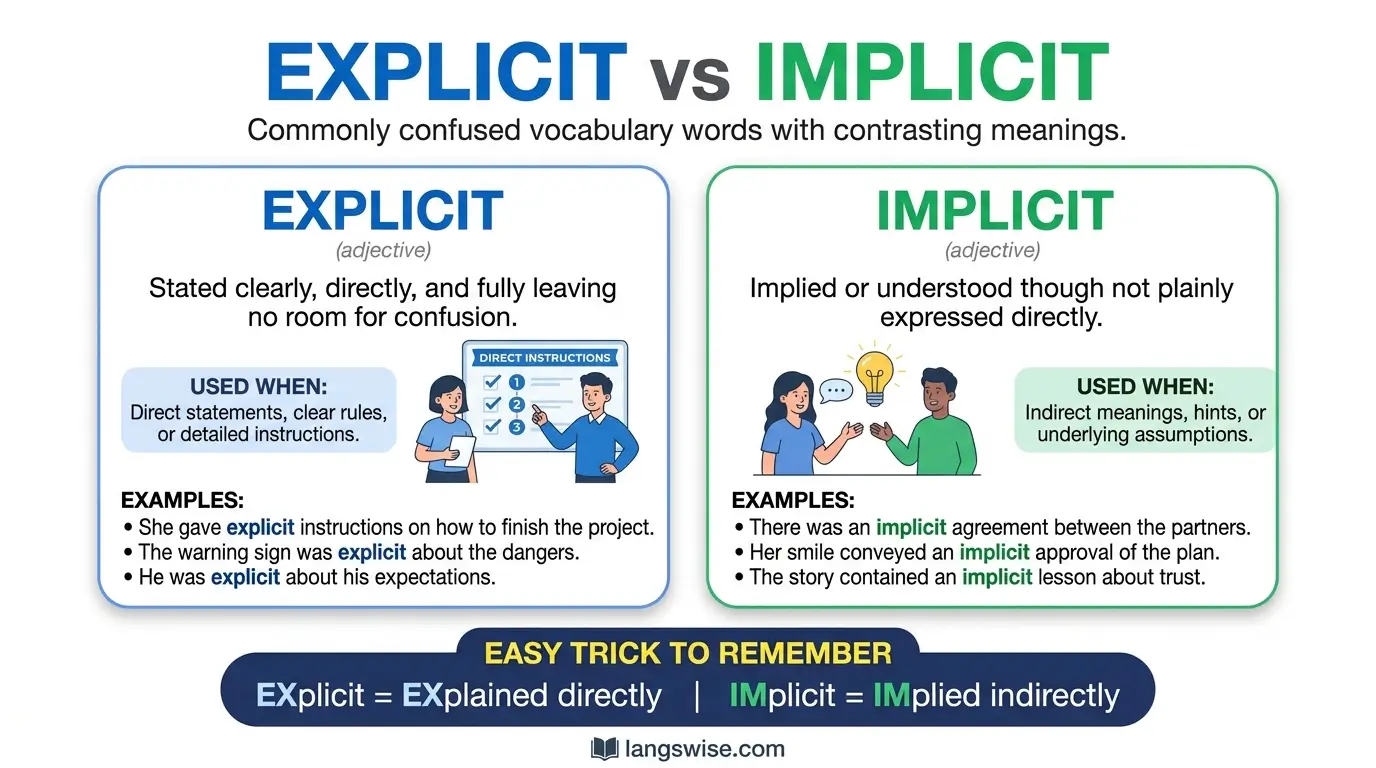
Explicit means direct and clear; implicit means indirect or suggested.
The words explicit and implicit are often used when talking about messages, instructions, ideas, and meanings. However, they have very different meanings.
Knowing the difference can help you write clearly, understand conversations, and avoid mistakes in school, work, and everyday life.
People often search for “explicit or implicit” because they want to know which word describes a clear statement and which describes a hidden or suggested meaning.
Both words are correct, but they are not interchangeable. An explicit message says something directly, while an implicit message suggests something without saying it openly.
For example, “Please arrive at 9 a.m.” is an explicit instruction. “The meeting starts early, so come prepared” may carry an implicit message about arriving on time.
In this guide, you will learn the meaning, origin, differences, and correct use of explicit and implicit. You will also find simple examples, common mistakes, and practical tips to help you choose the right word in different situations.
Explicit or Implicit – Quick Answer
Explicit means clear, direct, and fully stated. Implicit means suggested, understood, or implied without being directly stated.
Examples:
- Explicit: She clearly told me to call her.
- Implicit: Her message suggested that she wanted me to call her.
Remember: Explicit means directly stated, while implicit means indirectly understood.
The Origin of Explicit and Implicit
The words explicit and implicit come from Latin. Although they have different meanings today, both are connected to the idea of expressing or unfolding something.
- Explicit: Comes from the Latin explicitus, meaning unfolded or clearly explained. It describes something stated in a direct and easy-to-understand way.
- Implicit: Comes from the Latin implicitus, meaning folded in or involved. It describes something included or suggested without being directly expressed.
Both words entered English through Latin and French influences. Their prefixes help explain their difference. The prefix ex- suggests outward expression, while im- suggests something contained within.
Today, these words are common in education, communication, law, literature, business, and everyday conversations.
British English vs American English Spelling
There is no spelling difference between explicit and implicit in British and American English. Both countries use the same spelling.
However, pronunciation and word usage may vary slightly depending on the speaker and context.
| Word | American English | British English |
|---|---|---|
| Explicit | Explicit | Explicit |
| Implicit | Implicit | Implicit |
| Explicitly | Explicitly | Explicitly |
| Implicitly | Implicitly | Implicitly |
Examples:
- American English: The teacher gave explicit instructions.
- British English: The teacher gave explicit instructions.
- American English: His answer contained an implicit warning.
- British English: His answer contained an implicit warning.
Both versions are correct. You do not need to change either spelling when writing for American or British readers.
Which Spelling Should You Use?
Since explicit and implicit have the same spelling in American and British English, your choice depends on the meaning you want to express, not your audience’s location.
- For American readers: Use explicit for direct statements and implicit for suggested meanings.
- For British and Commonwealth readers: Follow the same rule. Both words have identical spellings.
- For global readers: Choose the word that best explains your intended meaning. Use simple examples when the difference may be unclear.
For professional writing, always check whether the information is directly stated or only suggested.
Common Mistakes with Explicit and Implicit
Many people confuse these words because they both describe how information is communicated. Here are some common mistakes and their corrections.
| Incorrect usage | Correct usage | Explanation |
|---|---|---|
| The teacher gave implicit instructions written clearly. | The teacher gave explicit instructions. | The instructions were direct. |
| His words were explicit, but he never said them. | His words were implicit. | The meaning was suggested. |
| She explicitly hinted at the answer. | She implicitly hinted at the answer. | A hint suggests something indirectly. |
| The rule was implicit and clearly written. | The rule was explicit and clearly written. | A written, direct rule is explicit. |
Remember these tips:
- Use explicit when something is clearly said or written.
- Use implicit when something is suggested or understood.
- Do not use these words as interchangeable synonyms.
- Check the context before choosing either word.
Explicit and Implicit in Everyday Examples
Both words appear in daily communication, education, news, and professional writing. Here are some examples.
1. In Emails
- Explicit: Please send the report before 5 p.m.
- Implicit: I hope to review the report before the end of the day.
The first email gives a direct instruction. The second suggests a deadline without stating it clearly.
2. In News
- Explicit: The company announced that it would open three new offices.
- Implicit: The announcement suggested that the company planned to expand.
3. On Social Media
- Explicit: I do not agree with this decision.
- Implicit: This decision could have been better.
The first statement expresses an opinion directly. The second suggests disagreement.
4. In Formal Writing
- Explicit: The contract clearly states that payment is due within 30 days.
- Implicit: The contract implies that payment should be made within a reasonable time.
5. In Everyday Conversations
- Explicit: Please turn off the lights.
- Implicit: The room is too bright.
The first sentence makes a direct request. The second indirectly suggests what someone should do.
Explicit or Implicit – Comparison Table
The following table shows the main differences between these two words.
| Feature | Explicit | Implicit |
|---|---|---|
| Meaning | Direct and clear | Suggested or indirect |
| Communication | Openly stated | Not directly stated |
| Understanding | Usually needs little interpretation | Often needs interpretation |
| Instructions | Clearly explained | Suggested or assumed |
| Message | Direct message | Hidden or implied message |
| Example | He said no. | He showed that he disagreed. |
| Opposite | Implicit | Explicit |
| Adverb | Explicitly | Implicitly |
| Noun | Explicitness | Implicitness |
Easy way to remember:
- Explicit = Expressed openly.
- Implicit = Included indirectly.
Explicit or Implicit – Google Trends and Usage Data
People search for explicit and implicit to understand their meanings, differences, and correct usage. Both words are used in education, professional communication, literature, and online discussions.
Google Trends can help compare search interest for these words across countries and over time. However, it does not provide exact search counts. Instead, it uses a normalized score from 0 to 100 to show relative interest. Trends Help+1
Search interest by country
People in English-speaking countries, including the United States, United Kingdom, Canada, and Australia, may search for these words when studying vocabulary, grammar, and reading comprehension.
English learners in other countries may also look for simple explanations.
However, without a specific Google Trends comparison and date range, it would not be accurate to claim that one country searches for these terms more than another.
Common search contexts
- Education: Understanding explicit and implicit meanings in reading.
- Writing: Choosing the correct word for essays and reports.
- Communication: Understanding direct and indirect messages.
- Literature: Identifying stated and suggested meanings.
- Professional work: Understanding instructions, policies, and agreements.
You can explore country-level interest using Google Trends.
FAQs About Explicit or Implicit
1. What is the main difference between explicit and implicit?
Explicit means something is stated clearly and directly. Implicit means something is suggested or understood without being directly stated.
2. Is explicit the opposite of implicit?
Yes. Explicit and implicit are opposites. Explicit information is directly expressed, while implicit information is indirectly suggested.
3. What is an example of explicit and implicit?
Explicit: She told me to leave early. Implicit: She hinted that I should leave early.
4. Is explicit positive or negative?
Explicit is neither positive nor negative. It simply means clear, direct, and fully stated. Its meaning depends on the context.
5. What does implicit mean in simple words?
Implicit means something is not said directly but can be understood from the situation, words, or actions.
6. Are explicit and implicit spelled differently in British and American English?
No. Both words have the same spelling in British and American English. There is no regional spelling difference.
7. What are the adverbs of explicit and implicit?
The adverb forms are explicitly and implicitly. Explicitly means directly and clearly, while implicitly means indirectly or without being directly stated.
Conclusion: Explicit or Implicit – Which Word Is Correct?
Choosing between explicit and implicit becomes easy when you understand their meanings. Both words are correct, but they describe different ways of sharing information.
Explicit means something is stated clearly, directly, and openly. Implicit means something is suggested, understood, or included without being directly expressed.
Use explicit when writing clear instructions, giving direct answers, or explaining rules. Choose implicit when describing hidden meanings, indirect messages, or ideas that readers must understand from context.
For example, “She clearly asked for help” is explicit, while “She hinted that she needed help” is implicit. These examples show how one small word can change the meaning of a sentence.
Remember that neither word has a different spelling in British or American English. You can use both words with the same spelling for any English-speaking audience.
For better writing, always consider whether your message is direct or suggested before choosing a word. Understanding this simple difference will help you communicate more clearly, improve your vocabulary, and use English with greater confidence.