
Themselves or Themself: Which Is Correct?
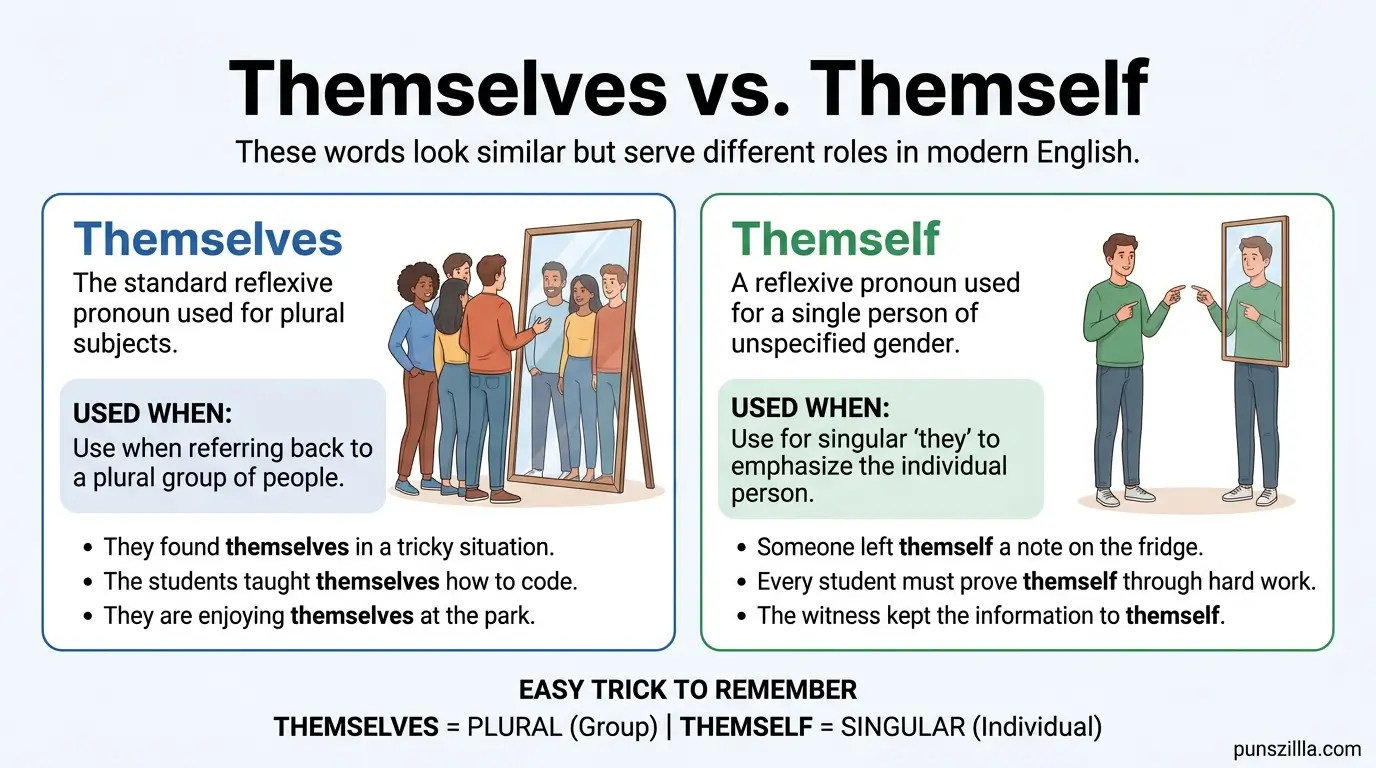
Themselves or themself? This small grammar question causes a surprisingly large amount of confusion. Both forms appear in modern English, but they do not always serve the same purpose.
The difference becomes important when they refers to one person rather than several people.For example, you may write, “They prepared themselves,” when talking about several people.
But what should you write when one person uses they/them pronouns? Is “They prepared themselves” correct, or should it be “They prepared themself”?
The answer depends on meaning, audience, and style. Themselves is the safer and more widely accepted choice, especially in formal writing. Themself is also a real English word.
It is increasingly used as a singular reflexive form of they, particularly when referring to one person. Major dictionaries now record this use, although some still label it nonstandard.
This guide explains themselves or themself in simple terms. You will learn the history, regional differences, common mistakes, professional usage rules, and examples for everyday writing.
Themselves or Themself Quick Answer
Here is the simple rule:
- Use themselves for plural people.
- Use themselves for singular they when you want the safest choice in formal writing.
- Use themself when singular they clearly refers to one person and your style guide or audience accepts it.
Examples
Plural:
The students prepared themselves for the exam.
Singular they:
Alex prepared themselves for the interview.
Also possible:
Alex prepared themself for the interview.
The second sentence makes the singular meaning more visible. However, themselves remains more widely accepted. Merriam-Webster notes that themself has increased in use as an alternative to singular themselves, while Oxford and Cambridge also record the form.
So, if you need one safe answer:
Use “themselves” unless you have a reason to use “themself.”
The Origin of Themselves or Themself
Both forms have a long history.
Themselves comes from them + selves. Its recorded use goes back to the Middle English period. Merriam-Webster gives the first known use of themselves as the 13th century.
Themself is even older than many people expect. Merriam-Webster records its first known use in the 15th century. Historical evidence shows that themself was once used more widely than it is today.
Over time, themselves became the normal form for plural they. The older singular-looking form themself became much less common.
Modern English created a new reason for themself to return. Singular they is now widely used for a person whose gender is unknown, unspecified, or nonbinary. This creates a natural pattern:
- they → them → their → theirs → themself
The logic is similar to:
- he → him → his → himself
- she → her → hers → herself
- you → you → your → yours → yourself
The form themself therefore gives writers a clearly singular reflexive form. Major dictionaries now recognize this modern use, although they do not all give it the same status.
British English vs American English Spelling
There is an important point here: themselves and themself are not a British-versus-American spelling difference.
British and American English both use themselves. Both also use themself, although acceptance and frequency can vary by speaker, publication, and style guide.
Collins lists themself in both British and American English. Its British entry calls it a non-standard variant, while its American entry also records singular, gender-neutral use.
| Form | British English | American English | Main use |
| themselves | Standard | Standard | Plural reflexive |
| themselves | Common with singular they | Common with singular they | Gender-neutral singular |
| themself | Used, but less formally accepted | Increasingly used | Singular they |
| theirself | Nonstandard | Nonstandard | Avoid in formal writing |
| theirselves | Nonstandard | Nonstandard | Avoid in formal writing |
The real difference is therefore usage and style, not spelling rules.
For example:
The players blamed themselves.
This is standard in both British and American English.
For one person:
Jordan blamed themselves.
This is widely used.
Or:
Jordan blamed themself.
This is increasingly used when the writer wants a singular reflexive form. Some style authorities accept it for this purpose.
The Government of Canada, for example, lists both themselves and themself as possible reflexive forms for singular they.
Which Spelling Should You Use?
Your best choice depends on your reader.
For American English
Use themselves in general professional writing. Use themself when your publication, organization, or subject uses it.
Merriam-Webster recognizes themself and notes its growing use, especially for singular they and nonbinary people.
For British English
Themselves is the safest choice in formal writing. Themself is understood and increasingly visible, but some British dictionaries still describe it as nonstandard.
For Canadian and Commonwealth English
Follow the relevant style guide. Canadian government guidance allows both themselves and themself for singular they, while noting that themselves is the standard form.
For global English
If your readers come from many countries, themselves is usually the safest option.
If a person specifically uses themself, however, respect that choice.
For academic writing
Check your required style guide. If there is no specific rule, themselves is the conservative choice.
For personal writing
Either form can work. If you are writing about a specific person who uses themself, using their preferred form is often the clearest and most respectful choice.
Common Mistakes with Themselves or Themself
Mistake 1: Using themself for a plural subject
Incorrect:
The children taught themself to swim.
Correct:
The children taught themselves to swim.
Why? The subject is plural.
Mistake 2: Assuming themself is always wrong
This is too simple.
Themself is an established word. Dictionaries record its use, especially with singular they. However, it is not accepted equally by every style guide.
Mistake 3: Assuming themselves is always plural
Modern English often uses themselves with singular they.
If anyone calls, tell them to help themselves.
Here, anyone is singular, but themselves is used as a gender-neutral reflexive form. Oxford and Merriam-Webster both document this use.
Mistake 4: Writing theirself
Avoid:
Someone should prepare theirself.
Use:
Someone should prepare themselves.
Or, where accepted:
Someone should prepare themself.
Mistake 5: Changing the verb after singular they
Do not write:
They is responsible for themselves.
Write:
They are responsible for themselves.
Singular they still takes the verb form are, just as ordinary they does.
Themselves or Themself in Everyday Examples
In emails
Safe professional version:
Please ask the applicant to introduce themselves at the beginning of the meeting.
If the person uses themself and your workplace accepts it:
Please ask the applicant to introduce themself at the beginning of the meeting.
In news writing
News organizations may use singular they for a person whose gender is unknown or for a person who uses they/them pronouns.
The spokesperson said they would represent themselves at the hearing.
Themself may appear when it refers specifically to one person:
The artist said they wanted to express themself through the work.
Merriam-Webster notes that themself has appeared in major newspapers, although it remains much less common than themselves in edited text.
On social media
Informal writing often accepts themself more easily:
Everyone should be free to be themself.
This form is especially common when people are discussing identity or individual self-expression.
In formal writing
For a broad audience, choose the more established form:
Every employee should ask themselves whether the decision is fair.
If a person’s own pronoun preference is themself, use that form when appropriate:
Sam said they wanted to describe themself in their own words.
In academic writing
Follow your institution’s style guide. Some major style authorities now allow themself for a singular person using they/them pronouns, while themselves remains more common.
Themselves or Themself Google Trends & Usage Data
Search interest for “themselves or themself” reflects a wider change in English. People are not only asking which spelling is correct. They are also asking how singular they works.
There is no simple official Google Trends number that represents the worldwide usage of these words.
Google Trends measures relative search interest, not the total number of times a word is used in English. Search results can also change by country, date range, and search category.
The broader language evidence is clearer:
- Themselves remains much more established and common.
- Themself is gaining attention as singular they becomes more widely accepted.
- Themself appears more often in discussions of gender-neutral language and individual identity.
- Dictionaries in both American and British English now record the form.
- Formal acceptance still varies by dictionary and style guide.
Usage research also shows that themself remains relatively infrequent compared with themselves, even though it has gained ground in recent decades.
This explains why people searching for “themselves or themself” often see conflicting answers. The language is changing, but not all style authorities are changing at the same speed.
For current search interest, Google Trends is best used with a selected country and date range rather than treated as a permanent worldwide ranking.
Themselves vs Themself: Comparison Table
| Feature | Themselves | Themself |
| Basic form | them + selves | them + self |
| Plural people | Yes | No |
| Singular they | Yes | Yes |
| Formal acceptance | Very high | Varies |
| Common in edited writing | Yes | Less common |
| Common in speech | Yes | Increasing |
| Used for nonbinary singular they | Yes | Yes |
| Safest general choice | Yes | Depends on style |
| British English | Standard | Less formally accepted |
| American English | Standard | Increasingly accepted |
| Canadian guidance | Standard | Also permitted in some guidance |
| Main risk | Can sound plural to some readers | Some readers may view it as nonstandard |
The key point is simple: themselves has wider acceptance, while themself has a more specific singular function.
FAQs
Is “themself” a real word?
Yes. Themself is a real English word recorded by major dictionaries. It is used especially as a singular reflexive form of they. Some dictionaries still label it nonstandard or less accepted.
Is “themselves” correct for one person?
Yes. Singular they can take themselves, especially in general or formal writing.
Everyone should look after themselves.
This use is widely recognized.
Is “themself” grammatically correct?
It can be. Themself is increasingly used for one person who is referred to with singular they. However, acceptance differs among style guides and readers.
Which is more formal: themselves or themself?
Themselves is generally the safer formal choice because it has broader acceptance.
Should I use “themself” for a nonbinary person?
If that person uses themself, yes. Respecting a person’s stated pronouns and preferred language is more important than forcing a different form.
Is “theirself” correct?
Theirself is generally treated as nonstandard. In most formal writing, use themselves or themself, depending on meaning and style.
Is “themselves or themself” a British or American English issue?
No. Both British and American English use themselves and recognize themself. The main difference is the level of acceptance and frequency, not the spelling system.
Conclusion
The choice between themselves or themself depends mainly on number, meaning, audience, and style. When the subject is clearly plural, themselves is the correct choice: “The players congratulated themselves.”
When they refers to one person, both themselves and themself can appear. Themselves is still the safer choice for most formal, academic, and professional writing because it is more widely accepted.
Themself is a genuine English form that is becoming more common, especially with singular they and when referring to a specific person who uses they/them pronouns.
There is also no simple British-versus-American spelling rule here. Both varieties use both forms. The real issue is style and acceptance.
If you are unsure, use themselves. If a person prefers themself, or your style guide permits it, themself can be a clear and useful choice.
In short: themselves is the safest general answer; themself is an increasingly accepted singular option.