Scarred or Scared: Which Is Correct? Meaning, Spelling & Examples
Have you ever written “I was scarred” when you meant “I was scared”? You are not alone. Scarred or scared is a common English confusion because the two words look almost identical and sound very similar in many accents. However, they have completely different meanings.
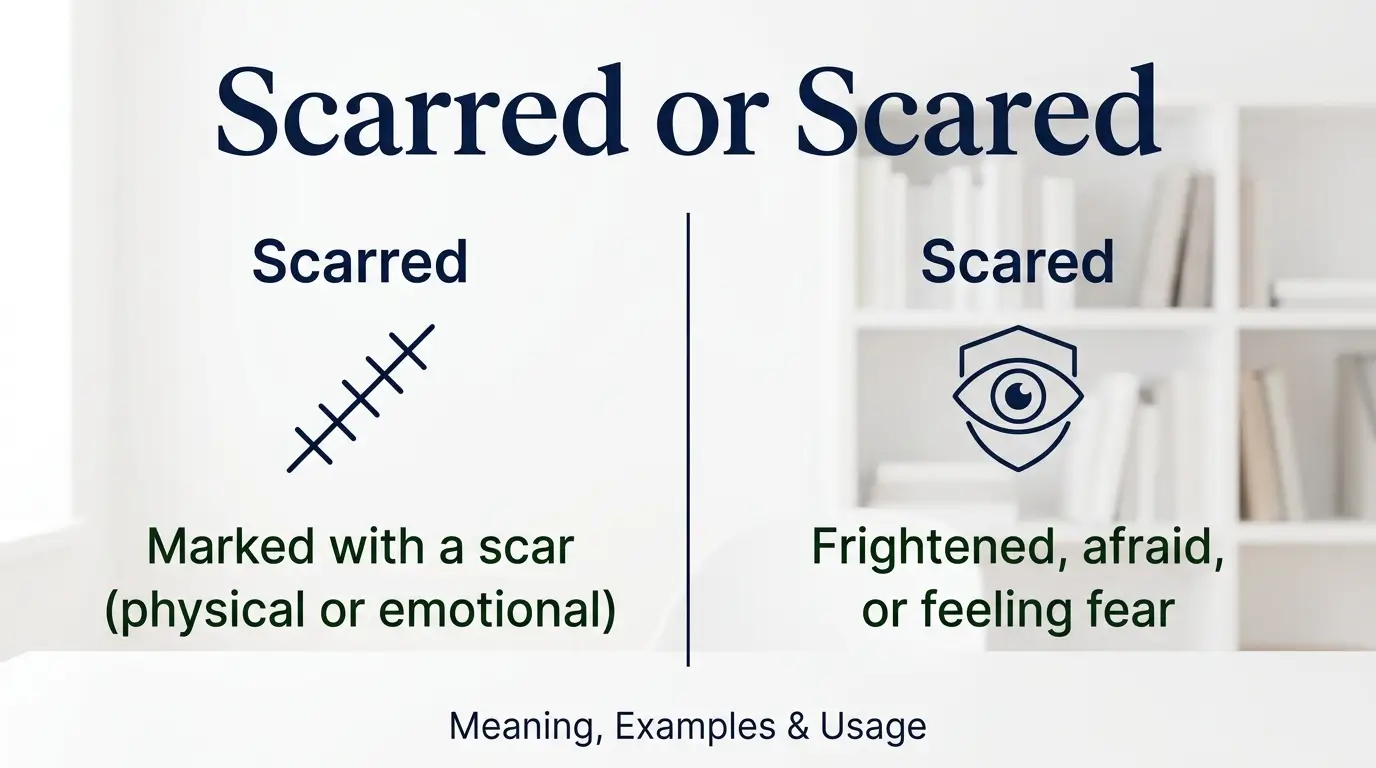
Scared means feeling afraid or frightened. Scarred means having a physical mark left by an injury, or being deeply affected by a painful experience.
For example, “The child was scared of the dog” means the child felt afraid, while “The accident left him scarred” means the accident caused lasting damage.
Knowing the difference is important in schoolwork, emails, social media posts, essays, and professional writing. One extra r can completely change your sentence. The good news is that the rule is simple: scared = afraid; scarred = marked or damaged.
In this guide, you will learn the meaning, origin, spelling, pronunciation, common mistakes, and correct everyday use of scarred or scared.
Scarred or Scared Quick Answer
Scared is correct when you mean afraid or frightened.
- I was scared by the loud noise.
- She is scared of spiders.
- The little boy looked scared.
Scarred is correct when you mean marked by a scar or deeply affected by something painful.
- His face was scarred after the accident.
- The old building was scarred by years of damage.
- She was emotionally scarred by the experience.
Easy memory trick
Scared = fear
Scarred = scar or lasting damage
The extra r in scarred can remind you of a physical or emotional scar.
| Word | Meaning | Example |
|---|---|---|
| Scared | Afraid or frightened | I was scared during the storm. |
| Scarred | Marked or damaged by an injury or painful experience | The accident left him scarred. |
These words are not interchangeable.
The Origin of Scarred or Scared
Although scarred and scared look similar, they come from different word histories.
Origin of “Scared”
Scared comes from the verb scare, meaning to frighten or make someone afraid. The history of scare is connected with Scandinavian and Old Norse forms associated with frightening or frightening away.
Over time, scare became the normal English verb for causing fear, while scared developed as its past-tense and past-participle form.
For example:
- The movie scared me.
- I was scared by the movie.
Origin of “Scarred”
Scarred comes from scar, the noun for a mark left on the skin after a wound heals. The word scar has a complex history involving Old French and Greek, with the English word recorded from the Middle Ages. The verb scar later developed from the noun, giving us scarred and scarring.
The word can also be used figuratively:
- The accident scarred him physically.
- The experience scarred him emotionally.
So, the different spellings are not random. They come from two different base words:
scare → scared
scar → scarred
British English vs American English Spelling
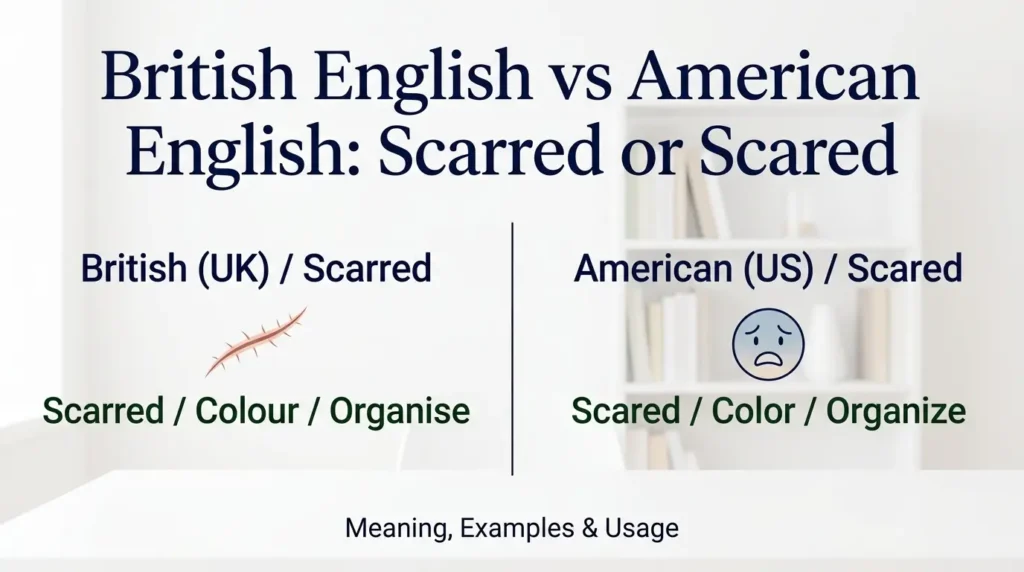
There is no spelling difference between British and American English for these words.
Both varieties use:
- scared
- scarred
The main difference may be pronunciation, especially because many British accents are non-rhotic, while most standard American accents pronounce the r more clearly.
| Feature | American English | British English |
|---|---|---|
| Afraid | scared | scared |
| Marked by injury | scarred | scarred |
| Spelling | Same | Same |
| Main difference | Regional pronunciation | Regional pronunciation |
| Correct form | scared / scarred | scared / scarred |
For international writing, you do not need to change the spelling based on whether your reader uses British or American English.
Which Spelling Should You Use?
The answer depends on what you mean, not where your reader lives.
For American English
Use scared for fear:
I was scared when I heard the noise.
Use scarred for lasting marks or damage:
His hand was scarred after the accident.
For British English
The same spelling and meaning apply:
She was scared of the dark.
His face was scarred by the injury.
For Commonwealth and global English
The distinction remains the same. Whether you are writing for readers in Canada, Australia, India, Pakistan, New Zealand, or another English-speaking region, use:
scared = afraid
scarred = marked or emotionally damaged
This makes the words easy to use in international writing.
Common Mistakes with Scarred or Scared
Because these words differ by only one letter, spelling mistakes are common.
Mistake 1: “I am scarred of dogs.”
❌ I am scarred of dogs.
This says you have scars, not that you feel afraid.
✅ I am scared of dogs.
Mistake 2: “The accident scared his face.”
❌ The accident scared his face.
If you mean that the accident left marks on his face, use scarred.
✅ The accident scarred his face.
Mistake 3: “She was scarred by the horror movie.”
This sentence can technically be correct if the movie caused lasting emotional damage. But if you simply mean she felt frightened while watching it, use:
✅ She was scared by the horror movie.
Mistake 4: Confusing “scarred” with “scaring”
Remember the difference:
- scared = felt fear
- scaring = causing fear
- scarred = marked or emotionally damaged
- scarring = causing a scar or lasting damage
Scarred or Scared Comparison Table
| Word | Base Word | Meaning | Example |
|---|---|---|---|
| Scared | scare | Feeling afraid | He was scared of the storm. |
| Scaring | scare | Causing fear | The noise is scaring the dog. |
| Scarred | scar | Marked by injury or lasting damage | The accident left her scarred. |
| Scarring | scar | Causing lasting marks or damage | The injury is scarring his skin. |
| Scare | scare | To frighten | Loud noises scare me. |
| Scar | scar | A mark left by an injury | The cut left a scar. |
Scarred or Scared in Everyday Examples
In Emails
Scared:
I was scared when I received the unexpected message.
Scarred:
The accident left the building badly scarred.
In News Writing
Scared:
Residents were scared after the sudden explosion.
Scarred:
The historic building was scarred by years of neglect.
On Social Media
Scared:
I was so scared when I heard that sound!
Scarred:
Some experiences leave you emotionally scarred.
In Formal Writing
Scared:
The students were scared by the sudden change in conditions.
Scarred:
The community was emotionally scarred by the tragedy.
In Everyday Conversation
Scared:
“Are you scared?”
“Yes, a little.”
Scarred:
“Did the injury leave a scar?”
“Yes, my arm is still scarred.”
Scarred or Scared Google Trends & Usage Data
Search interest for “scarred or scared” and similar word-confusion queries appears in English-learning contexts, particularly among students, writers, and people checking spelling or meaning.
Online usage comparisons also show that scared is generally much more common in everyday English than scarred, because fear is discussed more frequently than physical or figurative scarring.
The exact level of search interest changes over time and by country. Interest is commonly associated with English-learning markets such as the United States, United Kingdom, India, Pakistan, and Australia, where people search for differences between confusing English words.
The important point for writers is that popularity does not determine which spelling is correct. Meaning determines the correct word.
If the sentence is about fear, choose scared. If it is about a scar, lasting damage, or deep emotional harm, choose scarred.
FAQs About Scarred or Scared
Is it scared or scarred?
Both are correct words, but they have different meanings. Scared means afraid, while scarred means marked or damaged.
What is the difference between scared and scarred?
Scared describes fear. Scarred describes a lasting physical or emotional mark.
Is “I am scarred of dogs” correct?
No. The correct sentence is “I am scared of dogs.”
Is “scarred for life” correct?
Yes. Scarred for life means someone has experienced lasting physical or emotional damage.
Is “scared for life” also correct?
Yes, but it means something different. Scared for life means someone remains afraid, while scarred for life suggests lasting damage or emotional harm.
Do British and American English spell these words differently?
No. Both British and American English use scared and scarred. Pronunciation can vary by accent.
How can I remember scared vs. scarred?
Think of scared as fear and scarred as scar. The extra r in scarred can remind you of a scar.
Can scarred describe emotional damage?
Yes. Scarred can describe deep emotional or psychological effects caused by a painful experience.
Which word is more common: scared or scarred?
Scared is generally more common in everyday English because it describes a common emotional state. Corpus-based comparisons also show higher overall use of scared.
Conclusion
The difference between scarred or scared is simple once you focus on meaning. Scared means afraid, frightened, or fearful.
Scarred means marked by a physical injury or deeply affected by a painful experience. The two words may look and sound similar, but they cannot normally be used interchangeably.
Remember the easiest rule: scared has one “r” and relates to fear; scarred has two “r”s and relates to a scar or lasting damage.
For example, “I was scared of the dog” means you felt afraid, while “The accident left me scarred” means the accident caused lasting damage.
The spelling does not change between British and American English, so you only need to choose the word that matches your meaning.
Before submitting an email, essay, article, or social media post, check whether you are describing fear or a lasting mark. Once you remember that difference, you will rarely confuse scared and scarred again.