Recur or Reoccur: Which Word Is Correct?
Recur or Reoccur: Both are correct, but recur usually means something happens repeatedly or regularly, while reoccur simply means it happens again.
Have you ever stopped while writing because you were unsure whether to use recur or reoccur? You are not alone.
Both words mean that something happens again, so the difference can seem very small. Yet, they can carry a slightly different meaning, especially when you want to describe a repeated pattern.
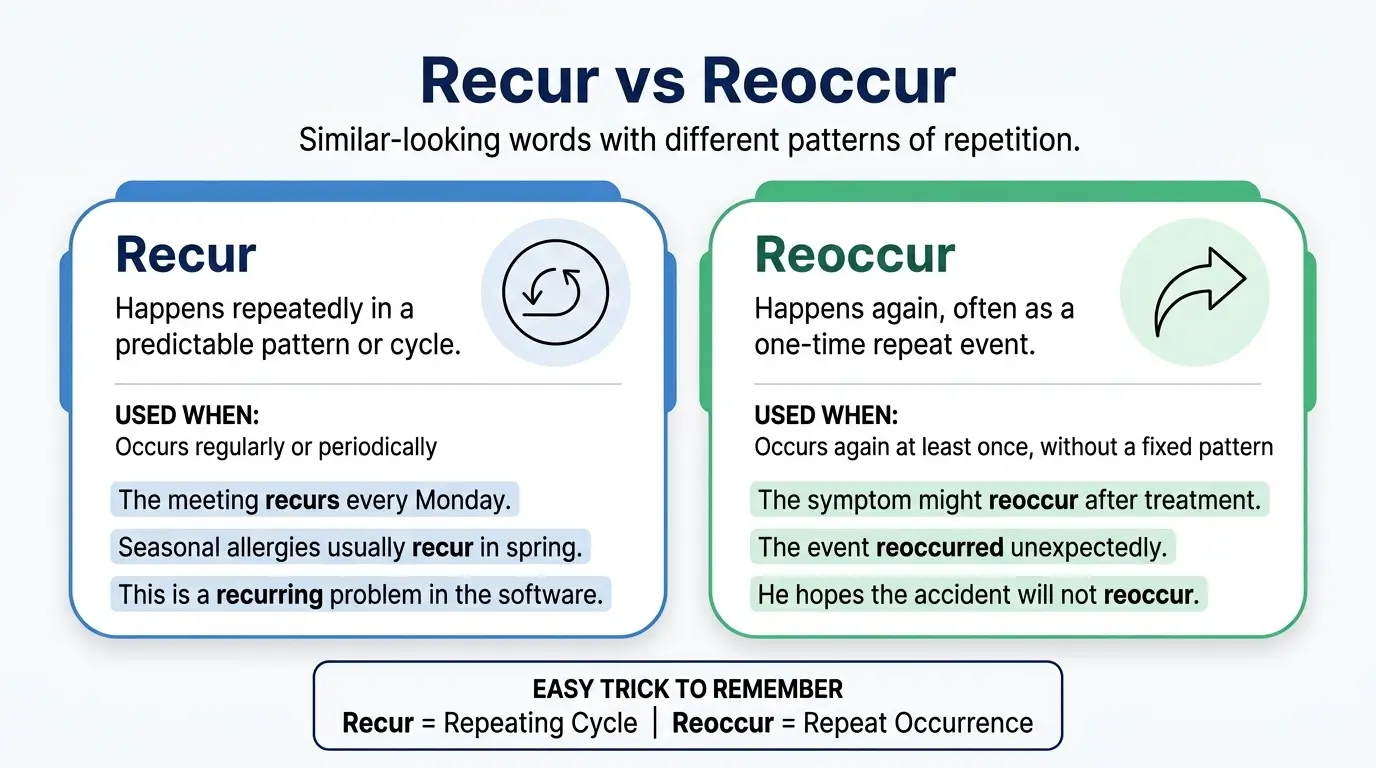
In simple terms, recur often suggests that something happens repeatedly, frequently, or at regular intervals. Reoccur simply means that something happens again, without necessarily suggesting a pattern or schedule.
For example, “The problem may recur every month” suggests a repeated pattern, while “The problem may reoccur” only says that it may happen again.
This guide explains recur vs. reoccur in simple English. You will learn their meanings, origins, spelling, common mistakes, real-life examples, and which word works best in professional writing.
Recur or Reoccur Quick Answer
Both recur and reoccur are correct words.
- Recur = happen again, especially repeatedly or regularly.
- Reoccur = happen again, without saying that it happens regularly.
Examples
Recur:
The same error keeps recurring every Monday.
Reoccur:
We hope this error does not reoccur.
A useful memory trick is:
Recur = repeat in a pattern.
Reoccur = occur again.
However, this is a usage preference, not an absolute grammar rule. Dictionaries note that the meanings overlap, and both words can mean “happen again.”
The Origin of Recur or Reoccur
The two words have related histories, but they did not develop in exactly the same way.
Recur comes from the Latin recurrere, meaning “to run back” or “to return.” The English verb appeared much earlier than reoccur. Its modern sense of “happen again” developed later. Merriam-Webster dates the first known use of recur to about 1512.
Reoccur is built from re-, meaning “again,” and occur, meaning “to happen.” Merriam-Webster dates its first known use to 1734.
Interestingly, both words connect to the Latin root currere, meaning “to run.” The idea behind recur is closer to “run back,” while reoccur is more directly understood as “occur again.”
This history helps explain why the words look different even though their meanings overlap.
British English vs American English Spelling
There is no major British-versus-American spelling difference between these words.
Both varieties of English use:
- recur
- recurred
- recurring
- reoccur
- reoccurred
- reoccurring
The main difference is not spelling. It is meaning and style.
| Form | American English | British English | Meaning |
|---|---|---|---|
| Recur | ✓ | ✓ | Happen again, often repeatedly |
| Recurred | ✓ | ✓ | Happened again |
| Recurring | ✓ | ✓ | Happening repeatedly |
| Reoccur | ✓ | ✓ | Happen again |
| Reoccurred | ✓ | ✓ | Happened again |
| Reoccurring | ✓ | ✓ | Happening again |
For example:
- US: The issue may recur next month.
- UK: The issue may recur next month.
- US: We hope the error does not reoccur.
- UK: We hope the error does not reoccur.
So, if you are wondering whether recur or reoccur changes between American and British English, the answer is no.
Which Spelling Should You Use?
Choose the word based on the meaning you want.
For a regular or repeated event: Use “recur”
Use recur when something returns again and again, especially when there is a pattern.
The meeting recurs every Friday.
These problems tend to recur during winter.
The same theme recurs throughout the novel.
For something happening again: Use “reoccur”
Use reoccur when you simply mean that something happens again and you do not want to suggest a regular pattern.
The mistake could reoccur if we do not fix the system.
The problem reoccurred several months later.
For US readers
Both forms are accepted. Recur is often the cleaner choice when repetition is regular or frequent.
For UK and Commonwealth readers
The same basic distinction works. There is no special British spelling you need to learn.
For global English
If your audience includes people from many countries, recur is often the safer choice when you clearly mean repeated or patterned behavior. If you simply mean “happen again,” reoccur can be precise.
Common Mistakes with Recur or Reoccur
Mistake 1: Treating “reoccur” as incorrect
Wrong idea: Reoccur is not a real English word.
Correction: Reoccur is a standard English verb. Merriam-Webster defines it as “to occur again” and lists examples of modern usage.
Mistake 2: Using “reoccur” for a clear routine
❌ The monthly payment reoccurs every month.
✓ The monthly payment recurs every month.
Recur works better because the event follows a repeated pattern.
Mistake 3: Assuming “recur” always means regular
Recur can also simply mean “happen again.” The regularity idea is a common nuance, not a strict rule.
Mistake 4: Writing “reoccurence”
The correct noun is:
reoccurrence
Not:
❌ reoccurence
The noun related to recur is:
recurrence
Mistake 5: Confusing “recurring” and “reoccurring”
Recurring problem = a problem that keeps coming back.
Reoccurring problem = a problem that happens again.
When the repeated pattern matters, recurring is usually the better choice.
Recur or Reoccur in Everyday Examples
In emails
Recur:
We have noticed that this issue tends to recur at the end of each month.
Reoccur:
We have fixed the problem and hope it does not reoccur.
In news writing
Recur:
Concerns about inflation have recurred throughout the year.
Reoccur:
Officials warned that similar flooding could reoccur.
On social media
Recur:
This trend seems to recur every summer.
Reoccur:
I hope that awkward moment never reoccurs!
In formal writing
Recur:
The pattern recurs throughout the study.
Reoccur:
Additional safeguards were introduced to prevent the error from reoccurring.
In business writing
Recur:
The report identifies several recurring customer complaints.
Reoccur:
The software update should prevent the same issue from reoccurring.
Recur vs Reoccur Comparison Table
| Feature | Recur | Reoccur |
|---|---|---|
| Basic meaning | Happen again | Happen again |
| Suggests repetition | Strongly | Yes |
| Suggests a pattern | Often | Not necessarily |
| Suggests regularity | Often | Not usually |
| Used in formal writing | Yes | Yes |
| Used in everyday English | Yes | Yes |
| Example | The problem recurs monthly. | The problem may reoccur. |
| Related noun | Recurrence | Reoccurrence |
| Best memory tip | Repeat | Occur again |
The distinction is useful, but it should not be treated as an unbreakable rule. Major dictionaries recognize substantial overlap between the two words.
Recur or Reoccur Google Trends & Usage Data
Google Trends measures relative search interest, not the total number of searches. Interest can also change based on country, language, and the exact search phrase.
For this keyword, search intent is usually focused on questions such as:
- “recur or reoccur”
- “difference between recur and reoccur”
- “recur vs reoccur”
- “is reoccur a word?”
- “recurring or reoccurring”
The broader usage evidence shows that recur is the more established and commonly encountered form, while reoccur is also accepted and used when writers want to emphasize that something happened again. Merriam-Webster specifically notes that both can mean “happen again,” while recur can add the sense of frequent or periodic repetition.
Usage also varies by context. Recurring is common in business, finance, technology, and general writing because it describes repeated events such as payments, problems, meetings, and patterns. Reoccur often appears when discussing an unwanted event that happens again.
Rather than relying on a fixed country ranking, writers should focus on meaning and audience. Both spellings are understood in major English varieties.
FAQs About Recur or Reoccur
Is “recur” or “reoccur” correct?
Both are correct. Recur often suggests repeated or periodic action, while reoccur means something happens again.
Is reoccur a real word?
Yes. Reoccur is a standard English verb meaning “to occur again” or “to happen another time.”
What is the main difference between recur and reoccur?
Recur often suggests a repeated pattern or frequency. Reoccur simply says that something happens again.
Is “recurring” or “reoccurring” better?
Use recurring when something happens repeatedly or follows a pattern. Use reoccurring when you simply mean that something happens again.
Is “reoccur” formal English?
Yes. Reoccur can be used in both formal and informal English.
What is the noun of recur?
The noun is recurrence.
Example:
The recurrence of the problem was unexpected.
What is the noun of reoccur?
The noun is reoccurrence.
Example:
The company wants to prevent a reoccurrence of the error.
Can recur and reoccur be used interchangeably?
Sometimes. Their meanings overlap, but recur can suggest repeated or periodic behavior. Choosing the more precise word can make your writing clearer.
Conclusion: Recur or Reoccur?
The choice between recur or reoccur is easier once you focus on the type of repetition. Both words are correct, and both can mean that something happens again. The main difference is the nuance.
Use recur when an event, problem, thought, or pattern comes back repeatedly, especially when it happens often or at predictable intervals.
For example, “The meeting recurs every Friday” clearly shows a pattern. Use reoccur when you simply want to say that something happens again, without suggesting a regular cycle. For example, “The error may reoccur” only tells the reader that the error could happen again.
There is no special American or British spelling difference. Both forms are accepted in major varieties of English. In professional writing, choose the word that best matches your meaning. When in doubt, remember: recur often means repeat; reoccur means occur again.