Duffle or Duffel: Which Spelling Is Correct?
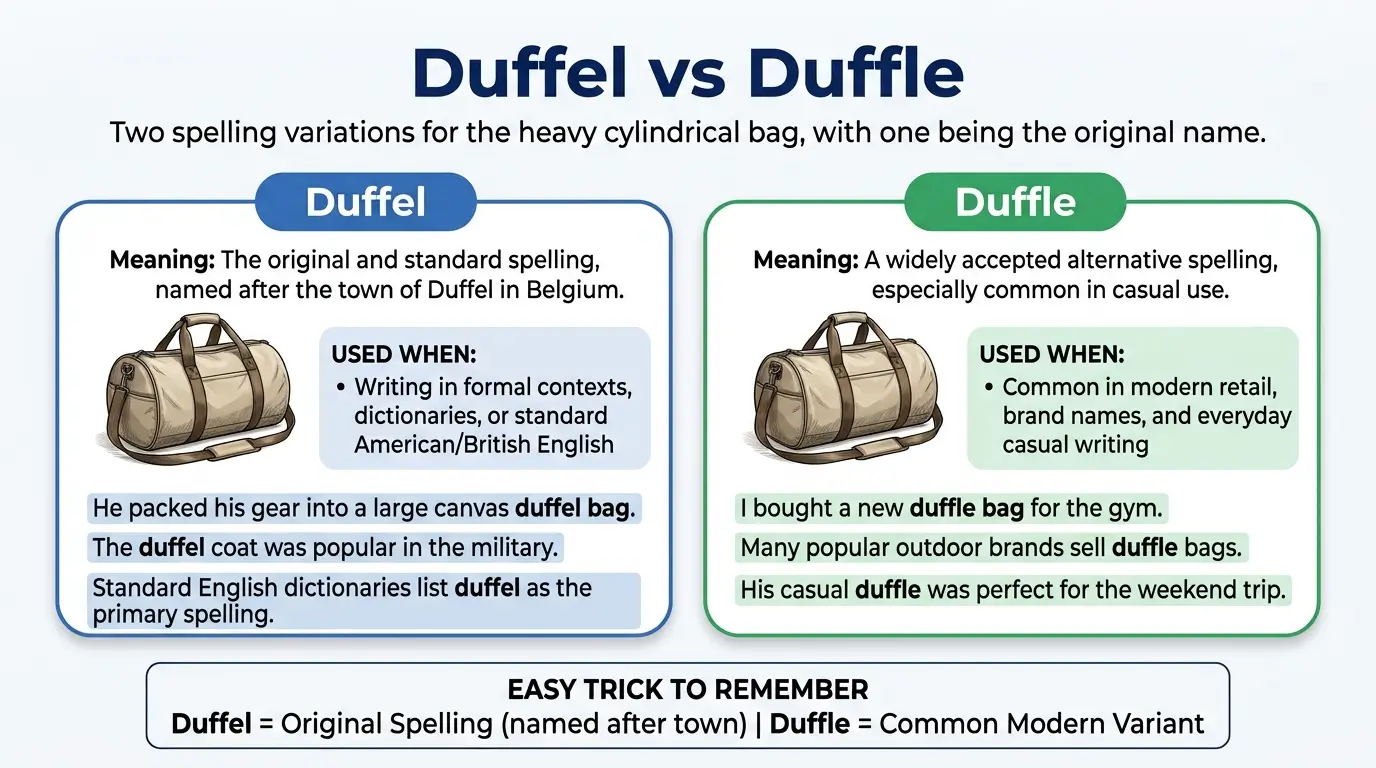
Duffle or duffel? Both spellings are correct, but “duffel” is more common in American English. “Duffle” is also widely accepted, especially in British English. For most writing, duffel is the safest choice.
Have you ever typed duffle or duffel and stopped to wonder which spelling is right? You are not alone. Both spellings appear on travel websites, shopping pages, social media, and even in published writing. That makes this small spelling difference surprisingly confusing.
The good news is simple: duffel and duffle are both accepted spellings for the same word. The difference is mainly one of regional and stylistic usage.
Duffel is the more common standard in American English, while duffle is also well established, especially in British English and in expressions such as “duffle coat.” Dictionaries such as Collins and American Heritage recognize both forms.
If you are writing for a broad audience, choosing duffel is usually the safest option. But if you see “duffle,” it is not automatically a spelling mistake. This guide explains the history, regional preferences, common errors, and best choice for professional writing.
Duffle or Duffel Quick Answer
Both “duffel” and “duffle” are correct. They refer to the same type of heavy cloth and, commonly, a large soft-sided bag used for travel, sports, camping, or carrying equipment.
- Duffel bag → preferred in American English and very common internationally.
- Duffle bag → accepted alternative spelling, especially familiar in British English.
- Duffel coat / duffle coat → both forms can be found.
Examples:
- I packed my clothes in a duffel bag.
- She bought a new duffle bag for the gym.
- He wore a traditional duffle coat.
So, if you are asking “duffle or duffel?”, the short answer is: both are correct, but “duffel” is generally the safer choice for modern general-purpose writing. Collins lists “duffle” as a variant of “duffel.”
The Origin of Duffle or Duffel
The word has a geographic history.
Duffel comes from Duffel, a town in Belgium near Antwerp. The town became associated with a thick, coarse woolen cloth. English adopted the word for the fabric, and later the term became associated with bags made from similar material.
The word entered English around the 17th century. Etymonline dates duffle as a word for coarse woolen cloth to the 1670s and notes that duffel bag is an American English expression dating to 1915.
Over time, English developed the alternative spelling duffle. Both forms survived, so modern English speakers can encounter either spelling.
The town itself has a long textile history. The municipality of Duffel explains the connection between its historic textile production and the English word used for the heavy fabric and later the famous coat.
In short:
Duffel (Belgian place) → duffel cloth → duffel/duffle → duffel bag
British English vs American English Spelling
There is no strict British-versus-American rule like colour/color. Instead, duffel and duffle are accepted variants, with preferences changing by region and context.
American English strongly favors duffel, especially for the bag:
I bought a new duffel bag for my vacation.
British English accepts both duffel and duffle. Collins specifically lists duffle as a British variant and notes that the bag-related sense is mainly associated with North American usage.
| Feature | Duffel | Duffle |
|---|---|---|
| Status | Correct | Correct |
| American English | Very common | Less common |
| British English | Used | Common alternative |
| Canadian English | Common | Also understood |
| Meaning | Same | Same |
| Bag example | duffel bag | duffle bag |
| Coat example | duffel coat | duffle coat |
| Best for broad audiences | Yes | Yes, but less universal |
American Heritage also lists duffel or duffle as acceptable forms.
Which Spelling Should You Use?
Your best choice depends on your audience.
For American English
Use duffel.
Example:
“I left my duffel bag at the hotel.”
This is the spelling most American readers expect.
For British English
Either duffel or duffle can work. If you are following a particular British publication or house style, follow its preference.
For Canadian English
Duffel is a strong choice, particularly when referring to a bag.
For Australian or international audiences
Both forms will be understood. However, duffel is a useful choice when you want one spelling that works well across a wide English-speaking audience.
For SEO and websites
If your main keyword is duffle or duffel, use both naturally. You do not need to force one spelling into every sentence.
For example:
Looking for a duffel bag? You may also see the same product described as a duffle bag.
This captures both variants while keeping the writing natural.
Common Mistakes with Duffle or Duffel
Mistake 1: Thinking “duffle” is always wrong
Wrong assumption:
“Duffle is a spelling error.”
Correction:
Both duffel and duffle are recognized forms.
Mistake 2: Treating them as different types of bags
There is normally no difference in the object.
Duffel bag = duffle bag
The difference is spelling, not design.
Mistake 3: Mixing spellings in professional copy
Using duffel in one paragraph and duffle in the next is not grammatically wrong, but it can look inconsistent.
Better: Choose one preferred form and use it consistently.
Mistake 4: Assuming the pronunciation changes
Both spellings are normally pronounced the same way: roughly DUF-uhl.
Mistake 5: Writing “duffle” because it looks more English
British English does use duffle, but that does not make duffel incorrect in British writing.
Duffle or Duffel in Everyday Examples
In an Email
Hi James,
Don’t forget to bring your duffel bag for the weekend trip.
In News Writing
Police found a black duffel bag near the entrance.
On Social Media
Packed my duffel and ready for the weekend! ✈️
In Travel Writing
A lightweight duffel bag is useful for short trips.
In Formal Writing
Each participant was advised to carry a small duffel bag for personal equipment.
In British-Style Writing
He packed his clothes into a duffle bag before leaving.
In Fashion Writing
The classic duffle coat is known for its hood and toggle fastenings.
The important point is that the spelling can change without changing the basic meaning.
Duffle or Duffel Google Trends & Usage Data
Search interest varies by region and by the exact phrase being searched. Public discussions and search-oriented sources consistently indicate that “duffel bag” has strong overall usage, particularly in American and international contexts, while “duffle bag” remains a well-established alternative.
Search behavior also changes with context. People looking for luggage commonly search phrases such as duffel bag, travel duffel bag, and gym duffel bag.
Recent search-data analyses show continuing interest in these bag-related terms, with seasonal increases around travel and holiday periods.
For SEO, this leads to a practical rule:
| Search/Usage Context | Recommended Form |
|---|---|
| General English | Duffel |
| American audience | Duffel |
| Travel websites | Duffel |
| Luggage product pages | Duffel |
| British audience | Duffel or Duffle |
| Duffle coat | Duffle is common |
| Keyword targeting | Use both naturally |
Google Trends should be treated as a relative-interest tool rather than an exact word-count database. Search interest can change over time and can differ sharply depending on whether you compare duffel, duffle, duffel bag, or duffle bag.
Duffle vs Duffel: Comparison Table
| Variation | Correct? | Main Use | Recommended? |
|---|---|---|---|
| duffel | Yes | General word | Yes |
| duffle | Yes | Alternative spelling | Yes |
| duffel bag | Yes | Travel/sports bag | Best general choice |
| duffle bag | Yes | Alternative bag spelling | Yes |
| duffel coat | Yes | Heavy wool coat | Yes |
| duffle coat | Yes | Traditional coat spelling | Yes |
FAQs About Duffle or Duffel
Is duffel or duffle correct?
Both duffel and duffle are correct spellings. Duffel is generally the safer choice for broad modern English.
Is “duffel bag” or “duffle bag” correct?
Both are correct. Duffel bag is more widely preferred in American English, while duffle bag is an accepted variant.
Is duffle British or American?
Duffle is commonly associated with British English, although it is also used in other English varieties. Duffel is especially common in American English.
Why are there two spellings?
The word entered English from duffel, the name of a Belgian town associated with the heavy woolen cloth. Over time, duffle developed as an alternative English spelling.
Does duffel mean the same as duffle?
Yes. In modern usage, the two spellings generally refer to the same cloth, bag, or related item.
Which spelling is better for SEO?
For a broad audience, duffel is usually the stronger primary spelling. However, including duffle naturally can help address searches using the alternative form.
Is “duffle coat” or “duffel coat” correct?
Both forms are used. Duffle coat is especially common as the traditional name for the coat.
Conclusion
So, duffle or duffel? The answer is reassuringly simple: both spellings are correct. They have the same basic meaning, and the difference is mainly regional and stylistic.
Duffel is the best default for most modern writing, especially for American English, travel content, product descriptions, and websites targeting a broad international audience.
Duffle is also a legitimate spelling and remains familiar in British English and traditional expressions such as “duffle coat.”
The word comes from Duffel, Belgium, a place historically associated with the heavy woolen fabric that gave the word its name. Over time, English developed the two accepted spellings.
If you are writing professionally, consistency matters more than worrying about whether duffle is “wrong.” Choose duffel as your main form unless your audience or style guide calls for duffle. When discussing both forms or targeting search traffic, mention both naturally.
In short: Duffel is the safest general choice; duffle is a correct alternative.