Mum or Mom: Which Spelling Is Correct?
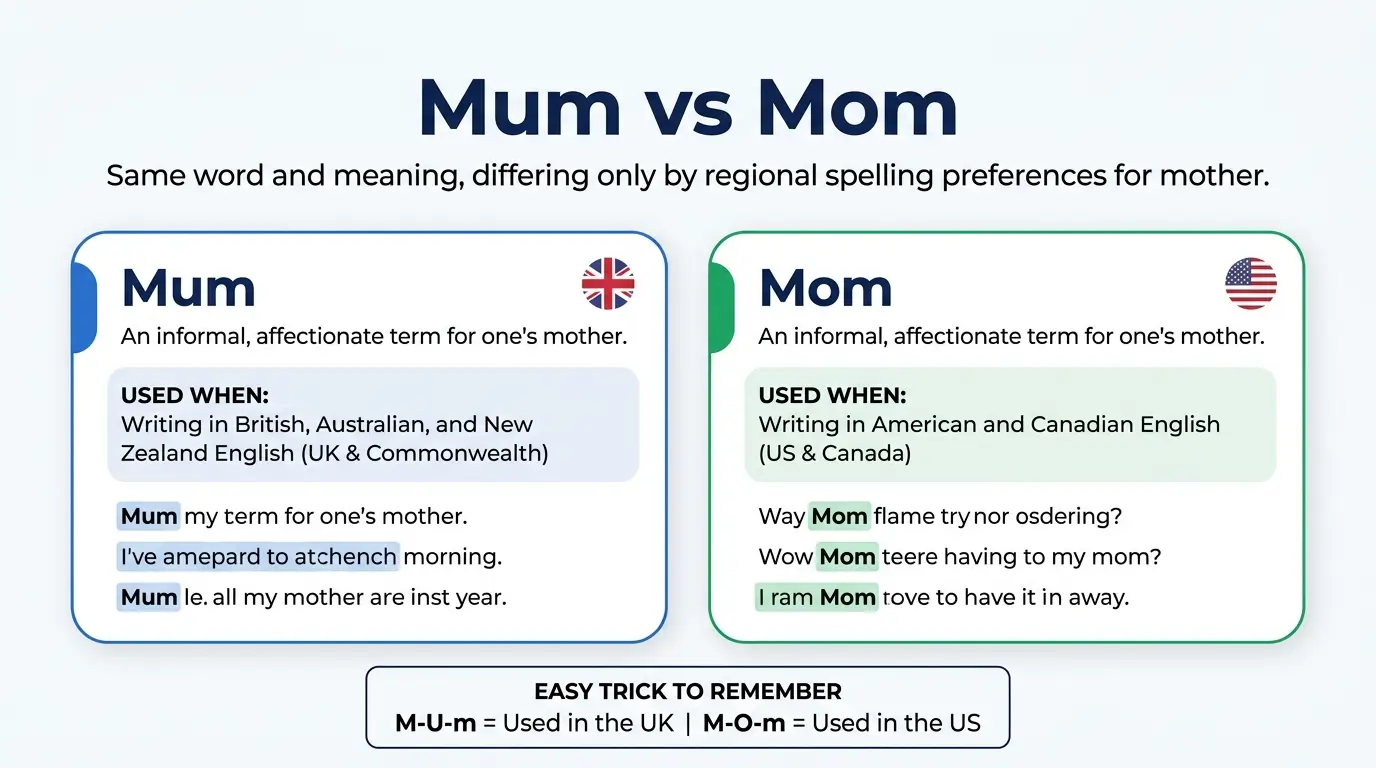
Mum or Mom? Both are correct! “Mum” is mainly British English, while “mom” is standard American English. Choose based on your audience.
If you have ever paused before writing “mum” or “mom,” you are not alone. Both words mean the same thing: a female parent.
The difference is mainly based on where English is spoken. “Mom” is the standard spelling in American English, while “mum” is common in British English and many other countries.
This small spelling difference can be confusing when you read books, watch movies, write online, or communicate with people from different English-speaking countries.
You may wonder whether one spelling is more correct, whether “mum” is only British, or which version you should use in professional writing.
The good news is simple: both “mum” and “mom” are correct. Your choice depends on your audience and the type of English you are using.
In this guide, you will learn where these words came from, how British and American English differ, which spelling to choose, common mistakes to avoid, and how each word appears in everyday writing.
Mum or Mom Quick Answer
“Mum” and “mom” are both correct spellings of the word for a female parent.
- Mum → British English, Australian English, and other varieties
- Mom → American English
- Mam → Also used in some British and Irish regions
Examples:
- UK: “I called my mum last night.”
- US: “I called my mom last night.”
- Australia: “My mum is visiting us.”
The meaning does not change. Only the regional spelling differs.
The Origin of Mum or Mom
The words mum and mom come from the same family of simple, child-like words used for mothers.
Words for parents often develop from early sounds made by babies. Sounds such as “ma,” “mama,” and similar forms appear in many languages around the world.
Over time, different English-speaking regions developed their own forms. “Mum” became strongly associated with British English, while “mom” became the usual American form.
The spelling “mum” has a long history in British English. In the United States, “mom” became the dominant form, although some American regions have used forms such as “ma” and “mama.”
So, the difference is not about one spelling being right and the other being wrong. It is mainly a result of regional language development.
British English vs American English Spelling
The clearest difference is geographic.
| English variety | Common spelling | Example |
|---|---|---|
| British English | mum | “My mum made dinner.” |
| American English | mom | “My mom made dinner.” |
| Australian English | mum | “I called my mum.” |
| New Zealand English | mum | “My mum is at home.” |
| Canadian English | mom is common | “My mom is coming.” |
| Irish English | mum/mam | “My mum is here.” |
Comparison of Mum or Mom Variations
| Word | Main usage | Meaning | Example |
|---|---|---|---|
| Mum | UK, Australia, New Zealand | Mother | “My mum is a teacher.” |
| Mom | US, Canada | Mother | “My mom is a teacher.” |
| Mam | Some regional varieties | Mother | “My mam lives nearby.” |
| Mama | Informal/global | Mother | “Mama is calling.” |
| Mother | Formal English | Female parent | “Her mother is a doctor.” |
The important point is that “mum” and “mom” do not have different meanings. They are regional forms of the same familiar word.
Which Spelling Should You Use?
Choose the spelling that matches your audience.
If You Write for Americans
Use mom.
“My mom works in New York.”
This is the standard form in American English.
If You Write for British Readers
Use mum.
“My mum lives in London.”
This is the natural choice in British English.
If You Write for Australian or New Zealand Readers
Use mum.
“My mum loves gardening.”
If You Write for a Global Audience
Either word can work, but consistency matters. If your website uses American English throughout, use mom. If it follows British English, use mum.
For SEO content, do not switch between the two randomly. Use the spelling that fits your target audience and include the alternative naturally when explaining the difference.
Common Mistakes with Mum or Mom
Mistake 1: Thinking “mum” is incorrect
Incorrect idea: “Mom is the only correct spelling.”
Correction: Both mum and mom are correct regional forms.
Mistake 2: Using “mom” in British English
This is not grammatically wrong, but it may sound American to British readers.
Better for British English:
“My mum is coming tomorrow.”
Mistake 3: Using “mum” for an American audience
Again, it is understandable, but mom is the normal American spelling.
Mistake 4: Mixing styles
Avoid switching between British and American spelling without a reason.
Inconsistent:
“My mom lives in London, and my mum loves tea.”
Consistent American English:
“My mom lives in London, and my mom loves tea.”
Mistake 5: Confusing “mum” with the flower
In British English, “mum” can also refer to a chrysanthemum in informal usage.
For example:
“She bought some mums for the garden.”
Context tells the reader which meaning is intended.
Mum or Mom in Everyday Examples
In Emails
British English:
Hi Sarah,
I’m visiting my mum this weekend.
American English:
Hi Sarah,
I’m visiting my mom this weekend.
In News Writing
A British publication may write:
“The boy returned home to his mum.”
An American publication is more likely to write:
“The boy returned home to his mom.”
On Social Media
People normally use the spelling that matches their everyday speech and regional English.
“Happy birthday to my amazing mum! ❤️”
or
“Happy birthday to my amazing mom! ❤️”
In Formal Writing
For formal writing, mother is often more appropriate than either “mum” or “mom.”
“The child was accompanied by his mother.”
However, if you are quoting someone or discussing a personal story, “mum” or “mom” may be perfectly suitable.
Mum or Mom Google Trends & Usage Data
Search interest for “mum” and “mom” reflects the strong regional split between British and American English.
Generally:
- “Mom” is more popular in the United States.
- “Mum” is strongly associated with the United Kingdom.
- “Mum” is also common in Australia and New Zealand.
- Canadian usage often favors “mom.”
- Search results can vary depending on whether users are looking for spelling advice, Mother’s Day content, family-related topics, or regional language information.
Google Trends should be viewed as a measure of search interest, not a dictionary ruling. A higher search volume does not make one spelling more correct.
For SEO, the best approach is to understand your target country. A US-focused website should normally use mom, while a UK-focused website should normally use mum.
Mum or Mom: Quick Comparison
| Feature | Mum | Mom |
|---|---|---|
| Meaning | Mother | Mother |
| British English | ✅ Common | Less common |
| American English | Less common | ✅ Common |
| Australian English | ✅ Common | Less common |
| New Zealand English | ✅ Common | Less common |
| Canadian English | Less common | ✅ Common |
| Formal alternative | Mother | Mother |
| Pronunciation | Usually /mʌm/ | Usually /mɑːm/ or regional variation |
FAQs About Mum or Mom
Is “mum” or “mom” correct?
Both are correct. “Mum” is mainly British, Australian, and New Zealand English, while “mom” is mainly American English.
Is “mum” British or American?
Mum is primarily associated with British English and is also common in Australia and New Zealand.
Is “mom” British English?
“Mom” is understandable in Britain but is mainly associated with American English.
Do “mum” and “mom” mean the same thing?
Yes. Both words mean mother. The main difference is regional usage.
Which is correct in the UK, mum or mom?
Mum is the standard spelling in most of the UK.
Which is correct in the USA, mum or mom?
Mom is the standard American spelling.
Should I use “mum” or “mom” in an SEO article?
Use the version that matches your target audience. Use mom for US readers and mum for UK, Australian, or New Zealand readers.
Is “mam” also correct?
Yes. Mam is used in some regional forms of English, especially in parts of Britain and Ireland. It is not the standard form everywhere.
Conclusion
The choice between “mum or mom” is simple once you know the regional difference. Both words refer to the same person and have the same basic meaning: a mother. The main difference is where each spelling is commonly used.
Use “mom” when writing in American English, especially for readers in the United States. Use “mum” when writing in British English, Australian English, or New Zealand English.
Some regions also use “mam,” while “mother” is the safest formal term in any variety of English.
Neither “mum” nor “mom” is universally more correct. The best choice depends on your audience, location, and writing style.
If you are writing for a specific country, follow that country’s standard English consistently. If you are writing for a global audience, explain the difference when useful and avoid mixing spelling styles without a clear reason.
In short: British English says “mum,” American English says “mom,” and both are correct.