Unenroll or Disenroll: Which Spelling Is Correct?
Choosing between unenroll or disenroll can be confusing. Both words relate to ending enrollment, but they do not appear equally often in every type of English.
Add British spelling, American spelling, school rules, and formal documents, and the choice becomes even less clear.
If you are writing an email to a school, filling out an online course form, or editing a professional document, you may wonder: Should I write “unenroll” or “disenroll”? You may also see “unenrol” or “disenrol” and wonder if these are mistakes.
The good news is simple: both “unenroll” and “disenroll” are established English words. “Unenroll” is a natural choice for general, modern writing, while “disenroll” is common in official, administrative, and institutional contexts.
British English may use the single-l forms unenrol and, less commonly, disenrol.This guide explains the meaning, history, spelling, regional differences, and best usage. It also gives practical examples so you can choose the right form with confidence.
Unenroll or Disenroll Quick Answer
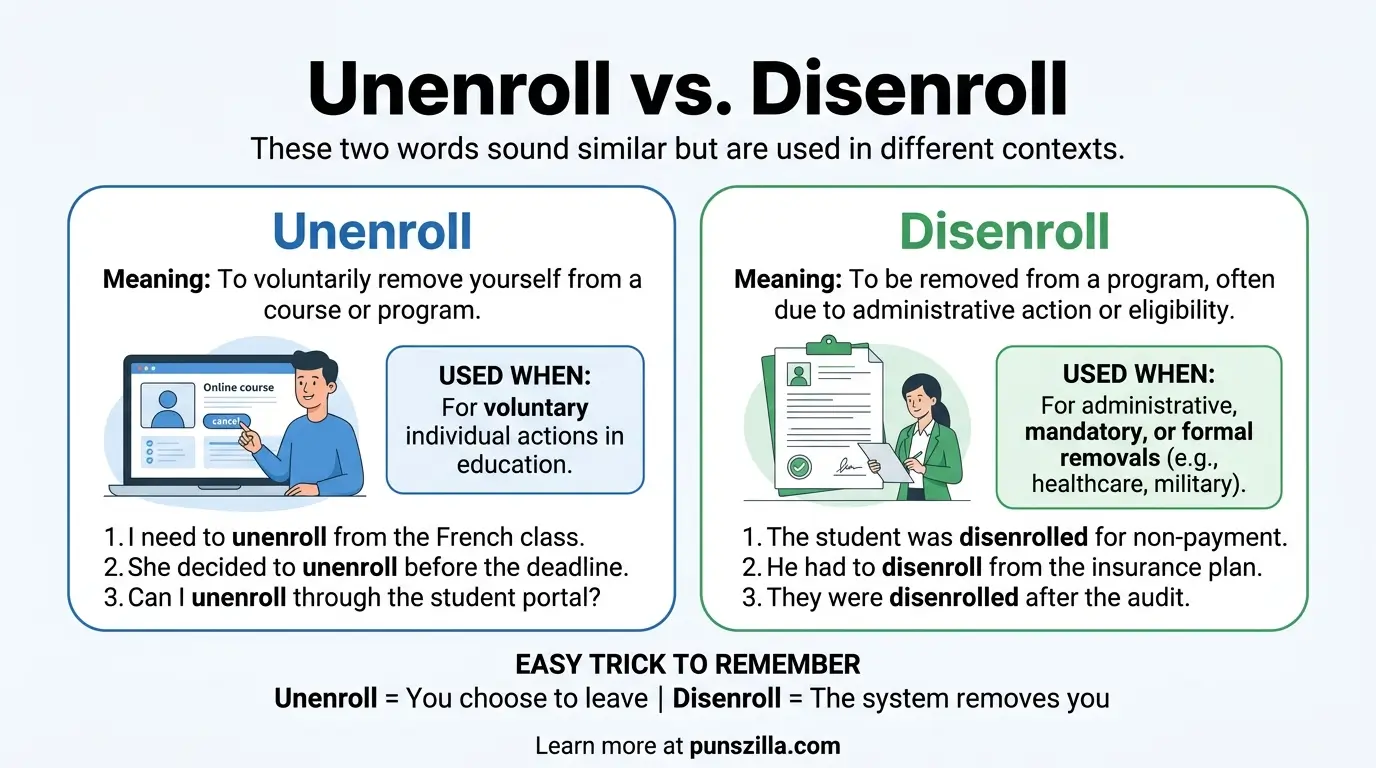
Unenroll and disenroll both mean to remove someone or yourself from enrollment in a course, program, organization, or service.
For most general writing, unenroll is the easiest and most natural choice.
Examples:
- “I want to unenroll from the online course.”
- “Students can unenroll before the deadline.”
- “The university may disenroll students who do not meet its requirements.”
There is a useful difference in tone:
| Word | Common use | Example |
| Unenroll | General, everyday, educational, digital | “I decided to unenroll from the course.” |
| Disenroll | Formal, administrative, institutional | “The agency may disenroll members from the program.” |
| Unenrol | British/Commonwealth spelling | “You can unenrol from the course.” |
| Disenrol | British spelling, less common | “The member was disenrolled from the scheme.” |
However, unenroll does not always mean voluntary removal, and disenroll does not always mean forced removal. The distinction is mainly about usage and context, not a strict grammar rule. Merriam-Webster defines disenroll as removing a name from a roll and, more broadly, releasing someone from membership in an organization.
The Origin of Unenroll or Disenroll
Both words are built from enroll, which means to place a person’s name on an official list or register.
The history of enroll goes back to Middle English enrollen, from Old French enroller. The basic idea was to place something on a roll or list.
The two modern words add different prefixes:
- un- + enroll = unenroll
- dis- + enroll = disenroll
The prefix un- often shows reversal or removal. We see the same pattern in words such as unlock, untie, and undo.
The prefix dis- can express separation, reversal, or removal. Similar examples include disconnect, disengage, and discontinue.
That is why both words make sense. Both describe reversing or ending an enrollment.
The spelling difference also comes from the base word:
- American English: enroll
- British English: enrol
Cambridge lists enrol as the UK spelling and enroll as the usual US spelling.
This creates forms such as unenroll/unenrol and disenroll/disenrol.
British English vs American English Spelling
The main regional difference is the spelling of enroll/enrol.
American English normally uses enroll, while British English uses enrol. The same difference appears in related words such as enrollment/enrolment.
Comparison Table
| Meaning | American English | British/Commonwealth English |
| Register | enroll | enrol |
| Remove from enrollment | unenroll | unenrol |
| Formal removal | disenroll | disenrol |
| Act of enrolling | enrollment | enrolment |
| Past tense | enrolled | enrolled |
| Present participle | enrolling | enrolling |
Notice an important point: enrolled and enrolling keep the double l in both varieties. For example:
- US: “She enrolled last week.”
- UK: “She enrolled last week.”
- US: “She is enrolling today.”
- UK: “She is enrolling today.”
The difference is mainly in the base verb and related noun forms.
British English commonly uses single-l forms such as enrol and enrolment, while American English uses enroll and enrollment.
There is one extra wrinkle: disenrol exists in British English, but it is much less common than everyday alternatives such as withdraw or leave. Collins currently labels disenrol as a British form and marks it obsolete in its dictionary entry.
Which Spelling Should You Use?
Your audience should guide your choice.
For American English
Use unenroll or disenroll.
For general writing, unenroll is often the clearer choice:
“You can unenroll from the course at any time.”
For official policies, healthcare documents, government programs, or institutional notices, disenroll may be more appropriate:
“Members may disenroll from the plan during the permitted period.”
Merriam-Webster recognizes disenroll as a standard verb.
For British and Commonwealth English
Use enrol rather than enroll as your base spelling.
Thus, unenrol is a logical British form. It is listed as an alternative form of unenroll.
In practice, British writers may also prefer clearer phrases such as:
- withdraw from a course
- leave a program
- cancel enrollment
- remove from the register
For Global English
If your readers come from many countries, unenroll is usually easy to understand.
However, consistency matters more than choosing one word perfectly. If your website, school, company, or software uses disenroll, follow that terminology throughout.
Common Mistakes with Unenroll or Disenroll
Several mistakes appear often.
1. Writing “un-enroll”
Incorrect or unnecessary in most modern writing:
“Please un-enroll me from the class.”
Better:
“Please unenroll me from the class.”
The word is normally written as one word.
2. Using “unroll”
Unroll is a different word. It means to open or spread something that was rolled up.
“Unroll the poster.”
For ending enrollment, use unenroll or disenroll.
3. Mixing US and UK spelling
Avoid mixing:
“Please unenrol from the course.”
in a document otherwise written in American English.
If you use US English, choose unenroll. If you use British English, unenrol can fit the spelling system.
4. Assuming “disenroll” is wrong
It is not wrong. Merriam-Webster lists disenroll and defines it as removing someone from a roll or membership.
5. Assuming the two words always have different meanings
There is some overlap. Unenroll can describe voluntary withdrawal, while disenroll often appears in formal removal notices, but this is a usage tendency rather than a universal rule.
6. Using “enrolled” when you mean “unenrolled”
These words have opposite meanings:
- enrolled = registered
- unenrolled = no longer registered
Example:
“The student is enrolled in the course.”
versus:
“The student is unenrolled from the course.”
Unenroll or Disenroll in Everyday Examples
The best word can depend on the setting.
In an Email
Natural:
Subject: Request to Unenroll
Hello,
I would like to unenroll from the course before the next session. Please let me know if I need to complete a form.
In a School Notice
Formal:
Students who do not meet the attendance requirements may be disenrolled from the program.
In a News Report
Formal and institutional:
The university said it would disenroll students who failed to meet the new requirements.
The word disenroll can appear in news coverage because journalists often report official institutional language.
Merriam-Webster noted increased attention to disenroll after a university announced that it would remove students who failed to meet a requirement.
On Social Media
A casual post would normally use unenroll:
“I finally unenrolled from that course. It was taking too much time.”
In Formal Writing
Disenroll may sound more administrative:
“The organization reserves the right to disenroll participants who fail to satisfy eligibility requirements.”
In an Online Course
User-facing software often benefits from plain language:
Unenroll from this course
This is short and easy to understand.
Unenroll or Disenroll Google Trends & Usage Data
Google Trends does not provide a simple worldwide count of how many times people use a word. Instead, it compares relative search interest over a selected time and location.
That matters when comparing “unenroll” and “disenroll.” Search interest can change because of school enrollment periods, government programs, healthcare policies, online learning, and major news events.
The available language evidence shows several clear patterns:
- Enroll/enrollment are strongly established terms in American English.
- Enrol/enrolment are standard British forms.
- Unenroll is used for general and educational contexts.
- Disenroll appears often in formal or administrative contexts.
- Unenrol exists as a British form.
- Disenrol exists but is much less common in modern British usage.
Country and audience also matter. US-focused websites, schools, software platforms, healthcare organizations, and government agencies are more likely to use the -ll spellings.
British, Australian, New Zealand, and other Commonwealth contexts commonly use enrol and enrolment.
A useful SEO lesson follows: people may search for “unenroll or disenroll,” “unenroll vs disenroll,” “disenroll or unenroll,” and related questions even when they ultimately need the same basic answer.
A good article should cover all of these natural variations without forcing keywords into every sentence.
Unenroll or Disenroll: Keyword Variations Compared
| Variation | Main meaning | Typical use | Recommended? |
| unenroll | End enrollment | General US English | Yes |
| disenroll | Remove from enrollment | Formal or institutional US English | Yes |
| unenrol | British spelling of unenroll | UK/Commonwealth | Yes, where appropriate |
| disenrol | British spelling of disenroll | Rare/formal/older usage | Use with care |
| un-enroll | Same basic idea | Nonstandard hyphenation | Usually avoid |
| unroll | Open something rolled up | Different meaning | No |
| withdraw | Leave a course/program | Very common alternative | Yes |
| drop a course | Leave a class | Casual/academic | Yes |
FAQs About Unenroll or Disenroll
Is “unenroll” or “disenroll” correct?
Both are correct English words. Unenroll is a natural general choice, while disenroll is common in formal and institutional contexts.
Is “unenroll” more common than “disenroll”?
In everyday and educational writing, unenroll is often the more natural choice. Disenroll is also established and appears frequently in official or administrative language.
Is “unenrol” correct in British English?
Yes. Unenrol follows the British spelling of enrol and is listed as an alternative form of unenroll.
Is “disenroll” American English?
Disenroll is well established in American English. Merriam-Webster lists it as a verb meaning to remove someone from a roll or membership.
Should I say “unenroll from a course”?
Yes. This is a natural construction:
“I want to unenroll from the course.”
You can also say:
“I want to withdraw from the course.”
Does “disenroll” mean that someone was forced to leave?
Not always. The word often appears when an institution removes someone, but there is no universal rule that makes disenroll involuntary and unenroll voluntary.
Which word is best for professional writing?
Use the term your organization already uses. If there is no house style, unenroll is a clear choice for general communication. For official policies, follow the terminology used by the relevant school, company, agency, or program.
Conclusion
The choice between unenroll or disenroll is easier once you understand the context. Both words describe ending or removing an enrollment. Neither is simply a spelling mistake.
For everyday American English, unenroll is a clear and natural choice. Disenroll is also correct and often appears in formal, administrative, healthcare, government, and institutional writing.
The two words can overlap in meaning, so do not assume that one always means voluntary withdrawal while the other always means forced removal.
Regional spelling creates another layer. American English uses enroll, while British English uses enrol.
This leads to forms such as unenroll/unenrol. Disenrol also exists, but modern British usage often favors other expressions, such as withdraw or leave a course.
For professional writing, the safest rule is simple: follow your audience and your organization’s style. If no style guide applies, choose the clearest form and use it consistently. For most general US-focused content, unenroll is a strong default.