
Micheal or Michael: Which Is Correct?
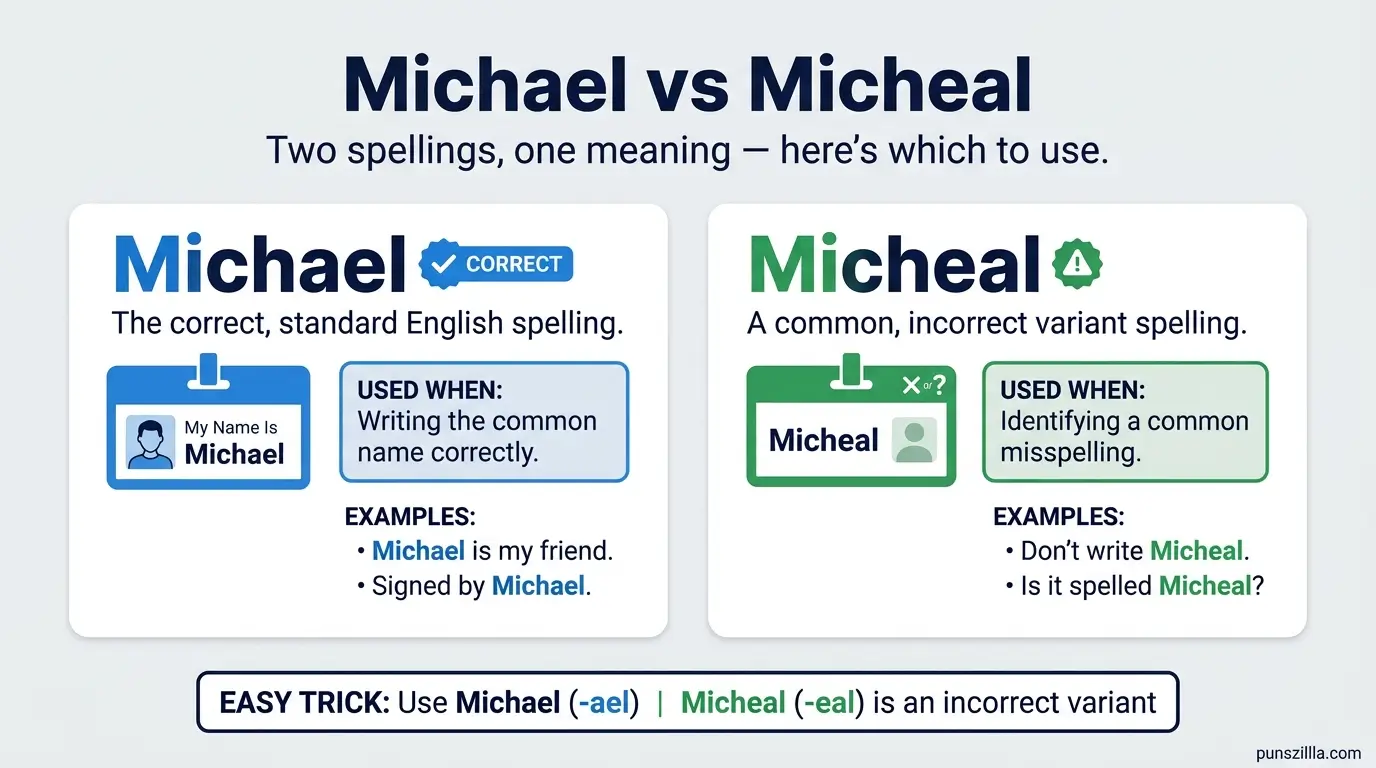
Michael is the standard English spelling, while Micheal is often a misspelling. However, Micheal can be a valid personal name, so always check the person’s preferred spelling.
Have you ever wondered whether to write Micheal or Michael? These names look almost identical, but their spelling can cause confusion.
Michael is the standard English spelling of this popular name. However, Micheal is also a legitimate name spelling in Irish and Scottish Gaelic contexts. It is not always a mistake.
People often type “Micheal” when they mean “Michael.” The letters appear in a similar order, making it easy to mix them up.
Both spellings may also look familiar because they share the same basic name history.
The important point is context. If you are writing the common English name, use Michael. If someone’s official name is Micheal, keep that spelling exactly as given.
This guide explains the difference between Micheal and Michael. You will learn their origins, correct usage, and common spelling mistakes.
You will also see examples for emails, social media, schoolwork, and professional writing.
By the end, you will know which spelling to choose and how to remember it. You will also learn how to check name spellings without accidentally changing someone’s identity.
Micheal or Michael Quick Answer
Quick Answer: Michael is the standard English spelling of the name. Micheal is often a misspelling when someone intends to write Michael.
However, Micheal can also be a valid Irish or Scottish Gaelic name form. Always use the spelling a person uses for their own name.
Examples of Michael
- Michael is joining our team next Monday.
- I sent the report to Michael yesterday.
- Michael enjoys reading books in his free time.
Examples of Micheal
- Micheal will attend the meeting tomorrow.
- I spoke with Micheal about the project.
- Micheal has confirmed his place at the event.
These sentences are correct if the person’s actual name is Micheal. The spelling alone does not make a person’s name incorrect.
The simple rule to remember
Use Michael for the standard English spelling. Use Micheal when that is the person’s actual name or intended Gaelic form.
If you are unsure, check the person’s email signature, official profile, or preferred spelling.
The Origin of Micheal or Michael
Michael has a long history across several languages. It comes from the Hebrew name Mikha’el, commonly understood to mean “Who is like God?”
The name passed through Greek and Latin before becoming established in English. It also became widely used in Christian traditions because of the archangel Michael.
Over time, the name spread across Europe and developed different forms in different languages. Examples include Mikhail, Miguel, Michel, and Mikael.
You can read more about the name’s history in the Etymology Online entry for Michael.
Why do Micheal and Michael look different?
The difference comes from spelling traditions and the order of the letters.
Michael is the familiar English form. Micheal is associated with Irish Mícheál and Scottish Gaelic Mìcheal, with accents often omitted in English-language contexts.
The two spellings can also become confused because people may remember the pronunciation but not the exact letter order.
For example, someone may write “Micheal” by mistake when filling out a form. Another person may correctly use “Micheal” because that is their given name.
Therefore, it is important to separate a spelling error from a genuine name variant. The correct choice depends on the person’s name and the context.
For more information, see Behind the Name’s entry for Michael.
Correct Spelling vs Common Misspelling
When you mean the standard English name, Michael is the spelling to choose. Micheal is a common letter-order mistake in that context, but it is also a recognized name form.
The key is to identify the intended name before correcting it.
| Word | Use when | Example sentence |
|---|---|---|
| Michael | Writing the standard English name | Michael sent me a message. |
| Micheal | The person’s name is officially spelled Micheal | Micheal will arrive this afternoon. |
When should you use Michael?
Use Michael when writing the common English form of the name.
For example, write Michael Jackson or Michael Jordan. Use the same spelling in school assignments, reports, and articles about people who use this form.
When should you use Micheal?
Use Micheal when a person spells their own name this way. It may also be used as a name form connected with Irish or Scottish Gaelic.
Do not automatically change Micheal to Michael in a person’s name. Names can have different spellings, even when they sound similar.
Why is Micheal often considered incorrect?
People often search for “Micheal or Michael” because they want to know which spelling is standard.
In ordinary English writing, Michael is the expected form. If you accidentally reverse the letters, you have made a spelling mistake.
However, this rule does not mean every person named Micheal has an incorrectly spelled name. Personal names require attention to their individual spelling and cultural context.
Which Spelling Is Correct?
The right spelling depends on what you mean. For the standard English name, choose Michael. For someone whose actual name is Micheal, preserve that spelling.
For US readers
Michael is the standard form used in American English. Use it when writing about someone whose name is Michael or when giving the name as a general example.
Do not assume that every person named Micheal made a mistake. Check the person’s own spelling before editing it.
For UK and Commonwealth readers
Michael is also the familiar English form in the UK and other Commonwealth countries. The spelling does not change between American and British English.
Micheal may appear as a personal name, including in Irish and Scottish Gaelic contexts.
It should not be treated as a regional English spelling equivalent to a standard US or UK spelling variant.
For students taking IELTS or TOEFL
When writing essays, use the spelling that matches the name you intend to discuss.
If you mention a person called Michael, spell the name correctly throughout your answer.
IELTS and TOEFL assessors expect accurate spelling. However, a person’s genuine name should not be changed simply because it differs from the most familiar English form.
For business emails and formal writing
Always check names before sending an email, letter, report, or invitation. A misspelled name can appear careless, especially in professional communication.
If the person’s email address or official signature says Micheal, use Micheal. If their name is Michael, use Michael.
Remember: The standard English spelling is Michael, but the person’s own name takes priority.
Common Mistakes with Micheal or Michael
These mistakes often happen when people type quickly or rely on memory.
| Wrong | Right | Why |
|---|---|---|
| Micheal Jackson | Michael Jackson | The standard spelling of the singer’s name is Michael Jackson. |
| Micheal Jordan | Michael Jordan | The basketball player’s name is spelled Michael Jordan. |
| Dear Micheal, | Dear Michael, | Use Michael if that is the recipient’s name. |
| Micheal Smith, when the person’s name is Michael Smith | Michael Smith | The letters are in the wrong order. |
| Michael, when the person’s actual name is Micheal | Micheal | Do not change someone’s genuine name spelling. |
| Treating Micheal as a UK spelling of Michael | Michael for standard English usage | This is not a US-versus-UK spelling difference. |
Mistake 1: Reversing the letters
The most common problem is writing Micheal instead of Michael. The middle letters appear in a different order.
Tip: Remember the sequence “chael” in Michael. Writing the name slowly can help you avoid the mistake.
Mistake 2: Assuming both spellings are interchangeable
The names may look similar, but they are not automatically interchangeable. One spelling may be a mistake in a particular sentence, while the other may be a person’s genuine name.
Mistake 3: Correcting someone’s name without checking
Never change a name just because another spelling looks more familiar. Check the person’s official profile or ask them if necessary.
Mistake 4: Using the wrong spelling in an email
An incorrect greeting can create a poor first impression. Confirm the spelling before sending a message, especially to a client, teacher, or manager.
Mistake 5: Assuming the difference is American versus British English
Michael is the standard English form in both regions. Micheal is not simply the British version of Michael.
Mistake 6: Relying only on spell-check
Spell-check tools may not identify every personal name correctly. They may flag a valid name or fail to recognize a name-specific error.
Always consider the intended name and the person’s preferred spelling.
Micheal or Michael in Everyday Examples
The spelling matters in many everyday situations. The examples below show how to use both forms correctly.
| Context | Example |
|---|---|
| Hi Michael, could you review the attached document? | |
| Hello Micheal, thank you for confirming your appointment. | |
| News headline | Michael Announces Plans for a New Project |
| News headline | Micheal Shares Details of His Upcoming Event |
| Social media | Michael had a great time at the concert! |
| Social media | Happy birthday, Micheal! Hope you have a wonderful day. |
| Formal writing | Michael will represent the department at the conference. |
| Formal writing | Micheal will attend the ceremony under his registered name. |
These examples use each spelling in a possible real-world context. The correct choice depends on the individual being discussed.
In emails
Check the recipient’s name before sending a message. If their name is Michael, do not write Micheal in the greeting.
For example:
- “Dear Michael, please find the report attached.”
- “Hi Micheal, thank you for your quick response.”
The second example is correct when the recipient’s name is actually Micheal.
In news headlines
News articles must spell people’s names accurately. Editors should follow reliable records and the person’s preferred spelling.
For example:
- “Michael Discusses His Latest Business Plans”
- “Micheal Announces a New Community Project”
A headline should never change someone’s name simply to match a more common spelling.
On social media
People often type quickly on social media. This can lead to accidental letter swaps.
For example:
- “Michael is sharing his travel photos today.”
- “Welcome, Micheal! We’re glad you’re here.”
Check the name before tagging someone or publishing a public post.
In formal writing
Names in reports, applications, certificates, and official documents should match the relevant records.
For example:
- “Michael completed the training course.”
- “Micheal signed the registration form.”
Accuracy is especially important when a name appears on legal or administrative documents.
Micheal or Michael Google Trends & Usage Data
Michael is the more familiar spelling in standard English writing. Micheal is often searched when people are unsure about the letter order or need to confirm a person’s name.
However, these spellings have different uses. Search interest alone cannot tell you whether a particular person’s name is correct.
Which spelling is more common?
Michael is widely established in English-language naming traditions. It appears in books, news reports, biographies, professional profiles, and everyday communication.
Micheal appears less often in general English usage. It may appear in personal records, social media profiles, and discussions about Irish or Scottish Gaelic names.
These are general usage observations, not measured search-volume results. No live search-interest figures are provided here.
| Word | More common in | Where you see it |
|---|---|---|
| Michael | Standard English name usage | News, books, biographies, formal writing |
| Micheal | Personal-name and Gaelic-related contexts; also spelling mistakes | Personal profiles, records, social media, spelling searches |
How to compare the spellings yourself
Check It Yourself:
- Open Google Trends and compare Michael with Micheal. Choose your country and a suitable time range.
- Check the search-interest graph and regional breakdown. Remember that Trends shows relative interest, not the total number of searches.
- Open Google Books Ngram Viewer. Compare both spellings to explore their appearance in published books. Remember that book mentions do not prove that every use is correct.
Use the results as supporting evidence, not as a rule for spelling an individual’s name.
Comparison Table
| Word | Type/Meaning | Region or Status | Example | Formality | Memory trick |
|---|---|---|---|---|---|
| Michael | Standard English personal name | Common English usage worldwide | Michael joined the team. | Suitable for all contexts | Remember the “chael” sequence. |
| Micheal | Recognized personal-name form; often a misspelling of Michael | Associated with Irish and Scottish Gaelic forms; also used as a personal name | Micheal joined the team. | Suitable when it is the person’s actual name | Check the person’s preferred spelling. |
The main distinction is not a difference in meaning between two ordinary English words. Both forms are used as personal names, but Michael is the expected spelling for the standard English name.
FAQs
Is Micheal or Michael correct?
Michael is the standard English spelling. Micheal can also be a valid personal name, particularly in Irish or Scottish Gaelic contexts. If you are writing about a specific person, check their preferred spelling before deciding which form to use.
Is Micheal a misspelling of Michael?
Micheal is often a misspelling when someone intends to write Michael. However, it is not always incorrect. Micheal is also a recognized name form, so the context and the person’s actual name determine whether the spelling is appropriate.
Why do people spell Michael as Micheal?
People may reverse the letters because the name is familiar but its exact spelling is easy to forget.
The two forms look similar, and typing quickly can cause mistakes. Some people also use Micheal as their genuine given name.
Is Micheal the Irish spelling of Michael?
Micheal is associated with Irish Mícheál, usually written without the accent in English-language contexts. The Scottish Gaelic form is Mìcheal.
These forms have their own spelling traditions and should not be confused with accidental misspellings.
Is Michael spelled differently in American and British English?
No. Michael is the standard English spelling in both American and British English.
Unlike words such as color and colour, the name does not have a regular US-versus-UK spelling difference. Individual names may still have other spellings.
How can I remember the correct spelling of Michael?
Remember the middle letters: M-i-c-h-a-e-l. The sequence “chael” can help you avoid writing “cheal.” If you are writing about a specific person, check their name in an official profile or email signature.
Should I correct Micheal to Michael in a document?
Only if you know the intended name is Michael. If the person’s actual name is Micheal, keep it unchanged. For official documents, follow the spelling in the relevant records. When uncertain, ask the person rather than guessing.
Conclusion
Key Takeaways:
- Michael is the standard English spelling of the name.
- Micheal is often a misspelling of Michael, but it can also be a valid personal name.
- Neither spelling should be changed without checking the intended name.
- Always use the correct spelling in emails, schoolwork, and official documents.
Choosing between Micheal and Michael becomes easier when you understand the context. If you mean the familiar English name, write Michael.
This spelling is used in American and British English, as well as many other English-language settings.
However, names are personal. Someone named Micheal may use that spelling because of their cultural background, family tradition, or official records. In that case, changing it to Michael would be incorrect.
For students, the best approach is to remember the letter order in Michael. For professional writers, editors, and email users, checking the person’s name is the safest choice.
If you are unsure, consult an official profile or ask the person directly. Do not rely only on spell-check tools or the popularity of a spelling.
Ultimately, use Michael for the standard English name and Micheal when that is the person’s actual name. Context matters more than assumptions, and accurate names show care and respect.