
Devine or Divine: Which Is Correct?
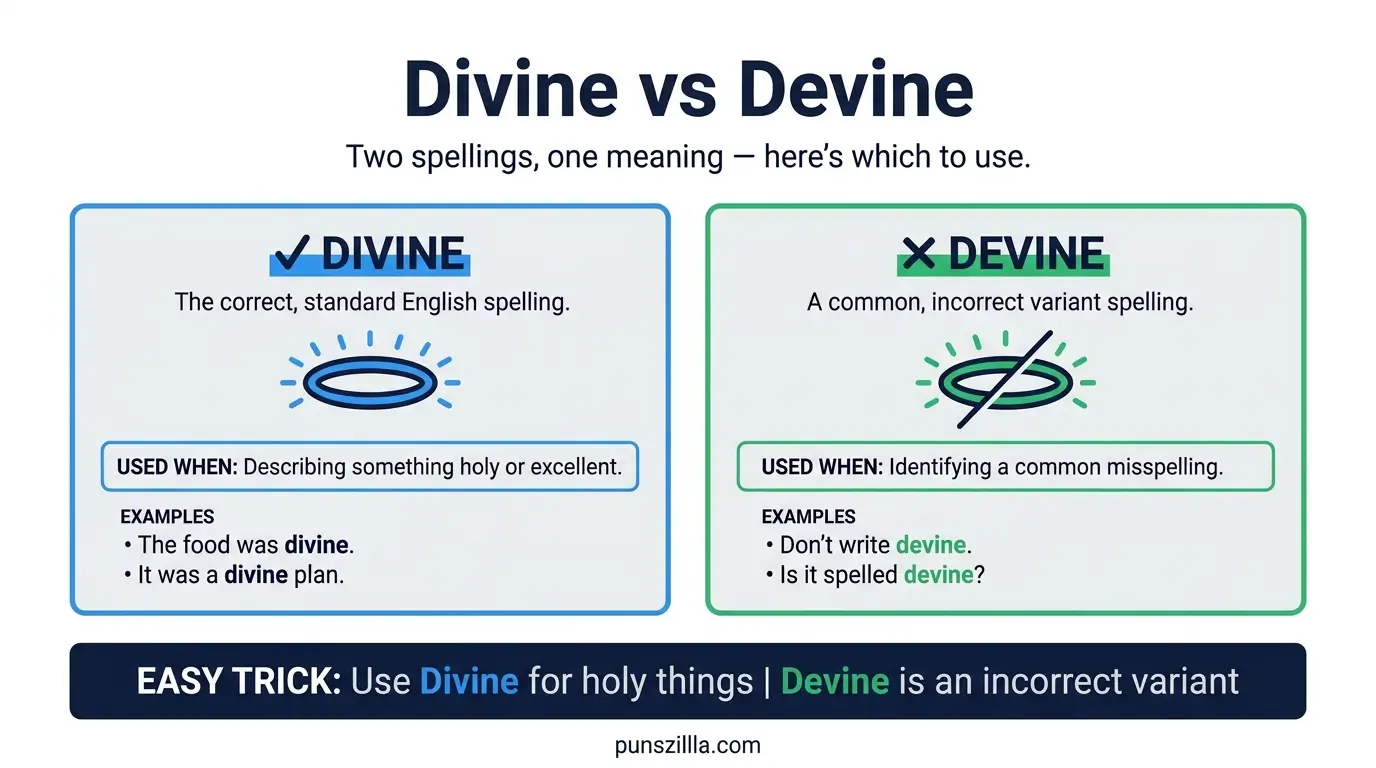
Divine is the correct spelling when you mean holy, heavenly, or wonderful. Devine is usually a misspelling, but it can be a correct surname or proper name.
Have you ever wondered whether to write devine or divine? These words look almost identical, but only one is the standard spelling for the everyday English word.
Divine is the correct spelling when you mean something related to God, something heavenly, or something exceptionally good.
Devine is not the standard spelling of this word. However, Devine can be a person’s surname or part of a proper name.
This confusion often happens because English spelling does not always match pronunciation. Both forms may look reasonable when you hear the word spoken.
Yet, using the wrong spelling can make your writing look less polished.
The good news is that the difference is easy to remember. You only need to learn the correct spelling and understand when a capital letter matters.
In this guide, you will learn the meaning of divine, its history, common spelling mistakes, and examples for everyday writing.
You will also discover how to choose the right form for schoolwork, emails, and professional documents.
Devine or Divine Quick Answer
Quick Answer: Divine is the correct spelling when describing something holy, heavenly, or wonderful.
It can also mean discovering something through intuition. Devine is generally incorrect when used as a substitute for the common word divine.
However, Devine is a valid surname and may appear in personal or place names.
Examples of Divine
- The ancient temple was dedicated to divine powers.
- We enjoyed a divine meal at the new restaurant.
- She believed the message was a sign of divine guidance.
Examples of Devine
- Mr. Devine will lead the meeting tomorrow.
- I sent the invitation to Sarah Devine.
- The Devine family welcomed their new neighbors.
These examples show why context matters. Use divine for the adjective or verb. Use Devine when it is the correct spelling of a person’s name or another proper name.
The Origin of Devine or Divine
The word divine has a long history connected to religion and the idea of a god.
It entered English through Middle English and Anglo-French. Its roots trace back to the Latin word divinus, meaning related to a god. The Latin word divus also referred to a god or deity.
Over time, divine developed several meanings. It can describe something holy or connected with God. It can also describe something that seems heavenly or exceptionally good.
For example, someone might describe a beautiful song as divine. A person might also speak of divine wisdom or divine intervention.
The word can function as an adjective, noun, or verb. As a noun, a divine can refer to a clergyman or theologian. As a verb, to divine can mean to guess or discover something through intuition.
The spelling devine may appear because people confuse the letters or remember the sound incorrectly. It can also appear as a proper name, including a surname.
The key distinction is simple: divine is the standard English word for these meanings, while Devine is correct when a proper name uses that spelling.
Correct Spelling vs Common Misspelling
The difference between devine and divine is mainly about spelling and context.
Divine is the correct standard word. Devine is not an accepted alternative spelling of the ordinary adjective or verb. However, calling every use of Devine a spelling mistake would be incorrect because it is also a surname.
When to Use Divine
Use divine when describing something connected with a god, religion, or a heavenly quality.
Examples:
- The community prayed for divine protection.
- The dessert tasted divine.
- She tried to divine the reason for his sudden departure.
The meaning changes with the sentence, but the spelling remains the same.
When to Use Devine
Use Devine when it is the established spelling of a person’s surname or another proper name.
Examples:
- The letter was signed by John Devine.
- Devine joined the company last spring.
- The family visited their relatives, the Devines.
Do not replace a person’s actual surname with Divine. Names should follow the spelling used by the person or official record.
Comparison Table
| Word | Use when | Example sentence |
|---|---|---|
| Divine | Describing something holy | They prayed for divine guidance. |
| Divine | Describing something excellent | The chocolate cake was divine. |
| Divine | Meaning to discover intuitively | She tried to divine his intentions. |
| Devine | Writing a surname | Mr. Devine answered the phone. |
| devine | Attempting to spell the ordinary word | Write “divine,” not “devine,” in this sentence. |
Remember that capital letters do not automatically make a spelling correct. Divine can start a sentence or appear in a title, while Devine is appropriate for a surname that uses that spelling.
Which Spelling Is Correct?
For ordinary English writing, choose divine. It is the standard spelling used in dictionaries for religious, heavenly, excellent, and intuitive meanings.
The spelling devine is a mistake when you intend to use the common word divine. There is no general US or UK spelling rule that makes devine correct in this context.
Advice for US Readers
American English uses divine in school assignments, business emails, books, news articles, and everyday conversation.
Examples:
- The choir sang a divine song.
- The meal was absolutely divine.
If you are writing formally, check that the word matches your intended meaning.
Advice for UK and Commonwealth Readers
British English and other varieties of English also use divine. The spelling does not change between American and British English.
Whether you are writing in the United Kingdom, Australia, Canada, or another English-speaking region, use divine for the standard word.
Advice for IELTS and TOEFL
For IELTS and TOEFL, spelling accuracy matters. Use divine if it fits your sentence. Do not treat devine as a regional alternative.
For example:
Incorrect: The ceremony celebrated devine wisdom.
Correct: The ceremony celebrated divine wisdom.
Advice for Business Emails
In professional writing, use the correct spelling and make sure the meaning fits your message.
For example:
“Thank you for organizing the event. The meal was divine.”
If you are referring to a colleague named Devine, use the person’s actual name.
Simple rule: Use divine for the English word and Devine for a name spelled that way.
Common Mistakes with Devine or Divine
Even confident English writers can confuse similar-looking words. These mistakes are easy to prevent once you understand the difference.
| Wrong | Right | Why |
|---|---|---|
| The meal was devine. | The meal was divine. | Divine is the correct adjective. |
| We prayed for devine help. | We prayed for divine help. | Divine describes religious or heavenly help. |
| She has a devine voice. | She has a divine voice. | Divine means exceptionally beautiful or pleasing here. |
| He tried to devine the answer. | He tried to divine the answer. | Divine can mean to guess or discover intuitively. |
| Mr. Divine attended the meeting. | Mr. Devine attended the meeting. | If his surname is Devine, preserve its actual spelling. |
| The Devine intervention saved them. | The divine intervention saved them. | Use lowercase divine unless a capitalization rule applies. |
The fifth example depends on the person’s real surname. If the person’s name is actually Divine, then Divine is correct as a name.
Mistake 1: Choosing Spelling by Sound
Words do not always have spellings that are easy to predict from pronunciation. Do not rely only on how divine sounds.
Instead, remember its written form: D-I-V-I-N-E.
Mistake 2: Confusing a Name with an Ordinary Word
A surname can have a different spelling from a common English word. Always check the spelling of a person’s name before correcting it.
Mistake 3: Assuming Devine Is a British Variant
There is no standard British-English rule that changes divine to devine. Both American and British English use divine.
Mistake 4: Forgetting the Verb Meaning
Divine does not only describe something holy or wonderful. It can also be a verb.
For example: “I could not divine what she wanted.”
Here, divine means to figure something out through intuition or guesswork.
Mistake 5: Capitalizing the Word Without a Reason
The ordinary word is usually lowercase in the middle of a sentence. Capitalize it at the beginning of a sentence or when a proper name or title requires it.
Devine or Divine in Everyday Examples
The word divine can appear in different types of writing. The best example depends on the context and intended meaning.
| Context | Example |
|---|---|
| Thank you for the invitation. The dinner was divine. | |
| We hope to receive divine guidance during this difficult time. | |
| News headline | Local Restaurant Earns Praise for Its Divine Desserts |
| News headline | Community Holds Ceremony Celebrating Divine Inspiration |
| Social media post | This chocolate cake tastes divine! |
| Social media post | What a divine view of the mountains! |
| Formal writing | The text explores the role of divine authority in historical societies. |
| Formal writing | The investigator attempted to divine the cause of the unexplained event. |
| Personal correspondence | Dear Mr. Devine, thank you for your reply. |
| Personal correspondence | Please forward the documents to Ms. Devine. |
These examples show that divine works in religious, descriptive, and literary contexts. It can also sound natural in casual conversation when someone wants to praise food, music, scenery, or an experience.
Devine, by contrast, belongs in a sentence when it is part of a proper name. It should not replace the ordinary word just because the spelling looks similar.
A Quick Way to Check Your Sentence
Ask yourself what you mean.
- If you mean holy, heavenly, or wonderful, use divine.
- If you mean to guess or discover something intuitively, use divine.
- If you are writing someone’s surname, check whether it is Devine or Divine.
This small check can prevent most spelling errors.
Devine or Divine Google Trends and Usage Data
Without a verified comparison of search data, it would be misleading to claim exact popularity levels or identify specific countries as having the highest interest.
Still, the spelling distinction is clear in standard English usage. Divine is the established word found in dictionaries and used in ordinary writing.
Devine appears in searches when people are unsure of the spelling, and it also appears in searches for surnames and proper names.
Search results for devine may therefore include several different intentions. Someone may be checking a spelling mistake, looking for a person, or researching a family name. Search interest alone does not prove that a spelling is grammatically correct.
Word Usage Comparison
| Word | More common in | Where you see it |
|---|---|---|
| Divine | Standard English writing | Dictionaries, books, religious writing, reviews, and everyday conversation |
| Devine | Proper names and spelling queries | Surnames, biographies, family records, and spelling searches |
These are general usage descriptions, not measured search rankings. Regional search preferences should be verified before making stronger claims.
Check It Yourself:
- Open Google Trends and compare “divine” with “devine.” Select your country and a suitable time range.
- Review the search-interest graph and regional results. Remember that Trends shows relative interest, not exact search counts.
- Visit Google Books Ngram Viewer to compare the words in published books. Review the context of results because surnames can affect the comparison.
For dictionary confirmation, consult the Merriam-Webster entry for divine or the Collins English Dictionary entry for divine. These sources explain the word’s meanings and history.
Comparison Table
Use this table to review the difference between divine and devine at a glance.
| Word | Type/Meaning | Region or Status | Example | Formality | Memory Trick |
|---|---|---|---|---|---|
| Divine | Adjective meaning holy | Standard in US, UK, and global English | Divine wisdom can inspire people. | Formal and informal | Divine has an i before the final ne. |
| Divine | Adjective meaning wonderful | Standard English | The dessert was divine. | Informal and descriptive | Think of a heavenly experience. |
| Divine | Verb meaning to guess intuitively | Standard English | She tried to divine his plans. | Literary or formal | Divine can mean to figure something out. |
| Devine | Surname or proper name | Correct when that is the established name | Mr. Devine arrived early. | Depends on context | Names keep their official spelling. |
| devine | Attempted spelling of the ordinary word | Incorrect in standard English | Write “divine,” not “devine.” | Not suitable for standard writing | Remember the i in divine. |
FAQs
Is Devine or Divine correct?
Divine is correct for the ordinary English word. It describes something holy, heavenly, or exceptionally good. It can also mean to discover something through intuition.
Devine is appropriate when it is the established spelling of a surname or another proper name.
Is Devine a real word?
Devine is a real surname and proper name. However, it is not the standard alternative spelling of the adjective or verb divine. If you want to describe something as heavenly or wonderful, use divine.
What does the word divine mean?
Divine means related to God or a god, heavenly, or exceptionally good. It can describe religious beliefs, spiritual experiences, or something especially enjoyable. As a verb, it can mean to guess or discover something through intuition.
How do you spell divine correctly?
The correct spelling is D-I-V-I-N-E. Remember the letter i after the initial d. Use this spelling when describing something wonderful or religious. Check the spelling of a proper name separately because names may follow different conventions.
Is divine the same in American and British English?
Yes, divine is spelled the same in American and British English. Both varieties use it for religious meanings, heavenly qualities, and exceptional experiences.
You do not need to change the spelling when writing for American, British, or Commonwealth readers.
Can divine be used to describe food?
Yes, divine can describe food that tastes exceptionally good. For example, “The chocolate cake was divine” means the cake tasted wonderful.
This is a common expressive use of the adjective in reviews, conversations, and casual writing.
Why do people confuse Devine and Divine?
People confuse them because the spellings look similar and may sound alike. The difference is especially easy to miss when writing quickly.
Remember that divine is the standard word, while Devine can be a surname. Context helps you choose correctly.
Conclusion
Key Takeaways:
- Divine is the correct spelling for the ordinary English word.
- Devine can be correct as a surname or proper name.
- Divine can mean holy, heavenly, wonderful, or to discover something intuitively.
- American and British English both use the spelling divine.
Choosing between devine and divine becomes easy once you understand their uses. For everyday writing, remember that divine is the spelling you need when describing something sacred, heavenly, or excellent.
Use it in school assignments, emails, essays, reviews, and professional documents.
If you are writing about religion, the word can describe something connected with God or a god. If you are praising food or scenery, it can express how wonderful the experience feels.
Remember that Devine is not always a mistake. It may be someone’s surname, so check the correct spelling before changing a person’s name.
The easiest rule is to remember the i in divine. When you are unsure, check a trusted dictionary and read the word in context. This habit will help you improve your spelling and write more confidently.
Final rule: Write divine for the standard English word and Devine when that is the correct spelling of a name.