
These or This: Which Is Correct?
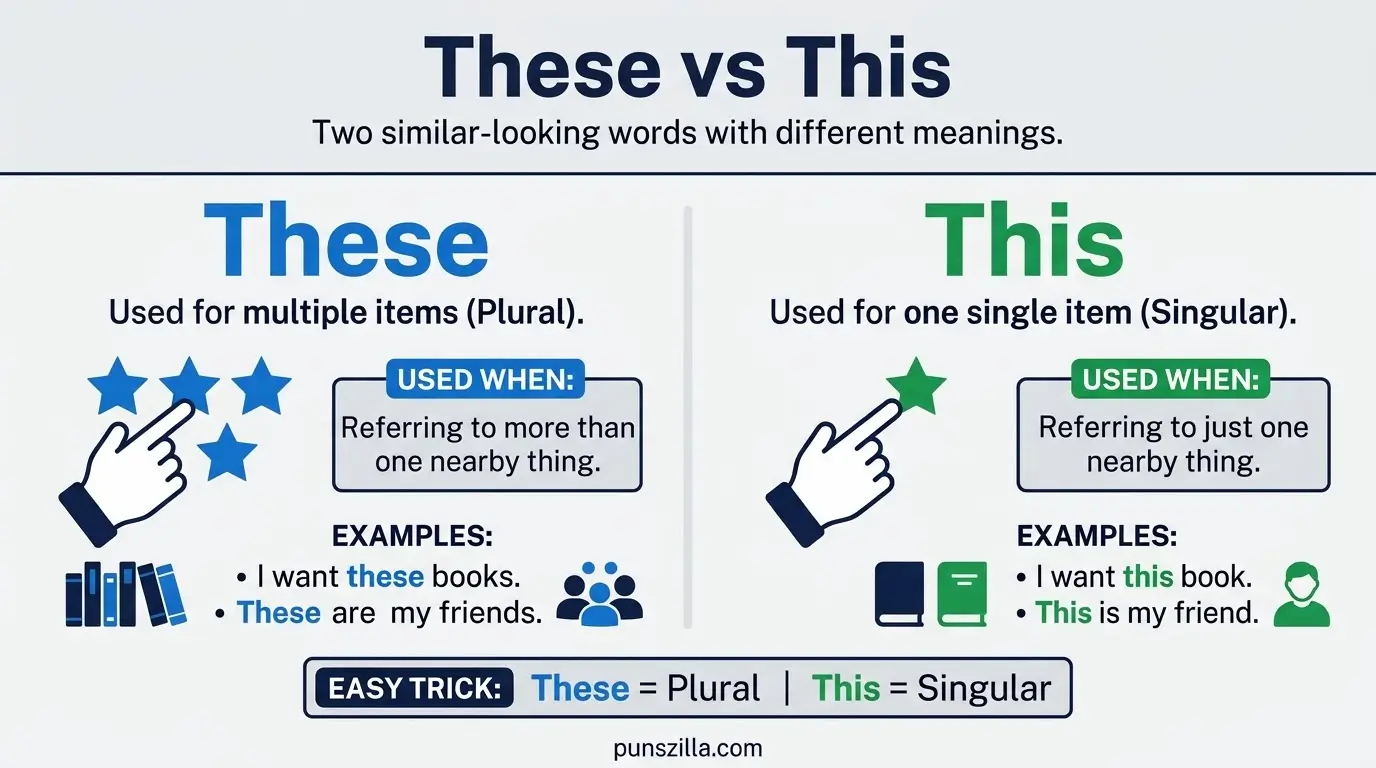
Use “this” for one person or thing, and “these” for two or more. For example, say “this book” (one) and “these books” (many).
Have you ever wondered whether to write “these” or “this”? Both words are correct, but they serve different purposes. Choosing the right one depends on whether you mean one thing or more than one.
The difference between these or this can confuse English learners. Both words point to people, places, objects, or ideas. However, they follow different grammar rules.
Use “this” for one person or thing. Use “these” for two or more people or things. For example, say “this book” when talking about one book. Say “these books” when talking about several books.
The same rule applies to everyday conversations, school assignments, emails, and professional writing. Learning this simple difference can help you avoid common grammar mistakes.
In this guide, you will learn when to use each word. You will also find clear examples, common mistakes, and easy memory tricks.
By the end, choosing between “these” and “this” will feel much easier.
These or This Quick Answer
Quick Answer: Both “these” and “this” are correct English words.
Use “this” with a singular noun and “these” with a plural noun.
Say “this apple” when referring to one apple, but say “these apples” when referring to several apples.
Remember: “this” means one, while “these” means more than one.
When to Use “This”
Use “this” to point to one person, object, place, or idea.
Examples:
- This book belongs to me.
- This is my favorite song.
- I need this chair for my desk.
When to Use “These”
Use “these” to point to two or more people, objects, places, or ideas.
Examples:
- These books belong to me.
- These are my favorite songs.
- I need these chairs for my desk.
Easy rule to remember: One thing takes “this.” More than one takes “these.”
The Origin of These or This
The words “this” and “these” have a long history in English. Both come from older forms of the language.
“This” developed from the Old English word þis. It referred to something present or nearby. It became part of the everyday English vocabulary.
“These” also has roots in Old English. Its history connects it to older forms of “this” and other demonstrative words. Over time, English developed separate forms for singular and plural meanings.
These changes helped create the grammar system we use today. Modern English uses “this” for singular nouns and “these” for plural nouns.
Both words belong to a group called demonstratives. Demonstratives help identify specific people, objects, or ideas. Other words in this group include “that” and “those.”
For more details, see the Oxford English Dictionary entry for “these” and its historical word information.
Difference Between These and This
The main difference is number. “This” refers to one person or thing. “These” refers to multiple people or things.
Both words usually point to something near the speaker. They can also introduce ideas or refer to information in a conversation.
1. Use “This” for One Thing
Use “this” before a singular countable noun.
Examples:
- This phone is new.
- This student works hard.
- This idea could help everyone.
You can also use “this” without a noun when the meaning is clear.
Examples:
- This is delicious.
- This looks interesting.
- This belongs to my sister.
2. Use “These” for Multiple Things
Use “these” before a plural noun.
Examples:
- These phones are new.
- These students work hard.
- These ideas could help everyone.
You can also use “these” without a noun.
Examples:
- These are delicious.
- These look interesting.
- These belong to my sister.
3. Match the Verb to the Word
“This” normally takes “is” when identifying something. “These” normally takes “are.”
Examples:
- This is my notebook.
- These are my notebooks.
- This is a useful lesson.
- These are useful lessons.
Avoid mixing singular and plural forms.
| Word | Use when | Example sentence |
|---|---|---|
| This | Referring to one countable item | This apple is fresh. |
| These | Referring to multiple items | These apples are fresh. |
| This | Referring to one idea | This is a good plan. |
| These | Referring to multiple ideas | These are good plans. |
4. Remember Uncountable Nouns
Use “this” with uncountable nouns, even when they refer to a large amount.
Examples:
- This water is cold.
- This information is helpful.
- This furniture looks expensive.
Do not use “these” directly with uncountable nouns in standard English.
Incorrect: These information is helpful.
Correct: This information is helpful.
You can use “these” with a plural countable expression instead.
Correct: These pieces of information are helpful.
Which Word Should You Use?
Choosing between “this” and “these” does not depend on whether you use American or British English. The same basic grammar rule applies across standard English varieties.
For American English Readers
Use “this” for one item and “these” for multiple items. Follow this rule in schoolwork, emails, reports, and everyday writing.
Examples:
- This store is open.
- These stores are open.
For British and Commonwealth Readers
The same rule applies in British, Pakistani, Australian, Canadian, and other Commonwealth English contexts.
Examples:
- This colour looks nice.
- These colours look nice.
Regional spelling differences do not change the singular and plural distinction.
For IELTS and TOEFL
Use the correct demonstrative in both speaking and writing.
For example, write “This argument is important” when discussing one argument. Write “These arguments are important” when discussing several arguments.
In IELTS and TOEFL, accurate grammar supports clear communication. Check whether your noun is singular or plural before choosing the word.
For Business Emails
Use “this” when referring to one document, meeting, or issue.
- This report needs approval.
- This meeting starts at noon.
Use “these” when referring to multiple items.
- These reports need approval.
- These meetings start at noon.
Simple rule: Find the noun first. If it is singular, use “this.” If it is plural, use “these.”
Common Mistakes with These or This
Writers often confuse these words because they look similar. The following table shows common errors and their corrections.
| Wrong | Right | Why |
|---|---|---|
| These book is mine. | This book is mine. | “Book” is singular. |
| This books are mine. | These books are mine. | “Books” is plural. |
| These is my friend. | This is my friend. | “These” does not identify one friend. |
| This are my keys. | These are my keys. | “Keys” is plural. |
| These information is useful. | This information is useful. | “Information” is uncountable. |
| This apples taste sweet. | These apples taste sweet. | “Apples” is plural. |
Mistake 1: Ignoring Singular and Plural Nouns
Always check the noun after the demonstrative.
Say “this house” for one house. Say “these houses” for multiple houses.
Mistake 2: Using the Wrong Verb
“This” normally pairs with “is.” “These” normally pairs with “are.”
Correct: This is my bag.
Correct: These are my bags.
Mistake 3: Confusing “This” with “These” in Questions
Use “this” when asking about one nearby item.
Example: What is this?
Use “these” when asking about several nearby items.
Example: What are these?
Mistake 4: Using “These” with Uncountable Nouns
Words such as “advice,” “information,” and “furniture” are usually uncountable in standard English.
Say “this advice,” not “these advice.”
Mistake 5: Forgetting the Noun in Longer Sentences
Long sentences can make it harder to identify the correct form.
Incorrect: This are the changes we discussed.
Correct: These are the changes we discussed.
Read the sentence again and check whether the subject refers to one thing or several.
These or This in Everyday Examples
The difference matters in emails, news headlines, social media posts, and formal documents. Here are examples of how to use both words naturally.
| Context | Example |
|---|---|
| This file contains the updated report. | |
| These documents need your signature. | |
| This email confirms your appointment. | |
| These details are important for the meeting. | |
| News headline | This decision changes the policy. |
| News headline | These changes affect local businesses. |
| Social media | This is my favorite photo! |
| Social media | These are the best moments of the trip! |
| Formal writing | This study examines the problem. |
| Formal writing | These findings support the conclusion. |
| Schoolwork | This answer is correct. |
| Schoolwork | These answers are correct. |
| Everyday speech | This looks great. |
| Everyday speech | These look great. |
Examples in Questions
Questions follow the same singular and plural rule.
- Is this your pen?
- Are these your pens?
- Does this answer make sense?
- Do these answers make sense?
Notice how the verb changes with the subject.
Examples Without a Noun
Both words can stand alone as pronouns.
- This is what I wanted.
- These are what I ordered.
The second example refers to multiple things. The word “these” replaces a plural noun understood from the conversation.
For more examples, consult the Cambridge Dictionary grammar guide to this, that, these, and those.
These or This – Google Trends & Usage Data
Both “this” and “these” are common English words. They appear in everyday conversations, books, news articles, emails, and online searches.
However, their uses differ because they serve different grammatical purposes. “This” commonly appears with singular nouns and uncountable nouns. “These” appears with plural nouns.
Without a specific Google Trends comparison, it is not appropriate to claim that one has greater search interest in a particular country. Search popularity and everyday language frequency are also different things.
Usage by Country and Context
| Word | More common in | Where you see it |
|---|---|---|
| This | Used across English-speaking regions | Singular nouns, uncountable nouns, emails, and conversations |
| These | Used across English-speaking regions | Plural nouns, reports, books, and conversations |
There is no major US-versus-UK spelling difference between these words. Both forms are standard in American, British, and international English.
Check It Yourself
You can compare the words using these free resources:
- Google Trends: Visit Google Trends and compare “this” with “these.” Select your country and time range.
- Google Books Ngram Viewer: Open Google Books Ngram Viewer and compare both words in published books.
- Review the results carefully: Search interest does not prove which word is grammatically correct. Check the context and sentence structure before drawing conclusions.
Comparison Table
| Word | Type/Meaning | Region | Example | Formality | Memory trick |
|---|---|---|---|---|---|
| This | Singular demonstrative | All English varieties | This chair is comfortable. | Formal and informal | This = one |
| These | Plural demonstrative | All English varieties | These chairs are comfortable. | Formal and informal | These = several |
FAQs
Is “these” or “this” correct?
Both are correct, but they are used differently. Use “this” for one countable item or an uncountable noun. Use “these” for multiple countable items. The correct choice depends on the noun and the meaning of your sentence.
What is the main difference between “these” and “this”?
“This” is singular, while “these” is plural. For example, “this pen” refers to one pen. “These pens” refers to multiple pens. Both words can point to nearby things or introduce specific ideas in conversation.
Should I say “this are” or “these are”?
Use “these are” when referring to multiple things. For example, “These are my books” is correct. Use “this is” for one thing, as in “This is my book.” Match the demonstrative and verb to the intended meaning.
Can I use “this” for multiple things?
Generally, not when “this” directly identifies several separate items. Use “these” instead. However, “this” can refer to a group, situation, or idea treated as one unit. For example, “This collection is valuable” refers to one collection.
Do Americans and British people use “these” and “this” differently?
No. The basic grammatical rules are the same in American and British English. Both varieties use “this” with singular nouns and “these” with plural nouns. Differences in regional spelling do not affect this rule.
Can “these” be used without a noun?
Yes. “These” can work as a pronoun when the reader or listener already knows what you mean. For example, “These are delicious” is correct when discussing several cookies or other food items.
How can I remember when to use “these” or “this”?
Remember one simple rule: “this” means one, and “these” means more than one. Practice with everyday objects. Say “this cup” when holding one cup and “these cups” when holding several cups.
Conclusion
Key Takeaways:
- This refers to one person, object, or idea.
- These refers to two or more people, objects, or ideas.
- Use “this is” for singular references and “these are” for plural references.
- Both words follow the same rules in American, British, and international English.
Choosing between “these or this” becomes easy when you identify the noun first. Check whether you mean one thing or several things. Then choose the matching word.
For example, write “This book is interesting” when discussing one book. Write “These books are interesting” when discussing multiple books.
Remember that uncountable nouns also take “this.” You can say “this advice” or “this information,” even when discussing a lot of information.
These rules apply to school assignments, IELTS and TOEFL writing, business emails, and everyday conversations. You do not need to memorize complicated grammar terms to use them correctly.
Practice by creating a few sentences each day. Check your nouns and verbs before submitting important writing. With regular practice, you will choose the correct word naturally.
The easiest rule to remember is this: one takes “this,” and several take “these.”